Choosing a reliable surge protector for coaxial cable lines helps safeguard TVs, satellite receivers, modems, and other gear from power spikes. The following selections cover inline coaxial surge protectors suitable for CATV, MATV, SATV, and home network setups. Each option emphasizes low signal loss, robust surge protection, and easy installation to ensure uninterrupted service during thunderstorms and electrical disturbances.
Summary Of Selected Products
| Product | Brand | Key Benefit | Typical Use |
|---|---|---|---|
| VCE Coaxial Surge Lightning Protector | VCE | 2-pack inline protection, low insertion loss | Cable TV, SATV, MATV lines |
| groword Coaxial Surge Protector (4 Pack) | groword | Multiple units for whole-home protection | Coaxial networks, modems, distribution |
| Parts Express Cable TV In-Line Surge Protector | Parts Express | Gas-tube surge protection, transparent to signal | HFC/FTTC networks |
| TII 212 Broadband Surge Protector | TII | Broadband-friendly, 1 GHz operation | TV, satellite receivers, cable modems |
| Proxicast Coaxial Lightning Arrester | Proxicast | Outdoor-rated, bi-directional protection | TV/satellite antennas, cable internet |
VCE Coaxial Surge Lightning Protector
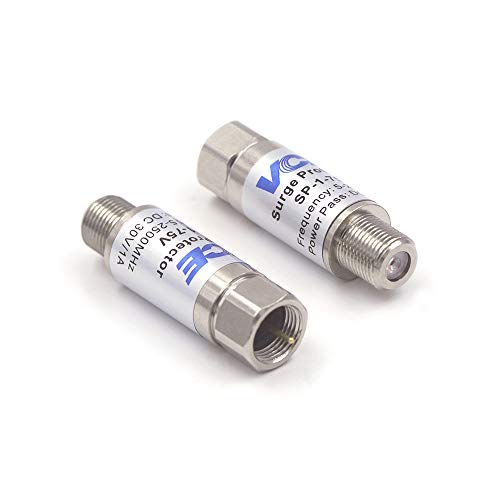
The VCE inline surge protector provides protection against both high and low voltage transient surges. It is CE and RoHS compliant and suitable for CATV, MATV, SATV, and cable networks. The unit is designed for in-line installation with low insertion loss and a high return loss, helping preserve signal quality. A DC outlet supports remote power for distributors or amplifiers where needed. This 2-pack offers flexibility for protecting multiple coaxial paths in a home or small office network.
groword Coaxial Surge Protector (4 Pack)

The groword set includes four F-type surge protectors intended for inline use with satellite receivers, cable boxes, and distribution amplifiers. It emphasizes safety in thunder-prone areas by limiting transient surges to protect home theater components and internet modems. The design remains compatible with licensed cable systems, and it is suitable for use with modems without blocking Internet frequencies. Installation is straightforward, with male-to-female F-type connectors facilitating quick setup across multiple devices.
Parts Express Cable TV In-Line Coaxial Surge Protector

Parts Express offers a unique patented in-line gas tube surge protection designed for HFC or FTTC broadband networks. The unit is transparent to both analog and digital bidirectional signal transmission, meaning it should not noticeably impact picture or data quality. Ideal for protecting coax-fed equipment in modern home networks, this device emphasizes reliable protection without significantly affecting signal integrity during normal operation.
TII 212 Broadband Cable TV And Satellite Protector

The TII 212 in-line protector is designed specifically for broadband and television setups, protecting HDTV receivers, DVRs, and cable modems. Its design aims to be virtually transparent to signals from DC to 1 GHz, while delivering robust protection against high and low voltage transients. This makes it a practical option for preserving signal quality while guarding critical equipment from surges.
Proxicast Coaxial Lightning Arrester

The Proxicast protector is designed for TV, satellite, and cable internet use with F-type connectors. It supports RG6, RG59, RG8X, and RG11 configurations and is outdoor-rated for in-line use. The device is bi-directional, providing protection against lightning-induced surges while allowing signals to pass with minimal interference. It is compatible with 4G/5G signal boosters for outdoor antennas, offering flexible deployment for various setups.
Cable Protector For TV (2 Pack)

This two-pack offers coaxial surge protection for satellite and cable TV lines. It emphasizes fast disconnect during lightning events and automatic reconnection after a short delay, ensuring minimal interruption. The devices are designed for inline use with CATV, MATV, SATV, and other cable networks, providing added protection for receivers, set-top boxes, and TVs in home networks.
Tripp Lite In-Line Surge Protector

The Tripp Lite DTEL2 focuses on protecting network and phone lines, with RJ45/RJ11 plugs to shield modems, telephones, and fax machines from surges entering through signal lines. It provides protection for up to two data/phone lines and ships with an RJ11 patch cable for quick setup. While not a pure coaxial protector, it complements coaxial protection in mixed setups where modem and telephone equipment share lines.
Buying Guide
- Coaxial compatibility: Look for 75-ohm connectors (F-type) and supported frequency ranges that cover your service (common ranges include 5–2500 MHz or 5–1500 MHz). This ensures the protector does not bottleneck your signal.
- Protection type: Gas tube and varistor-based designs are common. Gas-tube protectors offer robust surge handling with low leakage, while other designs prioritize compact inline use. Consider the environment (indoor vs outdoor) when selecting a unit.
- Signal integrity: Choose devices advertised as low insertion loss and high return loss to minimize any impact on picture and data quality. In-line devices should be transparent to DC and RF signals.
- Installation type: Inline coax protectors should be easy to install with standard F-type connectors. Some kits include multiple units for protecting several lines in a home or small office.
- Durability and weather resistance: Outdoor-rated protectors are ideal for exterior installations or roof-mounted antennas. Ensure enclosure ratings (e.g., IP ratings) meet your exposure conditions.
- Network compatibility: If you use broadband modems or distribution amplifiers, verify the protector does not block or degrade frequencies used by your Internet service.
- Maintenance and replacement: Some devices safeguard against surges automatically and reset after events. Consider units with straightforward replacement if gas tubes need servicing.
- Multi-pack value: For whole-home protection, a multi-pack can be cost-effective, enabling protection at multiple entry points for coaxial networks, satellite, and TV gear.
- Brand and certifications: Look for CE, RoHS, and manufacturer specifications. Certifications can indicate compliance with safety and performance standards.