Exploring the freedom of the open road often hinges on reliable power for lights, appliances, and charging your devices. This guide highlights five top-rated solar panel kits designed for RVs and off-grid use, focusing on durability, efficiency, and ease of installation. Each option is evaluated for variables like cell technology, shading tolerance, and compatibility with common RV battery systems, so you can choose a package that fits your travel style and energy needs.
Summary of chosen products:
- ECO-WORTHY 200W Kit with 30A PWM Controller
- Callsun N-Type 400W Bifacial Panel Bundle (200W x 2)
- Renogy 200W ShadowFlux N-Type Panel
- ECO-WORTHY 400W Four-Panel Kit
- Renogy 200W N-Type RV Panel Kit with Adventurer Controller
The following sections present each option with key features, benefits, and fit-for-purpose notes. A buying guide at the end compares relevant aspects to help you decide which setup best matches your RV lifestyle and off-grid ambitions.
ECO-WORTHY 200W Solar Panel Kit With 30A PWM Controller

The ECO-WORTHY kit targets RVs and other off-grid needs with a balanced emphasis on efficiency and rugged build. It uses high-efficiency monocrystalline cells claimed to deliver up to 21.5% improved light capture under suitable sun conditions, contributing to daily outputs around 800Wh in four peak sun hours. The 35.2 by 23.1 by 1.37 inch profile fits in many RV roof spaces, and the corrosion-resistant aluminum frame supports long service life against wind and snow loads. An IP65 junction box adds weather protection for exposed installations. This package is well-suited for small to mid-size rigs that want a straightforward, all-in-one solar charging solution with a PWM controller to manage battery charging and maintenance.
Callsun N-Type 16BB 400W Dual 200W Panels

This Callsun bundle pairs two 200W N-Type panels, leveraging advanced N-type cells and 16BB busbar technology for improved efficiency and reliability. Up to 25% conversion efficiency is highlighted, with a bifacial element that can capture energy from the rear side when light conditions and mounting permit. The improved anti-shade design uses a dual-module parallel arrangement, which helps maintain power output when one half is shaded. This makes the Callsun kit especially suitable for RVs that travel through trees or urban landscapes where sporadic shading is common. The pair approach also provides flexible installation options for larger roof areas or multi-panel arrays.
Renogy 200W ShadowFlux N-Type Panel

Renogy’s 200W panel emphasizes anti-shading performance with ShadowFlux technology, designed to reduce hot-spot risks and maximize energy when parts of the panel are shaded by nearby objects. The use of N-type cells with 16BB technology achieves up to 25% efficiency, supporting robust power generation and longer panel life by minimizing micro-cracks. The panel is notably compact and lighter than many PERC-based options, aiding in installation on smaller RV roofs where space is at a premium. This makes it a strong fit for RVs that require reliable performance in variable sunlight without occupying excessive roof real estate.
ECO-WORTHY 400W Four-Panel Kit

This four-panel kit advances off-grid capability for larger RV setups or those who run higher-draw appliances. Each panel uses 18V monocrystalline cells with 23% efficiency, providing a substantial daily energy window—up to about 1600Wh under four sun hours. A 25-year durability expectation accompanies a heavy-duty, weatherproof design with IP65-rated junction boxes and durable frames. The configuration is well-suited for longer trips or families who need more consistent energy for tools, climate control, and entertainment appliances during periods away from shore power sources.
Renogy 200W N-Type RV Panel Kit With Adventurer Controller
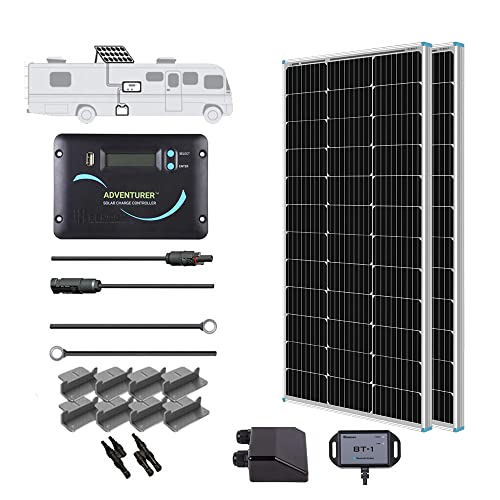
Renogy combines a 200W N-Type panel with a dedicated Adventurer PWM controller in this RV-focused kit. The Adventurer controller is designed to fit flush on RV walls while providing protective features against overcharge, over-voltage, discharge, and short circuits. The panel’s 22% efficiency value, corrosion-resistant frame, and robust construction support dependable outdoor use for RVs, campers, boats, and other off-grid applications. This kit appeals to users seeking a compact, integrated solution with an emphasis on safe and straightforward battery management on the road.
Buying Guide: Key Considerations For RV Solar Deployments
- Battery compatibility and charging control: Decide whether you prefer PWM controllers for simple systems or MPPT controllers for higher efficiency, especially in cooler mornings or when lines are long.
- Cell technology and efficiency: N-Type cells typically offer higher efficiency and better shading tolerance than traditional P-Type cells, which can translate to more usable power in the limited roof space of many RVs.
- Shading tolerance: If your RV roof has potential shade from antennas, vents, or nearby trees, consider panels with anti-shading features (such as ShadowFlux or dual-module designs) to minimize power loss.
- Physical footprint and weight: Space on RV roofs is limited. Compact, lighter panels enable easier installation and better weight distribution, especially on smaller rigs.
- Durability and weatherproofing: Look for IP65-rated junction boxes, corrosion-resistant frames, tempered glass, and robust mounting compatibility to withstand wind, rain, snow, and road vibrations.
- System sizing and daily energy needs: Estimate daily watt-hours (Wh) required for essential devices, then size the array to deliver sufficient output during typical sun conditions for your travel itinerary.
- Expansion potential: If you anticipate higher energy demands later, select kits with compatible expansion options or modular panels that can be added to the roof without a full reconfiguration.
- Installation approach: Some kits are designed for quick, integrated mounting on RV sides or roofs, while others may require more custom mounting hardware. Consider professional installation if routing and waterproofing concerns arise.
- Weather and climate considerations: In winter or high-latitude regions, lower sun angles can reduce daily output; choose panels with higher efficiency and consider battery storage capacity to smooth seasonal variability.
- Warranty and service: Review the panel and controller warranties, as well as available support resources, to ensure long-term reliability on the road.
Across these options, the best choice depends on your RV’s size, typical travel duration, climate, and how much energy you need to support climate control, lighting, devices, and cooking. For travelers prioritizing space efficiency and anti-shading performance, N-Type panels with advanced busbar or ShadowFlux technology are appealing. For larger RVs or families with higher energy use, multi-panel kits with durable frames and protective controllers can provide the necessary daily energy, while maintaining reliability in variable conditions.