Exploring solar panels for electronics means finding compact, efficient options that reliably charge or power small devices. This guide highlights five suitable picks for hobbyists, students, and outdoor enthusiasts who want portable, low-power solar solutions. Each product offers varying wattage, form factors, and build features to fit hands-on projects, toys, cameras, and small gadgets. Read on to compare performance, durability, and use cases to decide which panel best aligns with your electronics needs.
| Product | Brand | Output | Key Use Case |
|---|---|---|---|
| FellDen Micro Panels (5 pcs) | FellDen | 5V, 200mA each | DIY low-power projects |
| AOSHIKE Mini Panels (10 pcs) | AOSHIKE | 5V, 30mA each | DIY toys, displays, lights |
| Sunnytech Mini Panel | Sunnytech | 5V, 100mA | Small charging and teaching demos |
| 3Pcs Mini Panel (6V) | Eujgoov | 6V, ~1W total | DIY experiments |
| Soshine USB Mini Panel | Soshine | 5V, up to 6W | Camera, small pumps, fans |
FellDen Micro Solar Panels Kit — 5 Pack

FellDen offers a compact set of five 5V solar panels, each delivering about 200mA. The 110mm by 60mm footprint (4.33″ x 2.36″) and thin 2.5mm profile make these panels well-suited for small projects, educational kits, and DIY water pumps powered by solar energy. Wire leads simplify integration into hobby builds and experiments. This kit emphasizes flexible use for home lighting, low-power DC appliances, and various science projects without requiring large storage capacity or heavy equipment.
AOSHIKE 10Pcs Mini Solar Panels
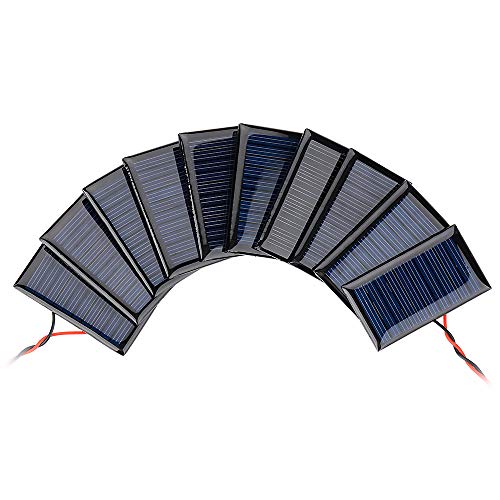
AOSHIKE provides ten small panels, each rated at 5V and 30mA, with a compact 2.08″ x 1.18″ size. These micro panels are designed for DIY solar-powered models, toys, displays, and decorative lighting. While individually modest in output, the array is suitable for experiments that demonstrate basic photovoltaic concepts or power tiny devices under sunny conditions. They are best used in low-power, educational setups rather than reliable single-device charging.
Sunnytech 0.5W Mini Solar Panel Module

The Sunnytech mini panel delivers about 0.5W at 5V, making it a popular choice for teaching kits and small charging demonstrations. It includes a blocking diode to prevent overcharging and reverse current, which helps protect connected components. The device features rugged epoxy resin construction with color-coded wires and two solder tabs for simple parallel or series connections when expanding a project. It’s suitable for solar toys, small DC battery charging, and educational displays.
Eujgoov 3Pcs Mini Panel Kit

This set of three mini panels provides a 6V, 1W power output with a 30cm connecting cable. Packaged for snowproof and windproof performance, the panels are designed for educational experiments and small DIY projects. The included cable aids quick setup, enabling basic experiments with weak light conditions where higher-efficiency panels might struggle. They are useful for demonstrating solar charging concepts and building small, solar-powered displays or toys.
Soshine USB Mini Solar Panel

The Soshine mini panel offers a higher energy potential, delivering up to 6W with 5V output and a robust monocrystalline cell design. It is compatible with USB-powered devices like cameras, small pumps, and camping lights, providing a practical balance of portability and performance. The panel emphasizes reliable charging in various outdoor conditions, supported by protective features and durable materials. It is a strong option for portable charging setups and small outdoor-powered devices.
FlexSolar 100W Portable Solar Panel

This larger FlexSolar panel is designed for serious off-grid needs, combining 100W of output with multiple outputs (USB-A, USB-C PD, and DC). It folds into a compact form for travel and emergency use, making it suitable for small power stations, phones, and power banks. The panel employs ETFE lamination and monocrystalline silicon to boost efficiency, and it includes a 4-in-1 charging cable for versatile connections. It is ideal for campers or as a dependable backup charging option when higher power is required.
Keshoyal 60W Portable Foldable Solar Panel

Designed for outdoor power needs, the Keshoyal 60W foldable solar panel provides USB output and 18V DC compatibility. Foldable and lightweight, it’s easy to transport with four fixing clips for quick setup. The unit emphasizes portability and multi-device charging, enabling smartphones, tablets, cameras, and portable power stations to stay powered during outdoor activities. Its high efficiency — aided by a 23.5% conversion rate — supports dependable operation even when light is limited.
FlexSolar 100W Portable Panel (Revisit)
Note: This product provides a high-power option with multiple output types, suited for emergency power, camping, and portable charging stations. It emphasizes portability through a lightweight design and a compact folded size, making it convenient for travelers who need reliable solar power on the go. The 23%+ conversion rate and weather-resistant construction support durable outdoor use.
Buying Guide: Key Purchase Considerations
When selecting solar panels for electronics, consider these factors to align with your needs:
- Power requirements: Match panel wattage and voltage to the device or project. Small devices may require 5V at tens to hundreds of milliamps, while larger setups benefit from higher wattage panels with multiple outputs.
- Portability: For on-the-go use, prioritize foldable designs, light weights, and included carrying accessories. Stationary setups can favor fixed-mount panels with higher durability.
- Durability and weather resistance: Look for IP ratings, ETFE or PET laminations, and robust housings if you plan outdoor use or exposure to wind, rain, or snow.
- Build quality and connections: Panels with pre-installed diodes, protective coatings, and easy-to-use connectors reduce risk of overcharging and simplify integration into projects.
- Expandability: If you anticipate needing more power later, select panels with parallel/series connection options and compatible wiring tabs to scale output.
- Reliability under low light: Some panels perform better in weak-light conditions; for outdoor or variable lighting, consider efficiency ratings and panel type (monocrystalline vs polycrystalline).
- Intended use: Educational kits benefit from smaller panels with simple wiring, while field use may require rugged, weatherproof solutions and higher output.
Overall, these products cover a spectrum from tiny classroom-friendly panels to higher-output portable units. For electronics projects, combine several micro panels for experimentation or pair a mid-range panel with a small battery or storage solution to maintain consistent power delivery in varying light conditions.