Owners of recreational vehicles increasingly rely on solar to power essentials, from lights and fans to pumps and portable fridges. This guide highlights five well-matched options for RV setups, focusing on ease of use, durability, and efficiency. Each product listing includes key features to help you compare performance, compatibility, and installation needs for camping, travel, and off-grid stays.
| Product | Brand | Output (W) | Type | Notes |
|---|---|---|---|---|
| Renogy Adventurer 200W Kit | Renogy | 200 | Monocrystalline Panel + PWM Controller | Compact RV-ready kit with mounting brackets |
| ECO-WORTHY 200W Kit | ECO-WORTHY | 200 | Monocrystalline Panel + PWM Controller | Durable frame, good weather resistance |
| SOLPERK 20W Kit | SOLPERK | 20 | Monocrystalline Panel + 8A Controller | Ideal for trickle charging and maintenance |
| Renogy 200W Starter Kit | Renogy | 200 | Two Panels + PWM Controller | Great value for basic off-grid RV power |
| ECO-WORTHY 260W Flexible Kit | ECO-WORTHY | 260 | Two 130W Flexible Panels + Controller | Flexibility for irregular roof shapes |
Renogy Adventurer 200W RV Solar Kit
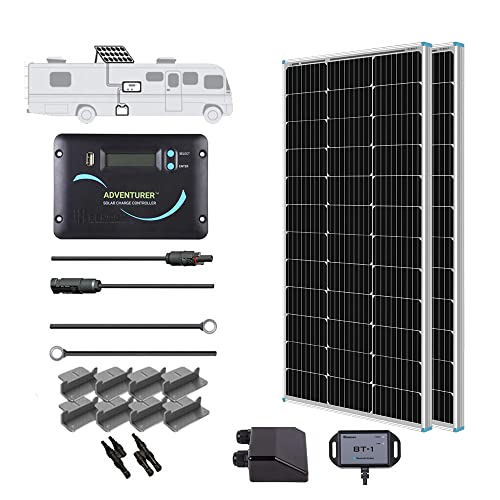
The Renogy Adventurer-Li kit provides 200 watts of monocrystalline solar power paired with a 30A PWM charge controller. Its design emphasizes durability with a corrosion-resistant aluminum frame that withstands high winds (2400 Pa) and snow loads (5400 Pa). The controller helps prevent battery overcharge, overvoltage, discharge, and short circuits, while offering reversed polarity protection. This setup suits RVs, boats, trailers, and marine use where space is limited and reliability matters.
Key specs and fit considerations include: 800Wh daily output under ideal sunlight, 4 hours of sun, and a compact footprint. The kit’s flush-mount compatibility makes it attractive for walls or roof installations on RVs, campers, and caravans. While performance hinges on sun exposure, the system is designed to deliver steady charging in typical RV environments.
Pros: compact footprint, robust frame, integrated protection features. Cons: performance varies with sun and may require expansion for high-demand RV setups. Suitable for travelers who prioritize straightforward installation and durable components.
ECO-WORTHY 200W Panel Kit For RVs

The ECO-WORTHY 200W kit uses high-efficiency mono solar cells to deliver strong daily output, with a robust aluminum frame built to resist corrosion. It is designed for RVs, campers, boats, and off-grid vehicles, offering an 800Wh daily target under favorable sunlight. The kit includes a 30A PWM controller and is engineered to withstand tough weather, with a wind rating of 2400 Pa and snow load of 5400 Pa. An IP65-rated junction box adds an extra layer of protection for outdoor use.
Ideal use scenarios include extended road trips, off-grid camping, or backup power for small appliances. It pairs well with standard 12V battery systems and can be expanded to meet higher power needs. Installation efficiency and long-term durability are central strengths for RV enthusiasts who value reliability and straightforward maintenance.
Pros: strong efficiency, durable build, weather protection. Cons: might require additional panels for larger power draws. Appropriate for RVers seeking solid baseline solar power with room to grow.
SOLPERK 20W Solar Panel Kit For RVs
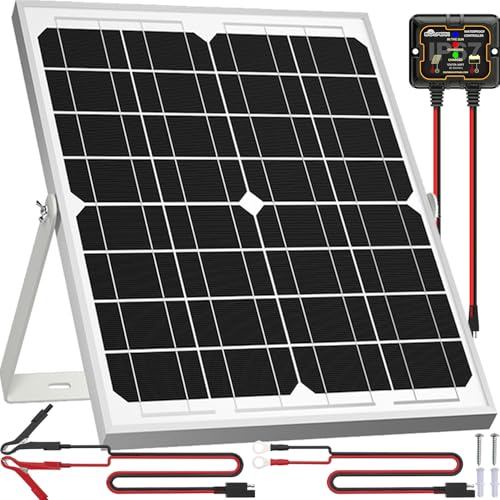
The SOLPERK 20W kit provides a compact option for battery maintenance and trickle charging in RVs and boats. Its 21%–30% cell efficiency range reflects modern A+ mono solar cells, delivering dependable 12V charging for a variety of batteries, including LiFePO4 and AGM. A robust, weatherproof design (IP68) and a corrosion-resistant aluminum frame support longevity in diverse conditions. An upgraded 8A controller enables improved charging efficiency and clearer status indicators for monitoring the process.
Use cases include keeping essential auxiliaries powered, charging small portable batteries, or maintaining a battery bank during long stays. Practical for trailers or smaller RV setups where space or weight is a concern. The kit emphasizes durability and user-friendly operation.
Pros: compact and light, versatile battery compatibility. Cons: limited output means it’s best for maintenance rather than full-power RV needs. Suitable for travelers who want a simple, low-profile solar boost.
Renogy 200W Starter Kit With Two Panels

The Renogy 200W Starter Kit combines two 100W panels with a Wanderer PWM Controller to deliver a practical off-grid solution for RVs and boats. The high module efficiency (up to 22%) supports steady energy production, even when light is partly obstructed. It uses multi-layer encapsulation and a protective back sheet to enhance durability and long-term performance. The Wanderer controller supports different battery types (sealed, gel, flooded, and lithium) and provides four-stage charging for optimized battery health.
What to expect: consistent daily output around 1000Wh under good sun, a robust build for outdoor use, and straightforward wiring suited for RV upgrades. This kit is a solid choice for those starting RV solar or expanding an existing system with dependable components from Renogy.
Pros: reliable, easy to install, broad battery compatibility. Cons: fewer advanced features than higher-end kits. Best for RVers seeking a dependable, mid-range solar upgrade.
ECO-WORTHY 260W Flexible Solar Kit

This flexible kit from ECO-WORTHY delivers 260 watts across two 130W panels designed for uneven roof surfaces or curved RV roofs. The kit includes a 30A 12V charger controller, solar cable, tray cable, and a Y-branch, enabling adaptable installation on RVs, boats, or off-grid setups. The flexible panels are 70% lighter than traditional glass panels, aiding transport and installation. The system emphasizes portability and ease of use, with a daily output target around 1040Wh under favorable sun conditions.
Best for RVs with non-flat roofs, or owners prioritizing lightweight, flexible installation. The solution scales with your needs by adding more panels or wiring, though installation may require careful roof fitting and proper weatherproofing. Overall, it balances higher power with adaptable form factors.
Buying Guide: Solar For Your RV
- Power needs: Assess daily energy usage to estimate wattage and daily amp-hours. Higher-demand rigs (fridges, air pumps, TVs) require more substantial arrays or multiple kits.
- Roof space and mounting: Flat roofs suit rigid panels; curved or uneven roofs benefit from flexible panels or modular kits with mounting brackets.
- Controller type: PWM controllers are affordable and reliable for modest systems; MPPT controllers offer higher efficiency, especially in cooler temperatures or partial shading, but cost more.
- Durability and weather rating: Look for corrosion-resistant frames, IP ratings, and robust back sheets. RV environments expose panels to wind, rain, and road debris.
- Battery compatibility: Ensure the controller supports your battery type (sealed, gel, flooded, lithium). Consider battery health and cycle life for long-term performance.
- Expansion potential: If future power needs grow, select kits that scale easily with additional panels or higher-capacity controllers.
- Portability vs. permanence: For frequent travelers, portable or foldable kits offer flexibility; for fixed installations, seek flush-mountable solutions with solid sealing.
- Warranty and support: Check manufacturer warranties and availability of replacement parts, especially for kits used in remote locations.
In summary, for RV owners, the best choice depends on roof shape, power demands, and installation preferences. Kits from Renogy provide robust, vehicle-ready options with solid controller integration. ECO-WORTHY offers durable builds and flexible configurations, while SOLPERK targets compact, low-power maintenance needs. The ECO-WORTHY flexible kit stands out for unusual roof geometries, and beginners may opt for a Starter Kit for straightforward setup with room to grow.