Ice dams can cause roof damage and pricey leaks when gutters and downspouts fail to shed melting snow. The right de-icing cables help keep water flowing and reduce the risk of ice buildup. This article highlights five top roof cable options, explains what to look for, and compares features to help homeowners choose the best fit for American winters.
| Product | Brand | Length | Wattage | Key Benefit |
|---|---|---|---|---|
| HEATIT HIRD 30 feet | HEATIT | 30 ft | 5 W/ft | Certified safety; ready-to-install with plug |
| H&G Lifestyles 140FT 8W/FT | H&G Lifestyles | 140 ft | 8 W/ft | Self-regulating, up to 158°F |
| HEATIT HIRD 240 feet | HEATIT | 240 ft | 5 W/ft | Extensive coverage; full safety certifications |
| Eastrexon 152FT 8W/ft | Eastrexon | 152 ft | 8 W/ft | Comprehensive four-layer safety design |
| TOPDURE 240 feet 5W/ft | TOPDURE | 240 ft | 5 W/ft | ETL & CSA certified; maintenance-free |
HEATIT HIRD 30 Feet Roof & Gutter De-Icing Cable

The HEATIT HIRD line offers constant wattage de-icing cable with full ETL and CSA safety certifications, ensuring high compliance across North America. The plug is UL certified, adding extra protection. A 6 ft 18/3 cold lead with a pre-assembled setup simplifies installation. The outer jacket uses weather-resistant PVC with XLPE inner insulation and a tinned copper braid for robust performance. Designed to prevent ice dams and keep water flowing through gutters and downspouts, this model emphasizes safety, ease of use, and effective ice dam prevention.
H&G Lifestyles 140FT Roof Heat Cable, 8W/ft

This self-regulating 8W/ft cable adapts to ambient temperatures, delivering up to 158°F as conditions demand. The technology reduces energy use by varying output to suit the environment, helping prevent ice dams without overheating. It includes durable construction with polyolefin inner insulation, a protective TPE layer, and a tinned copper core for safety and resilience in cold climates. Homeowners benefit from reliable ice dam prevention while maintaining pipe frost protection and leak reduction.
HEATIT HIRD 240 Feet Roof & Gutter Snow De-Icing Cable
This extended-length HEATIT HIRD cable mirrors the safety and build quality of the shorter version, offering large-scale coverage for longer gutters or expansive roof lines. It features full ETL and CSA certification and a pre-assembled 6 ft 18/3 lead with plug. The tough XLPE inner insulation and weather-resistant PVC outer jacket are designed to endure cold temperatures, while the aluminum foil and tinned copper braid enhance shielding. Ideal for larger homes or commercial-style roofs where long runs are needed to prevent ice dams and leaks.
Eastrexon 152FT Roof Heat Cable, 8W/ft

The Eastrexon heat tape provides all-round de-icing for roofs, gutters, and downspouts with 152 feet of coverage. Its four-layer safety design includes a waterproof outer jacket, insulation, shielding, and a PTC layer using AL-MG alloy wire with complete screening. The 9.8 ft power cord length adds flexibility for placement. This self-regulating option helps maintain heat output relative to ambient conditions, reducing ice dam risk while protecting against pipe freezes.
TOPDURE 240 Feet Roof & Gutter Snow De-Icing Kit
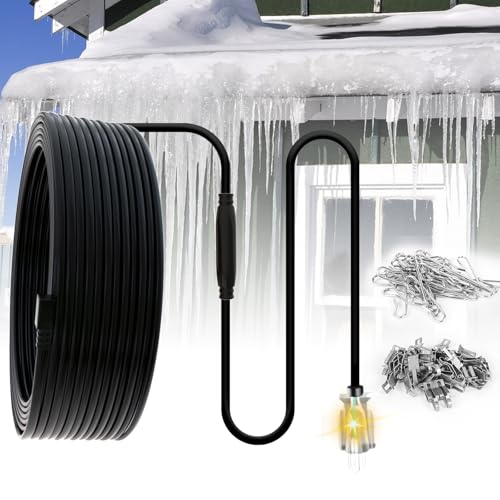
The TOPDURE kit emphasizes safety with ETL and CSA certifications and UL-certified plugs. It features a self-regulating heating cable that adjusts output as temperatures change, delivering dependable snow and ice melting. The kit is pre-assembled with a 6 ft 18/3 cold lead and comes with an instruction manual, clips, and spacers for straightforward installation. Built with tough XLPE inner insulation and 100% screening using aluminum foil and copper braid, it is designed for long runs and harsh winter use.
H&G Lifestyles 140FT 8W/ft Roof Heat Cable
This H&G Lifestyles option combines self-regulating 8W/ft performance with advanced safety design. It continuously adjusts power to maintain efficiency and prevent ice dam formation. The cable’s construction includes a polyolefin inner insulation, a protective TPE layer, and a tinned copper core, providing durable performance in cold environments. It is suitable for extended roof runs and gutters where consistent heat is necessary to keep water flowing and prevent clogs from ice buildup.
Buying Guide: Key Purchase Considerations
- Self-regulating vs fixed power: Self-regulating cables adjust output with temperature, improving energy efficiency and safer melting across varying conditions. Fixed-power cables maintain a constant wattage but can waste energy in milder weather and may underperform in extreme cold.
- Wattage per foot: Typical ranges are 5W/ft to 8W/ft. Higher wattage provides more aggressive ice melting but may increase energy costs. Assess roof size, insulation, and typical snow load to choose an appropriate wattage.
- Length and coverage: Measure gutter length and roof run to determine total cable length. Longer runs require durable insulation and robust shielding to withstand outdoor exposure.
- Safety certifications: Look for ETL, CSA, and UL certifications for electrical safety and compliance with North American standards. A fully certified cable (not just a plug) offers greater protection.
- Ease of installation: Pre-assembled leads, included clips, spacers, and clear manuals simplify setup. Some kits include all necessary hardware for immediate use, reducing install time.
- Durability and weather resistance: Outer jackets (PVC or similar) and inner insulation (XLPE or polyolefin) determine resistance to UV exposure, temperature swings, and moisture.
- Gutter and roof compatibility: Ensure the cable is compatible with your roof type (shingle, metal) and gutter materials to prevent damage and ensure effective heat transfer.
- Maintenance and ease of removal: Some self-regulating cables are easier to detach for seasonal storage. Consider whether you prefer a permanent install or a removable kit.
- Safety placement: Follow manufacturer guidance on cable routing to avoid walking areas, heat sources, or areas where pets may come into contact with the cable.
- Energy considerations: Even with self-regulating options, running heat cables during all cold periods can raise electricity usage. Plan use around freezing conditions and storms.