Finding a trustworthy power inverter for power tools means balancing wattage, portability, and battery compatibility. This guide highlights five top options that support DeWalt and other 20V battery systems, plus standard AC outlets and USB ports for charging accessories on the job or in emergencies. Each product is evaluated for compatibility, output, and practical use cases to help you select the right inverter for DIY projects, construction sites, or outdoor work.
Summary of selected products:
- LIVOWALNY Real 200W Power Inverter — Dewalt 20V compatibility, 200W continuous, 250W peak, 2 USB ports, Type-C, and 1 AC outlet.
- Pro Chaser 400W Power Inverter — 400W continuous, 800W peak, 2 USB ports, 2 AC outlets, long cable for flexibility.
- Azocek 220W Power Inverter — Dewalt 20V compatibility, 220W, 1 AC outlet, 2 USB, Type-C Fast Charge.
- BELTTT 2000W Pure Sine Wave Inverter — 12V to 120V, 2000W continuous, 4000W surge, dual AC outlets, LCD readout.
- Ecarke 300W Portable Power Inverter — DeWalt 20V compatibility, 300W, 3 USB ports and Type-C, 1 AC outlet, built-in LED lamp.
LIVOWALNY Real 200W Inverter For Dewalt 20V

This compact inverter is designed to power small devices when using Dewalt 20V max batteries. It converts DC 20V from compatible Dewalt packs to 110V AC with a rated real power of 200W and a peak of 250W. It supports charging phones, laptops, tablets, cameras, lights, and other USB-powered gear via two USB ports and a Type-C port, making it a practical portable station for quick jobs or remote setups. Battery not included, but compatibility spans several DCB battery models for versatility in the field.
Key features include 20V DC to 110V AC conversion, dual USB outputs (5V/2.1A) plus a fast Type-C charge, and a compact form factor ideal for tight spaces. It serves well as a lightweight backup for small handheld tools and electronics when you’re away from a main power source.
Overall, this LIVOWALNY model emphasizes battery-driven portability with sufficient output for essential tools and devices, though it’s best suited for lighter loads rather than heavy-duty power tools.
Pro Chaser 400W Vehicle Power Inverter
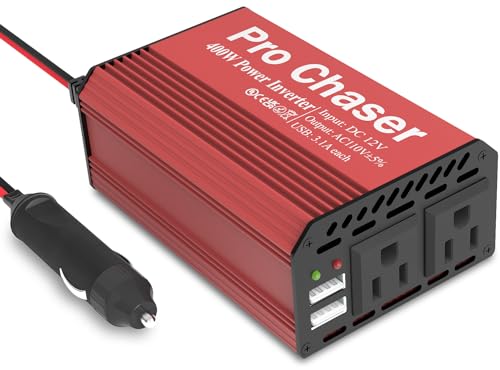
The Pro Chaser inverter delivers a steady 400W of DC to AC power with a peak of 800W, suitable for a range of on-the-go needs. It provides dual 110V AC sockets and two high-speed USB ports (3.1A). The unit is designed to handle devices like laptops, tablets, cameras, and small appliances while traveling or at a job site. A 30-inch cord offers flexibility for placement in a vehicle or workspace, making it a practical option for road trips, outdoor adventures, and family use where battery power is essential.
With its portable footprint and robust output, this inverter supports heavier loads than tiny 100–200W units, while still maintaining a compact, travel-friendly design. It’s particularly suited for powering laptops and other mid-range equipment during remote work or camping trips, where reliable charging is a priority.
In sum, the Pro Chaser 400W inverter balances portability with higher wattage capacity, offering dependable power for multiple devices at once on the move.
Azocek 220W Inverter For Dewalt 20V Battery

This 220W inverter is designed to pair with DeWalt 20V batteries, converting 20V DC to 110V–120V AC to power phones, laptops, tablets, and other small electronics. It emphasizes portability and outdoor readiness, providing a reliable power source when off-grid or during outages. The unit features a standard AC outlet plus two USB ports and a Type-C fast charging port, enabling simultaneous charging of multiple devices without sacrificing performance.
Key advantages include battery compatibility with popular DeWalt models, dedicated fast USB-C charging, and a compact form factor that fits easily into a tool bag or car trunk. It’s well-suited for light to moderate workloads rather than heavy-duty tools, but it covers essential electronics for field work or camping reliably.
Overall, the Azocek 220W inverter focuses on versatility and quick charging, making it a practical choice for weekend projects and emergency readiness with compatible 20V batteries.
BELTTT 2000W Pure Sine Wave Inverter

This high-capacity inverter is designed for serious power needs, delivering 2000W of continuous DC 12V to AC 110V–120V power with surge capability up to 4000W. The pure sine wave output helps protect sensitive electronics and appliances, reducing wear and noise while extending equipment life. An intelligent LCD display shows input and output voltages, battery status, and load conditions, assisting in timely troubleshooting and monitoring during operation.
For RVs, trucks, solar setups, or heavy-duty outdoor use, this inverter offers robust performance and reliability. The dual AC outlets increase flexibility for powering multiple devices, and the remote controller adds convenience for control from a distance. While larger than portable units, it suits environments where steady, clean power is essential for long durations.
In summary, BELTTT’s 2000W inverter targets heavier electrical loads with a focus on sine-wave quality, monitoring, and remote operation capabilities.
Ecarke 300W Portable Inverter With DeWalt 20V Battery

Ecarke’s 300W inverter is designed for seamless Dewalt 20V battery compatibility, enabling portable charging and power for a range of devices. It features 2 USB ports and a Type-C port alongside a standard 110–120V AC outlet. The unit is intended for emergencies, outdoor activities, and general backup power, allowing users to keep phones, tablets, laptops, and small lights charged on the move.
Highlights include wide battery compatibility, multi-port charging options, and a compact build that’s easy to transport. The built-in LED light (200 lm) is a practical addition for camping or dim environments, providing illumination when other power sources are unavailable. The inverter prioritizes practical usability and convenience for outdoor enthusiasts and DIYers alike.
Ecarke’s offering is best suited for light to moderate loads and quick deployments where a Dewalt battery is already on hand, making it a versatile backup option for outdoor projects.
Buying Guide: Key Considerations For Choosing A Power Inverter
- Power rating and surge capacity: Match the continuous (running) wattage to the tools you plan to run, and consider surge watts for motor starting or heavy loads. A 400W inverter handles most small tools; 2000W units cover larger devices and multiple tools simultaneously.
- Battery compatibility: If you rely on DeWalt 20V or other battery systems, verify compatibility with the exact battery models listed by the manufacturer. Battery (not included) affects portability and run time.
- Output quality: Pure sine wave inverters provide clean power suitable for sensitive electronics, reducing risk of damage and noise when powering laptops, radios, or precision equipment.
- Ports and versatility: Look for models with multiple outlets (AC, USB-A, USB-C) to charge devices at once. Type-C PD ports offer faster charging for newer devices.
- Portability and form factor: For field work, a compact unit with a long cord and LED indicators simplifies placement and monitoring in tight spaces or vehicles.
- Display and monitoring: An LCD or LED readout helps track input voltage, load, and battery status, which aids in safe operation and planning for recharges.
- Safety features: Overload protection, short-circuit protection, low-battery shutoff, and thermal protection help protect both the inverter and connected devices in unreliable power environments.
- Use-case alignment: For camping, RVs, or job sites, consider whether you need hardwiring options, remote control, or extra durability for outdoor exposure.
- Noise and emissions: Some inverters generate audible fan noise or heat. If quiet operation is required, check user reviews for thermal performance and cooling behavior.
When selecting an inverter, align the device’s wattage with your most demanding tool, ensure battery compatibility for portability, and prioritize output quality to protect sensitive electronics. Inverter usage in vehicles or outdoor setups should emphasize safety features and monitoring capabilities to prevent unexpected power loss.