Home backup generators provide resilience during outages, with options ranging from compact inverters to full-size dual‑fuel workhorses. This article highlights five top picks that balance power, portability, and safety for American households. Each unit features evaluator-friendly specs, including wattage, runtime, and noise level. Use this guide to compare options for essential appliances, climate control, and security systems during storms or power failures.
Product Summary
| Product | Brand | Power Range | Fuel Type | Notable Feature |
|---|---|---|---|---|
| 4400-Watt Portable Inverter Generator | PowerSmart | 3600W running | Gasoline | Very quiet, CO sensor |
| Oxseryn 4000W Inverter Generator | Oxseryn | 3200W running | Gasoline | Low THD, multiple outlets |
| Westinghouse 12500 Watt Dual Fuel | Westinghouse | 11200–12500W | Gas/Propane | Remote start, transfer switch ready |
| Westinghouse 13500 Peak Watt Tri-Fuel | Westinghouse | 8500–10500W running | Gas/Propane/Natural Gas | Tri-fuel, long runtime |
| DuroMax XP13000EH 13,000-Watt | DuroMax | 8000–10000W running | Gas/Propane | Electric start, whole-home capability |
PowerSmart 4400‑Watt Inverter Generator

The PowerSmart 4400-Watt Portable Inverter Generator offers a robust starting wattage of 4400W and a rated 3600W, suitable for essential home circuits and RV needs. With a 1.6-gallon fuel tank, it delivers up to 11 hours of runtime at 25% load, reducing refueling interruptions during outages. Noise is kept relatively low for an open-frame inverter, making it a practical option for residential environments while complying with emission standards. The CO-sensor adds a safety layer, alerting occupants to elevated carbon monoxide levels in enclosed spaces.
Oxseryn 4000W Inverter Generator

The Oxseryn 4000W inverter delivers 4000 peak watts and 3200 running watts with clean power suitable for sensitive electronics due to low total harmonic distortion. It includes multiple outlets: one 12V DC port, two 120V AC ports, and a 30A RV port, supporting home backups, camping, and small tool sets. The 2-gallon tank and fuel gauge enable approximately 14 hours of operation at modest loads. Its compact frame and low noise profile make it a strong choice for compact spaces or neighborhoods with noise restrictions.
Westinghouse 12500 Watt Dual Fuel

This dual-fuel powerhouse is designed for true home backup readiness with 12,500 peak watts (gas) and 11,200 peak watts (propane). It runs up to 12 hours on a 6.6-gallon tank and includes a remote start with a key fob, plus a transfer switch-ready configuration. Multiple outlets, including a 30A RV and 50A L14-30, support whole-house circuits and critical loads. Rubber outlet covers add weather protection, and the digital hour meter provides real-time run-time tracking for maintenance planning.
Westinghouse 13500 Peak Watt Tri-Fuel

The Westinghouse 13500 Peak Watt Tri-Fuel generator supports gasoline, propane, and natural gas, offering substantial flexibility for fuel availability during outages. It features a remote start, a long runtime on a large fuel tank, and multiple outlets, including RV and transfer switch-ready receptacles. The CO shutdown and low-oil monitoring protect both equipment and occupants, while the durable engine and heavy-duty construction support extended power needs in severe weather scenarios.
Westinghouse 6500 Watt Dual Fuel
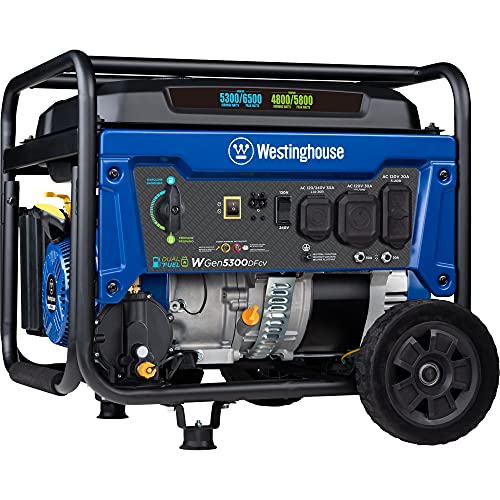
This dual‑fuel option provides 6500 running watts (gasoline) and 5800–6500 peak watts depending on fuel type. A 4.7‑gallon tank supports up to about 14.5 hours of runtime, with a 30A transfer switch and RV receptacle. It includes practical safety and convenience features such as rubber-covered outlets, a toolkit, and a wheel kit for mobility. The unit is well-suited for medium homes, workshops, and more demanding outage scenarios where portability remains important.
DuroMax XP13000EH 13,000-Watt

The DuroMax XP13000EH is a robust 13,000-watt dual‑fuel portable generator designed for whole-home backup. It offers electric and recoil start options, enabling flexible startup methods during outages. Its dual-fuel capability allows running on gasoline or propane, broadening fuel accessibility. The unit targets users seeking substantial power for essential appliances, HVAC, and other major loads, with transfer switch readiness and a reputation for durable construction and dependable performance in emergency scenarios.
Buying Guide: Key Purchase Considerations
Power needs and load calculation are the starting point. List critical appliances (refrigerator, HVAC, sump pump, lighting) and estimate their running watts, then select a generator with adequate continuous wattage and surge capacity. Dual‑fuel or tri‑fuel options provide flexibility when fuel supplies are limited. For whole-home backup, choose models with transfer switch compatibility and remote starting for convenience during storms.
Fuel efficiency and runtime affect outage resilience. Inverter generators generally run quieter and deliver cleaner power, but may have lower base output than traditional open-frame units. For sensitive electronics, verify THD levels and stable voltage output. Storage size, weight, and portability matter for homeowners with limited space or mobility needs.
Outlets and safety features should align with household equipment. Look for multiple 120V outlets, RV ports, and 240V options when needed. Safety extras like CO sensors, automatic low-oil shutoffs, and rubber outlet covers improve daily usability and long‑term reliability. Ensure you have a proper transfer switch and professional installation if connecting to a home panel.
Noise tolerance and neighborhood regulations influence choice. Quiet, inverter-based units are often favored in residential areas, but higher‑capacity dual‑fuel generators may be necessary for larger homes or longer outages. Consider maintenance requirements, warranty coverage, and local fuel availability when deciding which model best fits your home’s climate and risk profile.