Lockout tagout (LOTO) systems protect workers by preventing unexpected energization of electrical panels and circuit breakers during maintenance. This guide highlights five high‑performing LOTO products designed for standard single and double toggle breakers, plus offers practical buying tips for OSHA compliance and safer work practices in American facilities.
| Product | Brand | Key Benefit |
|---|---|---|
| Master Lock Red Electrical Box Circuit Breaker Lockout | Master Lock | Grip Tight design for quick, secure locking on common toggle breakers |
| QWORK 4 Pack Lockout Tagout Steel Cable Locks | QWORK | Multiple locks with keyed differences for multi-point isolation |
| AuRandoo Circuit Breaker Lockout Kit | AuRandoo | Clamp‑on design fits 120/277V breakers with durable non‑conductive construction |
| SAFBY Lockout Tagout Kit (Red Kit) | SAFBY | Comprehensive kit with hasps, tags, and padlocks for team lockout |
| TRADESAFE Lockout Tagout Cable Lock | TRADESAFE | Adjustable, long cable with durable coating for hard‑to‑reach panels |
Master Lock Red Electrical Box Circuit Breaker Lockout

The Master Lock 493B lockout is designed for standard height and tie-bar toggles found on typical 120 and 240 volt breakers. It supports OSHA‑compliant lockout tagout programs by providing a simple thumb‑turn locking action and a clamping handle that secures the toggle. The durable construction features powder‑coated steel and reinforced polymer, enabling operation in challenging environments. As part of a broader LOTO program, it facilitates quick, reliable isolation during maintenance while reducing the risk of accidental reenergization.
QWORK Lockout Tagout Steel Cable Locks (4 Pack)

QWORK’s four‑pack provides keyed different padlocks with 3-1/8″ flexible steel cable shackles. Designed for use in tight spaces like circuit breaker cabinets, these locks support multi‑point isolation. The set includes eight keys, enabling team-based lockout while maintaining key control. Built from industrial‑grade non-conductive thermoplastic and stainless steel cable shackles, these locks are resistant to corrosion and designed for long‑term industrial use in electrical lockout applications.
AuRandoo Circuit Breaker Lockout Kit
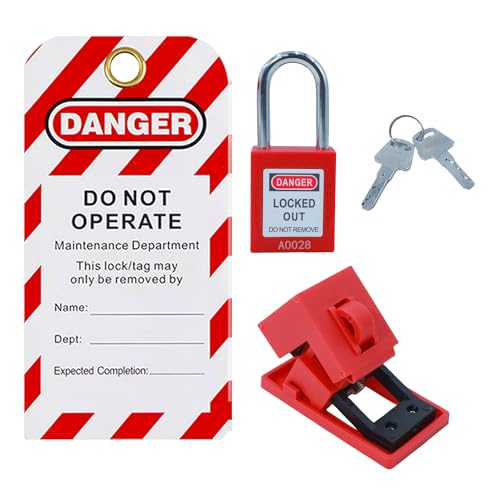
AuRandoo’s clamp‑on lockout device fits single‑pole breakers (20–50 amp) and breaker boxes with handles up to 16.5mm wide. The quick clip design provides a secure grip, preventing accidental removal during maintenance. Constructed from reinforced red polypropylene and nylon, the device resists corrosion and electrical hazards. This OSHA‑compliant kit includes a safety lock and pre‑printed LOTO tags, aligning with standard lockout tagout procedures and compatibility with Master Lock padlocks for team use.
SAFBY Lockout Tagout Kit (Red Kit)

SAFBY’s red kit emphasizes portability and OSHA alignment with a nylon lockout pouch and metal belt loops. It includes three clamp‑on breaker lockouts, three universal multi‑pole breakers, three different sized lockout hasps, 15 heavy‑duty lockout tags, and four keyed‑different safety padlocks. The kit’s comprehensive set supports multi‑point isolation and hazard communication, helping teams coordinate lockout tasks efficiently while maintaining consistent safety tagging practices.
TRADESAFE Lockout Tagout Cable Lock
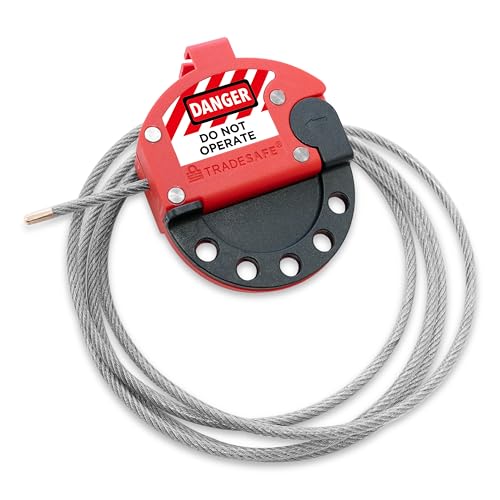
TRADESAFE offers a 6 ft adjustable lockout cable with a 5/32-inch stainless steel core and anti‑UV PVC coating. The tough nylon body is designed for extreme temperatures and rugged environments. The cable is suitable for locking out multiple breakers, valves, and hard‑to‑reach panels, with support for multiple LOTO locks. A distinct warning label on the front and additional space on the back for markings enhances hazard communication during turn‑around work and maintenance windows.
Buying Guide: Key Purchase Considerations
When selecting lockout tagout devices for electrical panels, consider compatibility with your breakers, the number of points of isolation required, and team workflow needs. The following perspectives help balance safety, cost, and practicality.
- Compatibility and fit: Ensure clamp‑on devices fit your breaker handles’ width and shape. Some devices cover a wide range (e.g., 16.5mm handles) and work across 120/277V systems. For panels with unusual handle configurations, a cable lock or padlock set may be more suitable.
- Locking reliability: Look for a secure locking mechanism (thumb turn, clamp, or cable lock) and a robust, insulated body to minimize electrical hazard risk. Keys should be controlled and issued per team member or shift to support accountability.
- Multi‑point isolation: In facilities with multiple energy sources, select sets that include multiple lockouts, hasps, and tags to isolate several points simultaneously without reenergizing any source.
- Durability and environment: Choose models with corrosion‑resistant materials and non‑conductive housings for harsh environments, including factories or outdoor installations.
- OSHA compliance and tagging: Confirm that tags meet OSHA standards and provide space for hazard communication, date, and initials. Include pre‑printed tags if available to streamline documentation.
- Kit completeness vs. modularity: A complete kit helps standardize operations, but modular choices allow teams to assemble exact components, possibly reducing upfront costs. Consider whether you need multiple locks per person or only a few for a dedicated crew.
- Maintenance and reuse: Reusable metal hasps and padlocks require inspection for wear. Ensure replacement parts are readily available and that you have a process to retire damaged components safely.
- Training compatibility: Align product selection with your lockout/tagout training program to simplify onboarding and ensure workers understand use, tagging, and key control procedures.
In practice, a well‑chosen combination often includes one clamp‑on breaker lockout for quick isolation, a set of durable cable locks for hard‑to‑reach panels, and a complete tagout kit to address multiple points and team workflows. This approach supports consistent safety practices while accommodating various electrical environments.