Selecting the right inverter often begins with the battery you plan to power. For a 100Ah capacity, the pairing matters—from AGM and LiFePO4 options to different voltages and BMS protections. This guide highlights five compatible battery choices that commonly work with inverters in off-grid, RV, marine, and backup-supply setups. Each entry includes key features to help you evaluate compatibility, safety, and performance when planning your power system.
| Product | Brand | Voltage | Chemistry | Notes |
|---|---|---|---|---|
| Renogy Deep Cycle AGM 12V 100Ah | Renogy | 12V | AGM | Safe, maintenance-free, up to 4P in parallel |
| WEIZE Deep Cycle AGM 12V 100Ah | WEIZE | 12V | AGM | Low self-discharge, good for long storage |
| AOUSK 48V 100Ah LiFePO4 | AOUSK | 48V | LiFePO4 | Built-in 100A BMS, Bluetooth/app |
| ECO-WORTHY 48V 100Ah LiFePO4 | ECO-WORTHY | 48V | LiFePO4 | CAN/RS485, Bluetooth/WiFi monitoring |
| GREENOE 12V 100Ah LiFePO4 Group 31 | GREENOE | 12V | LiFePO4 | 100A BMS, wide operating temps |
Renogy Deep Cycle AGM 12V 100Ah Battery

Renogy’s 12V 100Ah AGM battery is designed for fixed or mobile power systems, including RVs, cabins, and boats. Its maintenance-free AGM chemistry reduces the risk of spills and simplifies setup for inverter-based power. The battery supports series connections without limitation and up to four units in parallel, enabling scalable configurations. Safety-focused design emphasizes chemical stability and a sealed construction to minimize troubleshooting once installed, making it a practical option for users prioritizing reliability in off-grid or backup applications.
WEIZE Deep Cycle AGM 12V 100Ah Battery
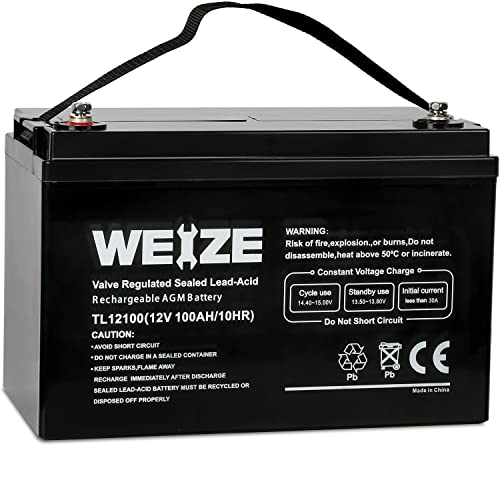
WEIZE’s 12V 100Ah AGM battery emphasizes low self-discharge and maintenance-free operation. Its compact dimensions and sealed construction help prevent leaks, making it suitable for compact inverter setups in RVs or small off-grid systems. The design prioritizes durability under variable temperatures, and a long cycle life is supported by AGM technology. The product page notes a substantial maximum discharge current, which is useful when powering high-draw appliances in a temporary off-grid scenario or during surge events.
AOUSK 48V 100Ah LiFePO4 Battery

This 48V LiFePO4 battery from AOUSK is built for high-energy, long-cycle operation with a robust 100A BMS and Bluetooth monitoring. It supports inverter communication for integrated control and can deliver substantial continuous power with a claimed multi-volt architecture. The unit emphasizes safety features, including low self-discharge and thermal protection, and is appropriate for more complex solar or hybrid inverters that require smart management at the battery level.
ECO-WORTHY 48V 100Ah LiFePO4 Battery

ECO-WORTHY’s 48V 100Ah LiFePO4 pack combines CAN/RS485 open communication with Bluetooth/WiFi monitoring. It is designed for server-rack integration and scalable capacity, with a focus on safety certifications and energy management. The device can be paralleled to extend capacity, and its networked monitoring helps operators track SOC, temperature, and system health through a companion app, enabling smarter grid-tied or off-grid configurations.
VATRER POWER 12V 100Ah LiFePO4 Group 24 Battery

VATRER POWER offers a 12V 100Ah LiFePO4 battery with a built-in 100A BMS and Grade A cells. Notable features include wide operating temperature ranges and auto-balancing of cells to maintain performance. The product emphasizes safety with protections against overcharging, over-discharging, and short circuits. A practical option for RVs, boats, or off-grid cabins where a compact, lightweight LiFePO4 solution is preferred over heavier lead-acid alternatives.
PUPVWMHB 48V 100Ah LiFePO4 With Inverter Connectivity

This option emphasizes inverter communication, Wi-Fi remote control, and a smart display. It includes built-in protections, a Bluetooth interface, and RS485/CAN adaptability for various inverter brands. Advanced monitoring supports real-time status updates, making it suitable for users who want to actively manage charging, SOC, and system health from a mobile app or smart panel in an off-grid or backup power setup.
Buying Guide: Key Considerations For 100Ah Battery Inverter Systems
- Voltage alignment: 12V systems pair with most standard inverters for lighter loads, while 48V systems can deliver higher power with fewer wiring losses. Match battery voltage to your inverter’s input requirements.
- Chemistry and safety: AGM batteries are maintenance-free and robust for seasonal storage, while LiFePO4 offers higher cycle life, better temperature tolerance, and smart BMS protections. Consider safety certifications and thermal management features for critical installations.
- Discharge capability: Look at maximum discharge currents and whether the battery supports surge power for amplifiers, inverters, or motors. Higher peak currents help with startup surges but may impact cycle life if misused.
- Monitoring and connectivity: Bluetooth, Wi‑Fi, CAN/RS485, and app-based monitoring help you track state of charge, temperature, and health. Integrated BMS features reduce risk of overcharge or deep discharge.
- Expandability: If you anticipate growing your system, consider batteries that support parallel or series configurations, or modular packs that scale with inverter capacity and loads.
- Physical footprint and weight: LiFePO4 packs are heavier than AGM in watt-hour terms, but they are lighter than lead-acid for equivalent capacities and support compact setups in RVs or tight spaces.
- Certifications and warranties: Check UL, CE, CEC listings as applicable, plus manufacturer warranty length and what it covers (cell-level vs. pack-level safety and performance).
- System integration: Verify compatibility with your inverter brand and model, communications protocols, and remote-monitoring capabilities to avoid integration issues.