Choosing the right extension cable is essential for efficient solar power systems. This guide highlights five dependable options, covering durability, weather resistance, and ease of use for RVs, boats, and home solar arrays. Each product features heavy-duty conductors, protective sheathing, and reliable connectors to ensure steady power transfer and long service life in outdoor conditions.
| Product | Wire Gauge | Length | Connectors |
|---|---|---|---|
| Renogy 20FT 12AWG Solar Panel Extension Cable | 12 AWG | 20 ft | Male & Female |
| Vansdon 2×30 Feet Solar Panel Extension Cable | 10 AWG | 60 ft total | Male & Female |
| OWINUSTECH 3Ft Solar Cable Extension | 10 AWG | 3 ft | Male & Female |
| Bateria Power 30Ft Extension Cable Set | 10 AWG | 30 ft | Male & Female (set of 2 cables) |
| BougeRV 20 Feet Extension Cable | 10 AWG | 20 ft | Male & Female |
Product picks for this guide
Renogy 20FT Solar Panel Extension Cable

Renogy’s 20-foot extension cable provides a straightforward, durable connection between solar panels and inverters or charge controllers. The assembly uses hard plastic connectors at each end, with a black wire that weather-resists sun exposure. Built to minimize power loss, the cable is UV resistant and waterproof and has undergone TUV testing, giving installers confidence in outdoor environments. The 12 AWG conductors balance flexibility with low resistance, suitable for mid-range solar setups where modest extension is needed without sacrificing efficiency.
Vansdon 2×30 Feet Solar Panel Extension Cable

This Vansdon option provides a total of 60 feet of reach when used as a pair of 30-foot cables, combining 10 AWG copper with dual red and black runs for easy polarity identification. The product carries TÜV, CE, and RoHS certifications, and its IP67-rated outer jacket plus XLPE/XLPO insulation supports outdoor use across a wide temperature range. The higher gauge reduces resistance and heat build-up, improving charging efficiency in longer cable runs and very sunny installations.
OWINUSTECH 3Ft Solar Cable Extension

The OWINUSTECH extension focuses on compact length for nearby components or snug array layouts. It uses 10 AWG conductors and PE outer material with PPO connectors. The cable is rated IP67 and carries TÜV/CE certifications, ensuring durable outdoor performance. The red and black dual-wiring helps distinguish polarity, aiding rapid and safe connections in temporary or permanent solar setups.
Bateria Power 10AWG 30Ft Extension Cable Set
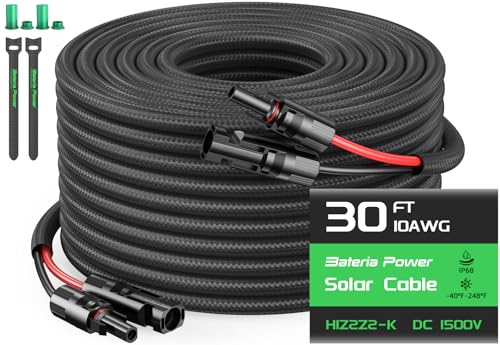
This 30-foot set includes two 10 AWG cables, red and black, with IP68 protection and XLPE/XLPO insulation designed for prolonged outdoor exposure. The dual-sleeved, flame-retardant jacket reduces abrasion and heat risk, while tin-plated copper conductors help minimize resistance and corrosion. The kit typically ships with cable ties for orderly installations and is suitable for home or RV solar layouts requiring reliable extension distance without sacrificing safety.
BougeRV 20 Feet Solar Extension Cable

BougeRV’s upgrade includes an extra pair of connectors and a 20-foot length at 10 AWG. The dual connectors are TÜV and UL certified, and the XLPE insulation provides broad temperature tolerance and UV resistance for outdoor solar arrays. The design emphasizes power retention and longevity, helping reduce losses in longer-distance runs and maintaining system efficiency in variable weather conditions.
Buying Guide: Key considerations for solar extension cables
- Current rating and gauge: Larger gauges (10 AWG) support lower resistance over longer distances, beneficial for higher current systems or longer cable runs. For shorter runs, 12 AWG can be adequate, but 10 AWG is common in outdoor solar setups.
- Weather resistance: Look for UV-resistant, waterproof or IP-rated jackets (IP67 or IP68) to endure sun, rain, snow, and humidity. Flame-retardant jackets and XLPE insulation add safety and durability in outdoor environments.
- Connectors and polarity: Ensure connectors are secure, weatherproof, and clearly color- coded (red for positive, black for negative) to minimize connection errors during installation and maintenance.
- Certifications: TÜV, UL, CE, RoHS, and IP ratings indicate tested safety and reliability. Certifications help verify quality for long-term use in harsh conditions.
- Length and management: Choose lengths that reduce voltage drop without creating excessive slack. Plan cable routes with cable ties or clips to avoid abrasion and physical damage over time.
- Compatibility: Verify connector types and system voltage ratings align with the solar array, inverter, or charge controller. Some kits include extra connectors or spare pairs for future expansion.
- Durability features: Look for tinned copper conductors to resist corrosion, and protective sleeving or jackets that resist abrasion and heat buildup, especially in RV and marine applications.