Choosing the right ESD spray for plastic surfaces helps reduce static buildup, protect sensitive electronics, and maintain cleanliness in workspaces. This article reviews five leading options that are effective on plastics, rubbers, fabrics, and equipment. Each product is evaluated for static control, ease of application, safety, and suitability for controlled environments.
Summary of Selected Products
| Product | Brand | Type | Size |
|---|---|---|---|
| I.C. Topical Anti-Stat in a ESD Safe Antistatic Spray Bottle | R&R Lotion | Antistatic spray | 16 oz |
| I.C. ESD Safe Spray Trigger Bottle (SCB-16-ESD) | R&R Lotion | Spray bottle with adjustable nozzle | 16 oz |
| I.C. ESD Safe Spray Trigger Bottle (SCB-32-ESD) | R & R Lotion | Spray bottle with adjustable nozzle | 32 oz |
| Spray Mister Bottle ESD Safe (Blue) | R&R Lotion | Static dissipative mister bottle | 2 oz |
| MG Chemicals 844AR ESD Safe Coating for Plastics | MG Chemicals | Coating | 850 mL |
I.C. Topical Anti-Stat in a ESD Safe Antistatic Spray Bottle
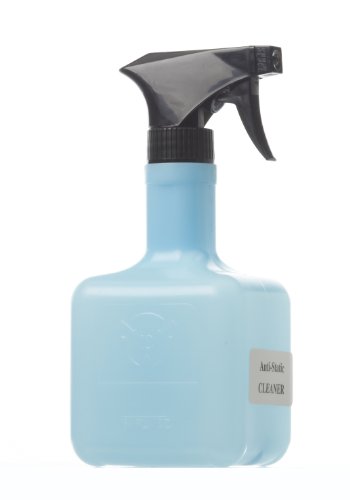
Efficacy centers on a robust antistatic coating that reduces static cling on carpets, fabrics, plastics, rubbers, and equipment. The formulation targets surfaces prone to charge buildup and supports compliance with ESD standards, making it suitable for electronics assembly areas. The product also acts as a dust and dirt barrier, helping maintain cleanliness and extend item life. It is designed as a cleanroom-safe, non-toxic option safe for handhelds, clothing, and work surfaces.
I.C. ESD Safe Spray Trigger Bottle (SCB-16-ESD)

Key features include an adjustable spray nozzle that enables precise control for a fine mist or targeted application, promoting even coverage on plastics and other materials. The non-corrosive stainless steel pump resists chemical exposure, extending durability in harsh environments. Its MDPE body is designed to be leak-proof and chemical resistant, making it suitable for various cleaning solvents used in electronics manufacturing and general cleanroom settings.
I.C. ESD Safe Spray Trigger Bottle (SCB-32-ESD)

This larger 32-ounce version offers the same advantages as the 16-ounce variant, including an adjustable nozzle for controlled application, a non-corrosive stainless steel pump, and a leak-proof MDPE design. It is well-suited for larger workspaces or environments requiring frequent treatment of plastic surfaces and other materials to dissipate static charges effectively.
Spray Mister Bottle ESD Safe (Blue)

This blue mist bottle features static dissipative properties with a surface resistivity range of roughly 10^9 to 10^10 ohms per square. It can dissipate static charges quickly, typically within two seconds, helping maintain a static-safe environment on small components, tools, and plastic surfaces. Available in compact sizes, it is convenient for personal workstation use, cleanrooms, or assembly lines where controlled misting of anti-static liquids is required.
Spray Mister Bottle ESD Safe (12 oz Yellow/Blue)

This larger mist bottle offers the same static-dissipative performance with a broad range of sizes. It has a similar resistivity range (10^9 to 10^10 ohms per square) and is designed for quick discharge of static on plastics and other surfaces. The color distinction helps with inventory or workflow labeling in facilities handling multiple chemical or liquid treatments.
MG Chemicals 844AR ESD Safe Coating for Plastics

MG Chemicals 844AR provides a permanent static dissipative coating for plastics, offering quick-drying performance and strong adhesion with excellent flexibility. This coating is designed for durable, long-lasting static control on plastic surfaces, making it suitable for components, housings, and protective enclosures in electronics manufacturing and cleanroom environments. It complements spray-based solutions by providing a protective film that reduces charge buildup over time.
Buying Guide
Choosing the right ESD spray or coating for plastic surfaces involves balancing application needs, environment, and material compatibility. Consider the following factors:
- Surface type and coverage: Plastic materials vary in porosity and texture. For large or irregular surfaces, larger bottle sizes and adjustable nozzles improve efficiency, while misting can provide uniform coverage on smooth plastics.
- ESD performance: Look for products with clear surface resistivity or dissipative ratings (often expressed as ohms per square). This helps ensure the product meets your facility’s ESD standards.
- Application method: Sprays are quick and easy for spot or broad coverage, while coatings offer longer-term static control through a cured film. Evaluate whether a temporary spray or a durable coating fits your workflow.
- Safety and compatibility: Ensure the product is non-toxic or cleanroom-safe if used around sensitive electronics or sterile environments. Verify compatibility with cleaning agents and solvents used in your process.
- Durability and maintenance: Some coatings provide permanent dissipation but require surface prep and curing. Sprays may require reapplication after cleaning or over time, depending on the environment.
- Size and storage: For mobile workstations or short-term projects, compact 2 oz to 16 oz bottles are convenient, while larger facilities may benefit from 32 oz or bulk options.
In practice, combining a spray product with a durable plastic coating can offer both immediate/static reduction and long-term protection. Always follow manufacturer guidelines for application and ventilation, especially in cleanrooms or electronics assembly areas.