Choosing the right DC breaker is essential for safeguarding battery-based power systems, including solar arrays, UPS units, and data centers. This article reviews five top-rated DC breakers and disconnect switches, highlighting how they protect circuits, simplify maintenance, and enable safe isolation. Each product is chosen for reliability, performance in DC environments, and ease of installation. Use this guide to compare features, mounting options, and suitability for your specific voltage range and load requirements.
| Product | Brand | Voltage Range | Key Benefit |
|---|---|---|---|
| DIHOOL 200 Amp DC Breaker | DIHOOL | DC 12V–500V | High current protection with thermal magnetic trip |
| 2 PCS DC 12V-24V 30A Auto Reset Breaker | Aikyciu | DC 12V/24V | Thermal auto-reset for automotive and marine setups |
| DIHOOL 100 Amp Battery DC Disconnect | DIHOOL | DC 12V–250V | Main power isolation with high silver content contacts |
| CHTAIXI 12V-110V DC Miniature Breaker | CHTAIXI | DC 12V–110V | Arc extinguishing system and DIN rail mounting |
| RED WOLF 60A Circuit Breaker | RED WOLF | DC 12V–48V | Waterproof housing with manual reset |
These selections cover a range of applications—from portable vehicles and RV setups to fixed solar installations and data centers—emphasizing durability, reliable arc suppression, and straightforward wiring. The list also includes both single-pole and multi-pole designs to suit different distribution layouts. Consider whether you need a dedicated battery isolator, a main power disconnect, or a protective device that also serves as a control switch for maintenance. The right choice balances current rating, voltage range, and environmental protection with installation constraints.
DIHOOL 200 Amp DC Breaker

The DIHOOL 200 Amp DC Breaker provides thermal magnetic trip protection for main power lines, offering overload and short-circuit protection in DC applications such as photovoltaic systems, UPS, and data centers. It is designed for front-access electrical installations and supports DC voltages up to 500V. Its robust construction and high current rating make it suitable for demanding battery-based systems seeking fast isolation and reliable protection.
2 PCS DC 12V-24V 30A Auto Reset Breaker

These auto-reset DC breakers are designed for 12V/24V systems and provide thermal auto-reset protection for overcurrent events. They are compatible with automotive, marine, RV, and truck installations, including battery chargers and other DC circuits. The included cover helps guard against accidental shorting while maintaining easy access for reset in the field.
DIHOOL 100 Amp Battery DC Disconnect
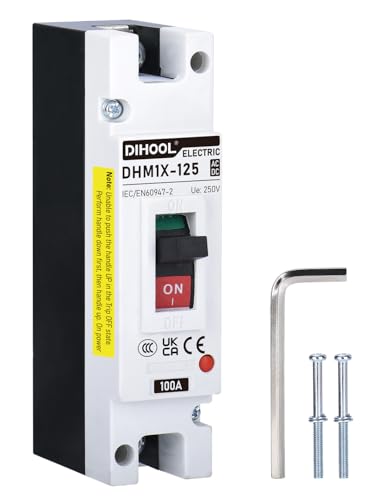
This 100 Amp DC disconnect switch works as a main power isolation device for solar, UPS, and battery systems. It uses a thermal magnetic trip and provides detailed current handling with silver content contacts, enhancing conductivity and durability. It supports a wide voltage range and is suitable for high-energy DC circuits that require reliable disconnection for maintenance or safety.
CHTAIXI 12V-110V DC Miniature Breaker
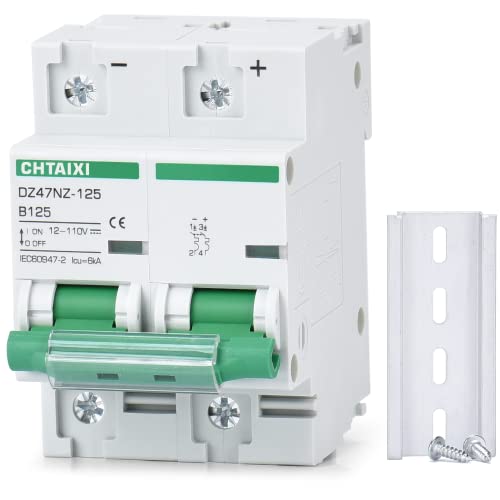
The CHTAIXI DC miniature breaker protects power distribution facilities from overloads and short circuits, with an arc-extinguishing magnetic system. It features silver alloy contacts and a flame-retardant shell for durable DC protection in solar PV systems and RV installations. DIN rail mounting makes integration into standard control panels straightforward.
RED WOLF 60A Circuit Breaker

Designed for 12V–48V DC systems, the RED WOLF 60A circuit breaker can act as both a protective device and a kill switch. It features a manual reset with a visible indicator and a weather-resistant housing suitable for marine or outdoor installations. The robust build helps protect battery banks, trolling motors, and solar array circuitry from over-current events.
DIHOOL Solar Disconnect Switch (30A)

DIHOOL’s solar disconnect provides a dedicated 30A two-pole switch for PV systems, with DIN rail mounting and a built-in arc quelling magnet. It supports a wide voltage range and is designed for robust DC protection in solar arrays, helping isolate panels for safe maintenance and system testing. The kit includes mounting and wiring hardware to streamline installation.
Buying Guide: Key Considerations For Choosing DC Breakers And Disconnects
Voltage and current ratings determine whether a breaker will handle your system’s maximum load. For DC systems, amperage ratings often reflect steady-state operation and surge tolerance—choose a device with a comfortable margin beyond your peak draw to avoid nuisance tripping.
Arc suppression and magnetic trip mechanisms are particularly important in DC circuits. A thermal magnetic trip provides reliable protection against both overloads and short circuits, helping prevent damage to batteries, inverters, and wiring. Look for products that explicitly state DC compatibility and arc-quenching features.
Mounting style and enclosure protection affect installation practicality. DIN rail mounting suits control panels and commercial racks, while weatherproof housings suit outdoor or boat applications. Consider IP ratings when the device will be exposed to moisture, dust, or splashes.
Expansion and compatibility matter in complex systems. If planning a distributed battery bank with multiple feeders, opt for multi-pole breakers or compatible disconnect switches that align with your wiring plan. Silver alloy contacts can improve conductivity and longevity in high-current DC networks.
Maintenance and accessibility are practical concerns. A clear reset mechanism and front-accessibility help reduce downtime during testing or fault-finding. In maritime or RV contexts, waterproof or splash-proof designs add critical reliability in variable environments.
Installation safety should guide your selection. Ensure correct wiring polarity, proper enclosure bonding, and secure mounting to prevent loosening under vibration. Verify that the device’s voltage rating matches the battery and inverter specifications to avoid insulation or insulation breakdown risks.
In sum, select a DC breaker or disconnect that matches your system voltage, current needs, mounting space, and environmental exposure. A well-chosen device not only protects equipment but also simplifies maintenance and reduces downtime in critical power applications.