Bi-directional meters play a crucial role in solar installations by tracking energy imports and exports in real time. This article reviews top options that support net energy metering, grid interaction, and home-automation integrations. It covers single- and three-phase devices, wireless connectivity, and compatibility with systems like Home Assistant and Modbus. Use this guide to compare features, ease of use, and suitability for residential or small commercial solar setups.
| Product | Type | Key Benefit | Link |
|---|---|---|---|
| IAMMETER WEM3080T (Three Phase) | Bi-Directional Din Rail Meter | Net energy metering with WiFi and Modbus; robust for three-phase setups | Amazon |
| IAMMETER WEM3080 (Single Phase) | Bi-Directional Din Rail Meter | Realtime export/import monitoring; good for split-phase homes | Amazon |
| IAMMETER WEM3080T (250A) | Bi-Directional Din Rail Meter | Higher current capacity for larger loads; detailed reports | Amazon |
| ZIBOO FT-1000W | PV Panel Tester / MPPT Meter | Bench-style validation of PV modules; records Pmax, Voc, Isc | Amazon |
| ACAGALA Tuya WiFi Meter | Bi-Directional Energy Meter | Real-time channel monitoring; mobile app access | Amazon |
IAMMETER WEM3080T Three-Phase Bi-Directional Meter

The IAMMETER WEM3080T is designed for three-phase solar grids, enabling net energy metering by recording energy exported to and imported from the grid. It supports WiFi connectivity and Modbus TCP/RTU, making it suitable for Home Assistant and Node-RED integrations. Real-time monitoring of grid interaction and solar production helps users model energy spend and potential savings across hours, days, or months. The device is appropriate for homes with more complex electrical demands or larger solar installations, where tracking three-phase energy flow matters for billing and system optimization.
Features include monitoring of “Exported to Grid” vs “Solar Production” in real time, enabling detailed energy accounting and reporting. It helps users compare electricity bills against solar income with structured outputs, and it supports split-phase configurations as needed. The meter’s compact DIN rail form factor facilitates straightforward installation inside electrical panels.
IAMMETER WEM3080 Single-Phase Bi-Directional Meter

This single-phase IAMMETER model focuses on real-time tracking of energy exchanged with the grid and solar production. It supports Modbus TCP/RTU, WiFi, and integration with Home Assistant, enabling automation rules based on energy flows. The meter is well-suited for homes with standard split-phase setups and smaller solar arrays, offering detailed hourly, daily, and monthly energy reports for financial analysis and system optimization.
Users can compare their electricity bill against solar income, and the device emphasizes easy installation on DIN rails and compatibility with common home energy systems. The included reporting features help homeowners quantify how much energy is exported versus consumed, aiding decisions about battery storage or solar panel expansion.
IAMMETER WEM3080T 250A Bi-Directional Meter

With higher current handling, this 250A option expands monitoring capacity for larger solar installations or more complex load profiles. It maintains real-time export/import tracking and supports net metering calculations, helping households evaluate energy use versus solar generation. The device integrates with Home Assistant and other automation platforms via Modbus, enabling advanced energy management scenarios and detailed reporting across billing intervals.
Performance highlights include accurate measurement of grid interaction alongside solar production, plus the ability to generate structured reports for hourly, daily, and monthly periods. It remains a DIN-rail mounted solution ideal for electrical panels, garages, or utility rooms where reliability and expandability are essential.
ACAGALA Tuya WiFi Smart Bidirectional Meter

The ACAGALA meter emphasizes real-time channel monitoring with a mobile app for forward and reverse power flows. It supports WiFi connectivity for remote access and offers straightforward tracking of voltage, current, power, and frequency per channel. This makes it suitable for homeowners who want a user-friendly interface and simple sizing for small to mid-size solar installations. The app-centric approach aids in monitoring daily energy production versus consumption and provides insights on how to optimize energy use within a home automation framework.
Key advantages include detailed real-time graphs and daily/monthly totals for forward and reverse energy, enabling better understanding of consumption patterns and solar performance. The device is compatible with common consumer smart-home ecosystems, and its modular design helps with quick installation and maintenance in residential settings.
Tooluantmall RC Watt Meter With PV Connector

The RC Watt Meter focuses on comprehensive measurement capabilities including voltage, current, power, and discharge metrics suitable for solar and battery configurations. It features a 1A step size and supports various scenarios with improved software updates for accuracy. The user-friendly interface supports quick calculations in diverse environments, making it a practical tool for field maintenance, RV setups, or small off-grid systems that require precise energy monitoring and quick reads on a display.
Applications include solar, wind, and battery systems with an emphasis on reliability and straightforward operation. This meter’s versatility is beneficial for technicians and DIY enthusiasts who prioritize clarity in measurements and ease of use when assessing performance in real-world conditions.
ELITEELEMENT AILI DC Bi-Directional Ammeter
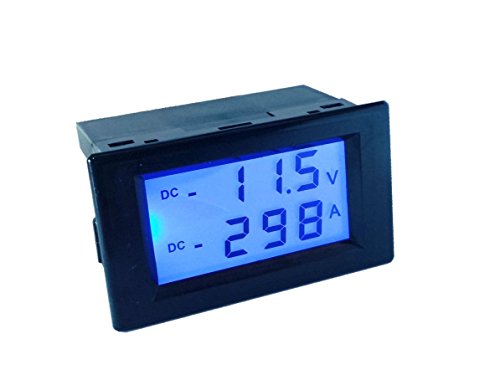
The AILI DC meter combines voltage and current measurements in a single compact unit with a dual display, capable of bidirectional current readings from -300A to +300A. It can be powered by the same source it measures, simplifying installation on limited panels or vehicles where space and wiring options are constrained. This makes it a practical option for solar micro-inverters, portable setups, or small solar installations that require clear, bidirectional current data for monitoring and troubleshooting.
The device is straightforward to install and use, with emphasis on real-time data visibility. It supports quick checks of power flow direction and magnitude, enabling quick decisions about system health and energy management in residential or light commercial scenarios.
EY1600W Solar Panel Tester MPPT Meter

The EY1600W meter provides auto and manual MPPT detection to optimize PV testing and monitoring. It measures PV panel maximum power point voltage and current, open-circuit voltage, and supports backlit display for use in varied lighting conditions. Protection features such as over-voltage, over-temperature, and reverse connection protection help ensure safety during testing of solar modules in field or manufacturing environments. This tool is particularly valuable for installers validating performance of solar arrays and for technicians conducting maintenance checks on larger systems.
It enables quick comparisons between actual panel performance and expected metrics, helping identify shading losses, degradation, or mismatches in series-connected modules. The device is suitable for technicians, researchers, and hobbyists focusing on PV performance verification and reliability testing.
Buying Guide: Key Considerations For Choosing A Bi-Directional Solar Meter
When selecting a bi-directional meter for solar, consider the following:
- Current and voltage ranges: Ensure the meter supports your system’s amperage and voltage (single-phase vs. three-phase) and any potential future expansion.
- Grid interaction capabilities: Look for features like net energy metering, export/import tracking, and compatible communication protocols (Modbus, WiFi, TCP/RTU) for integration with energy management platforms.
- Connectivity and automation: If you use Home Assistant or Node-RED, confirm that the device supports reliable integrations and data sharing with your preferred platforms.
- Installation form factor: DIN-rail mounting is common for simplicity and space efficiency inside electrical panels.
- Data granularity and reporting: Assess whether you need hourly, daily, or monthly reports, and whether the device provides export vs. production breakdowns.
- Safety and standards: For high-voltage or industrial-like environments, verify CAT ratings and safety certifications and ensure compliance with local electrical codes.
- Cost of ownership: Evaluate upfront cost, potential expansion needs (batteries, additional meters), and software/firmware update support.
Practical considerations include future-proofing for increased solar capacity, choosing between single-phase and three-phase meters based on your service, and ensuring reliable data access for billing or incentive calculations. For homeowners, ease of installation and app-based monitoring can reduce complexity. For pros, higher current ratings and robust Modbus support enable deeper system optimization.