Discover reliable triple output DC power supplies ideal for electronics testing, prototyping, and teaching environments. This guide compares top triple-output models from reputable brands, highlighting output configurations, precision, protections, and user features. Whether you need independent channels, series/parallel capabilities, or programmable control, these options cover a range of budgets and requirements.
| Product | Brand | Max Output | Notes |
|---|---|---|---|
| SPD3303X-E | Siglent | 32V/3.2A × 2; 2.5V/3.3V/5V/3.2A × 1 | Independent, Series, Parallel modes |
| MPS-3033X | MATRIX | 0-30V × 3A (per channel) | Independent 3 channels, programmable |
| MPS-3010H-3 | MATRIX | 0-30V × 10A (total) | High resolution, series/parallel mode |
| TP-3005D-3 | Tekpower | 0-30V × 5A | Triple outputs, constant voltage/current |
| TP3003D-3 | Tekpower | 0-30V × 3A | Triple outputs, thermo-sensor cooling |
Siglent SPD3303X-E Triple Output Power Supply
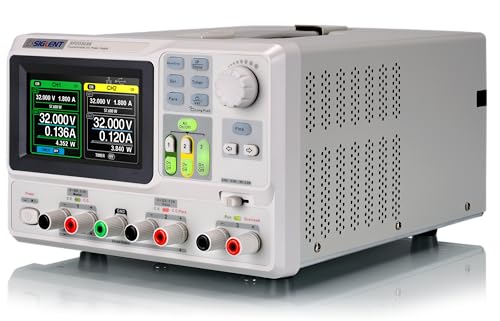
The SPD3303X-E provides three isolated outputs with independent control and protection. It features two 32V channels at 3.2A each and a third channel offering 2.5V/3.3V/5V at up to 3.2A. Output modes include Independent, Series, and Parallel, enabling flexible configurations for testing and prototyping. With a total power of 220W, this unit supports precise lab work while maintaining safety through robust protection features.
MATRIX MPS-3033X Triple Output Programmable Power Supply

The MATRIX MPS-3033X offers three independent channels with 0-30V and 0-3A per output, enabling precise, simultaneous readings. It supports low ripple and noise for clean DC delivery, and displays voltage and current for each channel. The device includes a user-friendly interface for fast adjustments and reliable performance across diverse lab tasks, including testing and calibration workflows.
MATRIX MPS-3010H-3 Triple Output Bench Power Supply
This triple-output supply emphasizes precision and stability, with a maximum of 30V and 10A total across channels. It features a 4-digit LED display and 10mV/1mA high resolution on voltage and current. The device supports Series and Parallel configurations with an intuitive interface, plus a Sense function for compensating voltage drops when distant from the load. It is designed for high accuracy in research, development, and educational settings.
Tekpower TP-3005D-3 Digital Variable Triple Outputs

The TP-3005D-3 provides triple outputs with 0-30V and up to 5A total, delivering persistent regulation in constant voltage and constant current modes. With automatic cooling via a built-in thermo-sensor, this Tekpower model maintains safe operation during extended lab sessions. It is suitable for classroom demonstrations, hobbyist projects, and professional prototyping that demands reliable voltage control across three channels.
Tekpower TP3003D-3 Digital Variable Triple Outputs

The TP3003D-3 delivers triple adjustable outputs (0-30V, 0-3A) with constant voltage and constant current modes. It includes an automatic cooling fan activated by a thermo-sensor to help prevent overheating during demanding tasks. Its compact design makes it suitable for compact lab benches, teaching laboratories, and small-scale prototyping work where reliable three-channel power is needed.
Buying Guide: Key Considerations For Triple Output DC Power Supplies
- Output configuration and independence: Look for truly independent channels or flexible series/parallel options to meet diverse testing needs. Independent channels simplify simultaneous testing of multiple circuits, while series/parallel modes enable higher voltages or currents.
- Voltage and current ranges: Ensure the supply covers the required voltage windows and current demands for your typical projects—whether it’s low-voltage electronics or higher-current prototyping.
- Resolution and stability: Higher resolution (mV/mA) and low ripple/noise improve measurement accuracy and reduce noise injection into sensitive devices. Consider models with digital readouts or LED/VFD displays for clear monitoring.
- Protection features: Overvoltage, overcurrent, overheating, and short-circuit protections protect both the device under test and the power supply. Look for automatic protections and user-settable limits.
- Control interface: Encoders, knobs, task-specific software, and remote sensing (SENSE) help achieve precise regulation and compensate for line drop. Evaluate ease of use for your workflow.
- Thermal management: Triple-output units can run hot under load. Fans and heatsinks, as well as automatic thermal shutdown protections, improve reliability in long sessions.
- Size, weight, and build quality: For desktop labs and teaching spaces, compact form factors with solid construction are preferable. Durability matters in frequent handling and demonstrations.
- Programmability and data logging: If you need repeatable tests or automated experiments, consider programmable models with data logging, remote-control interfaces, or software support.
- Cost versus capability: Compare features such as maximum current, isolation between channels, and Series/Parallel functionality against price to determine true value for your use case.