Choosing the right solar PV test equipment helps engineers, installers, and technicians verify panel performance, troubleshoot shading issues, and maximize energy harvest. This guide highlights five top options, covering max power ranges, open-circuit voltage, short-circuit current, and MPPT capabilities. Each product is evaluated on accuracy, safety, and practicality for field and lab use.
Summary of Selected Products
| Product | Key Capabilities | Best For |
|---|---|---|
| ZIBOO FT-1000W Solar Panel Tester MPPT Meter | Pmax up to 1000W, Voc 12-80V, Isc up to 35A, MPPT tracking | R&D, manufacturing, field maintenance |
| FrogBro 1800W Solar Panel Tester | 5-1800W, 20-120V, up to 60A, smart MPPT display | Residential and commercial PV testing |
| FrogBro Upgrade 800W Solar Panel Tester | Up to 800W, 20-60V, comprehensive MPPT data | Portable troubleshooting |
| ELEJOY 1800W Solar Panel Tester | 5-1800W, 20-120V, 60A, bright LCD/OLED options | Field diagnostics and data analysis |
| ELEJOY 800W Solar Panel Tester | 12-60V, 0-35A, portable with LCD display | 8-12V to 60V systems, quick checks |
ZIBOO FT-1000W Solar Panel Tester MPPT Meter

Professional-grade PV testing with a maximum power rating of 1000W, Voc from 12 to 80V, and Isc up to 35A. The device claims ±0.8% accuracy, suitable for validating panel performance in R&D, manufacturing, and field maintenance. Real-time MPPT tracking (Vmp 80V, Amp 35A) helps identify shading or degradation and optimize energy harvest. Safety features include CAT III 1000V and CAT IV 600V ratings with double-insulated probes, meeting IEC/EN 61010 standards for safe use on high-voltage PV arrays and combiner boxes.
Key specs and use cases:
- Accurate measurement of Pmax, Voc, and Isc to verify panel performance
- Real-time MPPT efficiency monitoring for up-to-date optimization
- Industrial safety and durability suitable for professional environments
FrogBro 1800W Solar Panel Tester

The FrogBro 1800W tester covers a broad power and voltage range, measuring 5 to 1800W and 20 to 120V with currents up to 60A. Its wide compatibility supports both residential and commercial PV systems, making it a versatile tool for on-site diagnostics and data analysis. A large display aids readability in bright outdoor conditions, helping technicians quickly interpret results and identify issues such as voltage drops or current limitations.
Highlights include:
- Broad measurement range for diverse PV configurations
- Real-time data display to support fast troubleshooting
- Portable design suitable for field use
FrogBro Upgrade Solar Panel Tester Meter 800W

This upgraded 800W model enables testing up to 800W with a voltage range that suits many residential PV arrays. It emphasizes a large LCD for readability and a single-display interface that presents essential values in one view. The product description notes a 12-month replacement service, underscoring support for field technicians who rely on dependable equipment. It is marketed for rapid MPPT-related diagnostics and open circuit voltage troubleshooting.
Key points:
- Compact, portable design with user-friendly display
- MPPT-focused measurements to guide optimal placement and operation
- Support and service terms aimed at ongoing field use
ELEJOY 1800W Solar Panel Tester
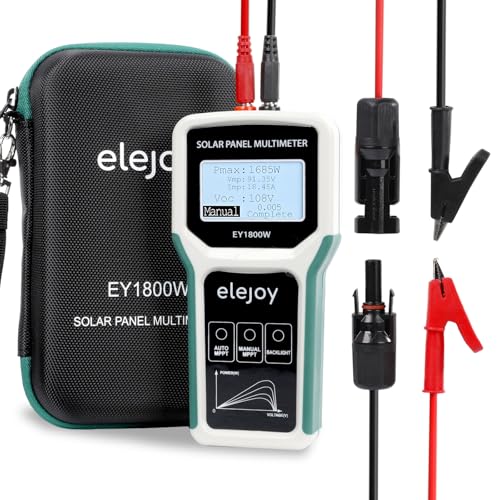
The ELEJOY 1800W tester provides measurements for up to 1800W, with a broad 20-120V range and up to 60A current. It emphasizes real-time MPPT data and a bright display for field use. This model is positioned for rapid field diagnostics and performance verification across larger PV arrays, including those found in commercial installations. It supports data collection and troubleshooting for panel performance, shading effects, and wiring integrity.
Notable aspects:
- Comprehensive MPPT and performance metrics
- High visibility display suitable for outdoor work
- Broad testing range for diverse system configurations
ELEJOY 800W Solar Panel Tester

The ELEJOY 800W tester targets 12-60V Voc and 0-35A Isc with a portable, battery-free design. It includes a backlit LCD display and is marketed for quick checks on common residential PV setups. By providing essential measurements at the point of testing, it helps installers verify that panels operate near their maximum power point and identify potential issues such as shading or wiring problems.
Key considerations:
- Battery-free operation simplifies field testing
- Compact and easy to transport
- LCD display for outdoor readability
Buying Guide: Key Purchase Considerations
- Measurement range and accuracy: Look for devices that cover Pmax, Voc, and Isc with stated accuracy. A wider range supports more panel configurations but ensure the device remains precise within your typical operating window.
- MPPT capabilities: Real-time MPPT tracking helps identify shading, panel degradation, and wiring issues. Confirm whether the tool provides Vmp and Imp readouts, and if it supports fast sampling rates for dynamic conditions.
- Voltage and current safety ratings: For high-voltage PV arrays, CAT III 1000V or CAT IV 600V ratings, insulation quality, and flame-retardant jackets increase safety during field testing.
- Display readability: Outdoor testing often requires backlit or high-contrast screens. OLED or bright LCD displays reduce misreadings in sunlight.
- Portability and durability: Field technicians benefit from rugged enclosures, comfortable grips, and lightweight designs. Some models include protective cases or EVA storage kits for easy transport.
- Accessories and compatibility: Check if cables, adapters, and probes match standard 4mm banana plug inputs. Some products offer compatibility with common multimeters or specialized test leads.
- Warranty and service: A clear replacement policy or extended warranty reduces downtime in busy installation schedules. Look for responsive customer support for field issues.
- Open data and interoperability: If data export or logging is important, verify whether the tester supports USB, Bluetooth, or SD storage and if data formats are accessible for later analysis.
- Cost vs. value: While higher-end models boast broader ranges and safety features, ensure the selected device matches your typical projects to maximize return on investment.
- Use case alignment: For small residential systems, 800W devices with straightforward MPPT readings may suffice. For larger commercial deployments, an 1800W unit with robust MPPT and wide voltage ranges might be more appropriate.