The following guide highlights top roof mount kits that help secure solar panels on pitched or flat roofs. Each option is evaluated for durability, adaptability, and ease of installation. Read on to compare kits that fit different panel counts and roof types, with practical notes for DIY projects.
Summary of selected products
| Product | Roof Type | Panel Count Fit | |
|---|---|---|---|
| Tandefio Solar Panel Mounting Kit | Shingle/roof | 8 panels (42″ wide) or 10 smaller panels | Versatile clamps and durable aluminum construction |
| Oungy Adjustable Solar Panel Tilt Mount | Flat surface roof | Various Wattage panels (tilt adjustable) | Adjustable tilt and long-arm design for flexible positioning |
| MCOOH Solar Panel Mounting Brackets | Tin/flat roofs | 4-piece kit per row, multiple rows possible | Secure rails with rubber pads and stainless hardware |
| BougeRV Cross Bar Mount | Vehicle roof racks with T-track | 100–200W panels | Specifically fits T-slot roof racks with padding |
| Renogy 28in Adjustable Mount Brackets | Flat surface (RV, roof, boat) | Adjustable for various setups | Foldable tilt legs and quick assembly |
Tandefio Solar Panel Mounting Kit

The Tandefio kit includes rails, clamps, L-shaped brackets, and mounting hardware designed to fit up to eight 42-inch-wide panels or ten smaller panels. It uses aluminum alloy for durability and weather resistance, aiming for long-term outdoor performance. The adjustable middle and end clamps expand compatibility with panel thicknesses between 30–45 mm, making it suitable for a variety of installations. Ground lugs and rubber gaskets help seal and secure a stable mount on shingle roofs.
Oungy Adjustable Solar Panel Tilt Mount

Oungy’s tilt mount is designed for flat-surface roofs and RV or off-grid applications. The bracket set comes largely assembled, with an adjustable arm that extends from approximately 14 to 27 inches. Tilts range from 15 to 30 degrees depending on panel size, enabling better sun exposure. Made from aluminum alloy, it emphasizes load-bearing strength, corrosion resistance, and wind endurance, while maintaining a lightweight profile for easier handling during DIY projects.
MCOOH Solar Panel Mounting Brackets
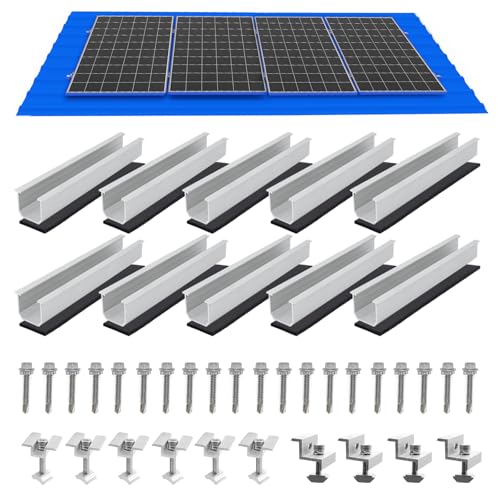
The MCOOH kit provides secure rails, clamps, and pre-drilled holes for straightforward DIY installation. It emphasizes waterproofing with EPDM rubber pads and corrosion-resistant stainless steel screws. The clamps are adjustable to accommodate panel thicknesses from 1.18 to 1.38 inches, while Z-end and T-middle clamps ensure a tight fit. The kit is positioned as a practical solution for off-grid solar systems, combining sturdy hardware with ease of assembly.
BougeRV Solar Panel Mounting Kit

BougeRV focuses on cross-bar mounting for vehicle roof racks with T-slot channels. It includes M6 T-bolts and interior rubber padding to protect the rack. The kit is designed for 100–200W panels and requires ensuring the panel spacing matches the T-slot length. This makes it a practical option for portable or mobile solar setups where roof space and mounting channels are the primary constraints.
Renogy 28in Adjustable Mount Brackets

Renogy offers adjustable mounting brackets with foldable tilt legs for flat surfaces, including RV roofs and boats. The system emphasizes quick assembly with stainless steel fasteners and precise hole spacing. Foldable tilt legs simplify setup and storage, making it suitable for temporary or semi-permanent off-grid installations where maneuverability matters and quick angle adjustments can enhance energy harvest.
Buying Guide
Key considerations when choosing a solar panel roof mount kit include roof type compatibility, panel dimensions, and wind load tolerance. For pitched or shingled roofs, look for clamps and rails with weatherproof gaskets and corrosion-resistant hardware. If space is limited, kits that support multiple panel thicknesses and offer adjustable tilt angles can maximize energy capture. For mobile uses, cross-bar mounting and T-track compatibility ensure secure fit with minimal roof modification. Assembly complexity, weight, and the availability of replacement parts are also important. Evaluate each option’s expandability to accommodate future panel upgrades or system scaling.
Additional factors to weigh include durability of aluminum alloys, resistance to rust and UV exposure, and the ease of integration with existing mounting holes or rails. Consider the climate and typical wind speeds in your area, as higher wind loads may require reinforced brackets and secure fasteners. Finally, verify that the kit includes all necessary hardware—bolts, nuts, gasket materials, and end clamps—and that replacement parts are readily obtainable from the seller or third-party suppliers.