Explore top solar panels and complete systems from ECO-WORTHY and Callsun designed to power homes, RVs, cabins, and off-grid adventures. This guide highlights five optimized kits and panels, focusing on efficiency, storage, and ease of installation. Each section links to the product’s Amazon page for quick reference and comparison.
| Product | Brand | Key Feature |
|---|---|---|
| ECO-WORTHY 200 Watts Solar Panel Kit | ECO-WORTHY | High-efficiency monocrystalline panel with 30A PWM controller |
| [Ultra] ECO-WORTHY 1200W Solar System | ECO-WORTHY | Complete off-grid system with 6x 195W panels and dual-axis tracker |
| ECO-WORTHY 10000W Complete Off-Grid Kit | ECO-WORTHY | High-capacity home/off-grid kit with 9840W solar panels and large storage |
| ECO-WORTHY 800W Off-Grid Kit For Travel Trailer | ECO-WORTHY | All-in-one RV-ready solar solution with monitoring |
| Callsun N-Type 400W 2-Pack Bifacial Panels | Callsun | Double-sided efficiency with anti-shade technology |
ECO-WORTHY 200 Watts Solar Panel Kit

The ECO-WORTHY 200W kit uses high-performance monocrystalline solar cells to deliver efficient energy in compact form. It supports everyday off-grid needs for RVs, campers, caravans, boats, and small builds with a 30A PWM charge controller. The panel’s aluminum frame is corrosion-resistant, and it’s designed to withstand strong wind and snow loads. An IP65-rated junction box protects internals, extending durability for outdoor installations. In practical use, daily output can approach 800Wh under four hours of peak sun, making it a strong starter kit for mobile lifestyles or backup power for small cabins.
Key considerations include ease of installation, compatibility with various 12V and 24V systems, and the balance between panel size and output. While not the largest system, its compact footprint makes it ideal for RVs and portable setups where space is at a premium. The included PWM controller is straightforward to configure, though some users may consider upgrading to a MPPT controller for higher efficiency in variable sunlight.
[Ultra] ECO-WORTHY 1200W Off-Grid Solar System
![[Ultra] ECO-WORTHY 1200W System](https://m.media-amazon.com/images/I/511dZ9S3EPL._SL500_.jpg)
This comprehensive off-grid kit is designed for larger energy demands. It includes six 195W solar panels, a 60A MPPT controller, and a dual 12.8V 280Ah lithium battery pack with a robust Battery Management System (BMS). The system features a 3000W pure sine wave inverter and claims daily generation around 5.52KWh under optimal sun. The dual-axis tracker option can boost efficiency by over 40%, making this a practical solution for RVs, cabins, or workshops needing more sustained power. The Li-ion storage benefits include deeper cycles and easier maintenance compared with lead-acid options.
Important considerations are energy storage capacity, real-world sun exposure, and maintenance of a larger system. The dual-axis tracking enhances output but adds mechanical complexity and potential maintenance. The integrated app-powered monitoring helps track performance, though setup may require careful wiring and safety checks for off-grid operation.
ECO-WORTHY 10000W Complete Off-Grid Kit For Home
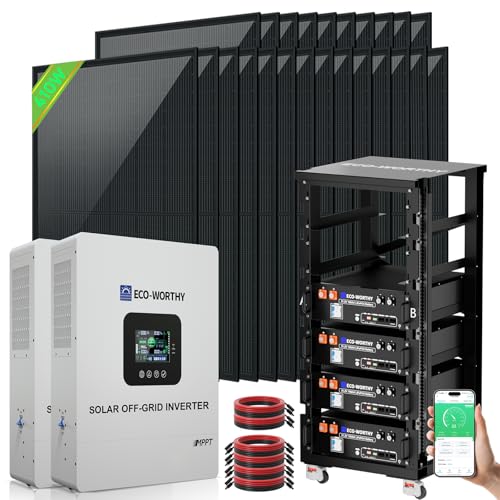
This high-capacity kit targets full-home off-grid performance. It combines a large solar array (9840W) with a pair of 5000W inverters, a 48V battery bank of four 100Ah LiFePO4 cells, and an MPPT-based control system. Real-world use cases include backup power for essential appliances, climate comfort, and home security during outages. The modular architecture supports expansion and remote monitoring via an app, enabling status checks and parameter adjustments from a smartphone. Safety certifications and robust battery management help protect equipment and inform ongoing maintenance needs.
Two main considerations are system scale and integration with existing electrical infrastructure. Installation demands professional planning for electrical safety and code compliance. While it offers substantial capacity, it is best suited for homes or cabins with predictable power needs and a willing investment in installation and safety monitoring.
ECO-WORTHY 800W Off-Grid Solar System For Travel Trailer

This 800W kit is a travel trailer-friendly solution designed for RV adventures. It includes four 195W bifacial panels, a 12.8V 280Ah lithium battery bank, a 60A MPPT controller, and a 2000W pure sine wave inverter. The setup promises a daily generation around 3.1 kWh with four hours of sun and stores up to 7.168 kWh of energy. An energy monitoring hub provides real-time visibility and control via a mobile interface, making it simpler to track consumption and adjust usage on the go. The configuration supports powering most RV appliances, including air conditioners and refrigerators, when sun is available.
Key considerations include portability, monitoring capabilities, and compatibility with RV electrical standards. The system leans toward ease of use and a balance of storage versus output, ideal for weekend trips or extended off-grid camping where maintenance access is straightforward.
Callsun N-Type 400W 2-Pack Bifacial Panels

Callsun’s N-Type 16BB bifacial 400W panels deliver higher efficiency and reduced shading impact through a dual-module, anti-shade design. The bifacial capability allows energy capture from the rear, boosting total output by up to 30% under ideal conditions. The twin-cell configuration provides a level of resilience; if part of the panel is shaded, the other half can continue producing power. These panels are well-suited for RVs, vans, boats, and rooftop off-grid arrays where space efficiency and reliability are important. The N-type cells offer lower degradation over time and improved performance in high-temperature environments.
Considerations include mounting options and compatibility with existing controllers. While bifacial panels can improve energy yield, performance gains depend on mounting position, sun angle, and backsheet exposure. For off-grid setups with limited panel area, these 400W units can maximize daily yield when paired with an efficient inverter and battery bank.
Buying Guide: Key Purchase Considerations For Solar Panels And Systems
- System scale and用途: Match kit size to daily energy needs. Small RV or cabin setups can begin with 200W–800W kits, while homes or large RVs may require multi-kilowatt systems with substantial storage.
- Panel technology: Monocrystalline cells offer higher efficiency and better performance in limited space; bifacial panels can increase output in favorable conditions but require specific mounting to maximize rear-side capture.
- Controller type: PWM controllers are simple and affordable but less efficient than MPPT controllers, especially in partially shaded conditions or higher voltage systems. MPPT controllers optimize conversion and can improve overall yield.
- Storage and inverters: Lithium battery banks provide deeper cycles and longer lifespans than lead-acid but cost more upfront. Inverters should match your AC loads (240V vs. 120V) and offer pure sine wave output for sensitive electronics.
- Durability and weather resistance: Look for corrosion-resistant frames, IP ratings, and structural robustness for outdoor installations in varying climates.
- Monitoring and remote access: Systems with app-based monitoring allow real-time status checks and control, aiding maintenance and optimization across off-grid periods.
- Install complexity and code compliance: Higher-capacity systems often require professional installation to meet electrical codes and safety standards. Budget considerations should include wiring, mounting hardware, and potential permits.
- Expandability: Consider modular kits that allow easy scaling by adding panels, storage, or inverters as power needs grow or seasons change.
These considerations help compare products across brands and configurations, ensuring selections meet energy goals, budget constraints, and practical installation needs. When evaluating options, prioritize real-world performance data, warranty terms, and vendor support to maximize long-term reliability and satisfaction.