Choosing a reliable solar energy storage system involves balancing capacity, safety standards, scalability, and ease of integration with existing solar setups. The following selected products provide a range of capacities, communication options, and form factors—from rack-mounted modules to portable power stations—designed for home backup and off-grid use. The list highlights devices with UL1973 and UL9540A safety certifications, built-in monitoring, and modular expansion to suit evolving energy needs.
Summary of selected products:
| Product | Brand | Capacity | Key Benefit | Typical Use |
|---|---|---|---|---|
| ECO-WORTHY 48V 600Ah Server Rack Battery | ECO-WORTHY | 48V 600Ah (approx. 30.72 kWh per 6-pack) | Rack-mountable, scalable, Bluetooth/WiFi monitoring | Home backup, small commercial |
| ECO-WORTHY 48V 100Ah LiFePO4 Battery | ECO-WORTHY | 51.2V 100Ah (≈5.12 kWh) | Space-saving rack design, expandability | Residential solar storage |
| OUPES Mega 1 Portable Power Station | OUPES | 1024Wh (expandable to 5120Wh) | Fast recharge, modular expansion, portable | Camping, home backup, off-grid |
| Oasesenergy 48V 300Ah Lithium Battery | Oasesenergy | ≈15.36 kWh | RS485 & CAN, easy installation | Off-grid, home energy |
| Oasesenergy 51.2V 300Ah Lithium Battery | Oasesenergy | ≈15 kWh | 200A BMS, app control, parallel up to 15 units | Residential off-grid, backup |
ECO-WORTHY 48V 600Ah Server Rack Battery Kit

Overview: This 48V server rack battery includes a 6-pack configuration offering substantial energy storage for home backup applications. It carries UL1973 and UL9540A certifications and has passed California Energy Commission (CEC) standards, underscoring reliability and safety.
Key features include closed-loop CAN/RS485 communication, enabling integration with leading solar inverters for smarter system operation. Built-in Bluetooth and WiFi facilitate monitoring via the ECO-WORTHY app. The space-saving rack design supports vertical mounting, with the ability to parallel up to 32 units, expanding capacity to as much as approximately 163.8 kWh.
Applications: Ideal for homeowners seeking scalable energy storage with smart monitoring. The pack’s safety certifications and thermal management focus address common concerns in larger residential solar installations.
ECO-WORTHY 48V 100Ah LiFePO4 Battery

Overview: This 48V 100Ah server rack battery offers compact capacity with the same robust communication options as the larger unit. It’s designed for space efficiency and easy expansion by paralleling multiple units, potentially reaching up to 163.8 kWh across a system.
Key features include closed-loop communication with CAN/RS485 interfaces, Bluetooth and WiFi monitoring via the ECO-WORTHY app, and a safety profile that aligns with UL1973, UL9540A, and CEC expectations. This makes it well-suited for smaller homes or modular setups that can scale over time.
OUPES Mega 1 Portable Power Station
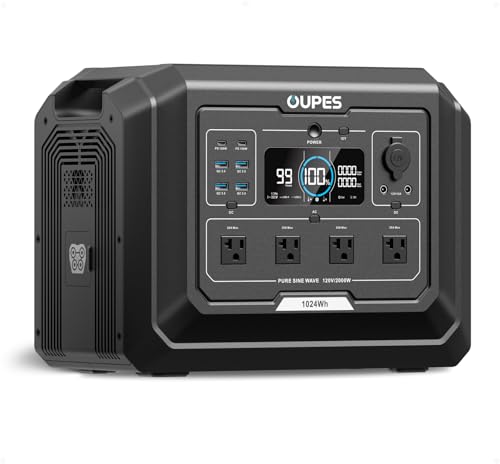
Overview: The OUPES Mega 1 is a portable solar generator with a 1024Wh base capacity, expandable up to 5,120Wh through modular B2 batteries. It delivers up to 2000W continuous output (4500W surge) with pure sine wave AC for safe operation of sensitive electronics and high-demand appliances.
Charging performance is highlighted by fast recharge capabilities, including rapid AC charging and solar input synergy. This unit is designed for mobile use—camping, road trips, and emergency home backup—while providing a straightforward path to larger capacity without complex wiring.
Oasesenergy 51.2V 300Ah Battery

Overview: This 51.2V, 300Ah LiFePO4 battery delivers about 15 kWh of storage and supports RS485 and CAN communications for broad inverter compatibility. The integrated BMS provides comprehensive protection, and the unit is designed for easy parallel expansion to build larger off-grid systems.
Key considerations include its mobility advantages, integrated monitoring, and the capacity to form a scalable 48V off-grid solution suitable for residential applications where simple expansion is desired.
DUMFUME 12V 600Ah LiFePO4 Battery

Overview: This 12V 600Ah LiFePO4 battery provides substantial capacity for 12V systems, featuring a robust 200A BMS and a long lifecycle. It is designed for RVs, off-grid scenarios, and backup storage, with a focus on deep cycling performance and safety protections, including low-temperature cut-off.
Consider this unit when building a custom 12V off-grid array or supplementing higher voltage systems with modular, high-capacity cells. The product is suitable for applications that require rugged, long-life 12V storage with strong protection features.
Buying Guide: Key Purchase Considerations for Solar Battery Storage
Capacity and voltage alignment: Match battery voltage (12V, 24V, 48V, or higher) to your inverter and solar array configuration. Higher voltage systems often reduce current and heat, enabling longer cable runs and better efficiency.
Safety certifications: Look for UL1973, UL9540A, and local safety certifications (e.g., CEC in California) to ensure reliable design, thermal management, and safe operation under real-world conditions. Certifications reflect testing for thermal runaway and electrical safety.
Communication and monitoring: Batteries with CAN/RS485, RS485, RS232, Bluetooth, or WiFi integration enable remote monitoring and smarter system control. Consider ecosystems that pair with inverters and solar optimizers you already own.
Expandability: If you anticipate expanding capacity, consider modular designs that allow paralleling multiple units. Rack-mount solutions and well-documented expansion limits help future-proof installations.
Physical footprint and installation: Rack-mount units save space but require proper ventilation and mounting space. Portable power stations offer mobility and simplicity but typically deliver lower total storage unless expanded with additional modules.
Cycle life and DoD: Look at cycle life and depth of discharge (DoD) ratings to estimate long-term performance and total cost of ownership. High-quality LiFePO4 chemistries generally offer longer lifespans and more cycles than lead-acid alternatives.
Cost of ownership: Beyond the upfront price, factor maintenance, monitoring needs, warranty terms, and potential savings from grid-tied backup. Scalable systems may deliver better long-term value for households planning expansion.
In summary, a well-chosen solar energy storage system should balance capacity, safety, and future growth. The products listed above provide varied options—from rugged rack-mounted modules to portable generators—so homeowners can align their choice with current needs and anticipated growth in solar adoption.