This guide highlights top all-in-one solar inverter chargers that combine MPPT charging with pure sine wave inverters. Each option supports battery-backed and battery-less configurations, enabling reliable off-grid or backup power for homes and RVs. We compare capacity, MPPT current, PV input range, and practical usage to help you choose systems that maximize solar energy while protecting delicate electronics.
Summary of Selected Products
| Product | Brand | Power (W) | MPPT (A) | Battery Type Support |
|---|---|---|---|---|
| SUMRY Solar Inverter Charger, 3600W | SRGFTS | 3600 | 120 | AGM, Lithium, Lead-Acid |
| SUMRY Hybrid Solar Inverter, 4000W | SRGFTS | 4000 | 140 | AGM, Lithium |
| SUNGOLDPOWER 10000W UL1741 Solar Inverter | SGPWATT | 10000 | 200 | Lead-Acid, Lithium |
| Aninerel 12000W Hybrid Solar Inverter | Aninerel | 12000 | 220 | Lithium, Lead-Acid |
| VEVOR Hybrid Solar Inverter, 3500W | VEVOR | 3500 | 100 | Lead-Acid, Lithium |
SUMRY Inverter Charger, 3600W Hybrid Power

The SUMRY 3600W Inverter Charger combines a pure sine wave inverter with an integrated MPPT solar charge controller and AC battery charger. It supports 60V-500V DC PV input (up to 4200W) and 110V/120V AC output. The unit is designed to work with a variety of 24V battery chemistries, including AGM, Gel, Lead-Acid, Lithium-ion, and LiFePO4. It can operate with or without a separate battery, allowing PV power to run loads directly when PV input exceeds 120V. This flexibility suits off-grid homes and backup systems where battery availability varies.
Key considerations: ensure your PV array provides adequate voltage and current for the MPPT, and verify that loads do not exceed 3600W continuous rating. Note that some configurations may require precise battery management to maximize performance and battery life.
SUMRY Hybrid Solar Inverter, 4000W

This SUMRY 4000W unit emphasizes a glass-top design with a large LCD display and touch controls. It delivers 4000W continuous output with up to 8000W peak, and a built-in 140A MPPT charge controller (PV input up to 350VDC, max PV power about 5600W). Pure sine wave output protects sensitive appliances and electronics. It’s suitable for battery-less operation or with AGM/Lithium batteries, offering several charging modes to align solar and grid usage with user needs.
Considerations include ensuring the PV array and batteries are matched to the 140A MPPT controller and verifying that device loads stay within the 4000W rating for reliable operation during surges.
SUNGOLDPOWER 10000W UL1741, Dual MPPT

The SUNGOLDPOWER 10KW inverters provide robust power with built-in dual MPPT solar controllers and up to 200A battery charging. It supports 120V/240V split-phase or 120V single-phase output, with WiFi for remote monitoring. This model features a wide PV input range (up to 500VDC) and a high peak capacity of 20,000W for short bursts. Four charging modes cover Hybrid Charging, Utility Priority, Solar Priority, and Solar-Only configurations. Parallel operation is supported to scale power, making it suitable for larger off-grid installations or backup systems requiring resilience and remote management.
Important considerations include ensuring proper enclosure cooling, accurate monitoring via the WiFi app, and planning for parallel units to achieve desired total output and surge capacity.
Aninerel 12000W Hybrid Solar Inverter

The Aninerel 12kW hybrid inverter provides 48V DC to 120V/240V AC output, delivering 12,000W continuous and 24,000W peak, with 2 MPPT solar charging controllers and parallel capability for up to six units. The system supports up to 500V PV input and up to 220A charging current, making it suitable for larger off-grid installations. It can operate in single-phase 120V or split-phase 240V configurations and offers expanded versatility for home, RV, or cabin solar setups.
Key planning notes: verify the electrical design for parallel operation, ensure adequate ventilation for high-power operation, and confirm battery compatibility with high charging currents to maximize performance.
VEVOR Hybrid Solar Inverter, 3500W
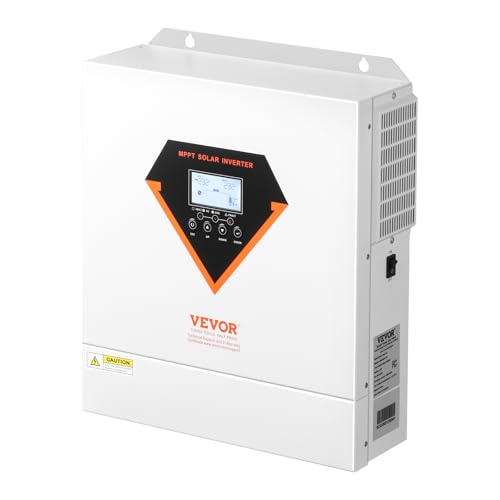
The VEVOR 3500W hybrid inverter combines a 3500W pure sine wave inverter with a built-in 100A MPPT solar charger. It supports a wide DC input (60V–500V) and accommodates lead-acid and lithium battery types. Designed for off-grid solar systems, it aims to deliver reliable power while maintaining efficiency through MPPT charging. This model is suitable for smaller off-grid cabins or backup systems where space and cost are constraints.
Practical considerations include ensuring the 100A MPPT charger aligns with your PV array’s voltage and current, and recognizing that the 3500W continuous rating should match the expected load profile for stable operation.
Buying Guide: Key Purchase Considerations
When selecting a solar charge controller and inverter combo, consider these dimensions to ensure the system meets your needs without overpaying for unused capacity.
- System size and load profile: Start with total continuous wattage needs and add a safety margin for surge loads (appliances with high startup draws).
- PV input and MPPT capabilities: Check open-circuit voltage (Voc) and actual MPPT voltage range to ensure compatibility with your solar array, especially for high-voltage configurations with multiple panels in series.
- Battery compatibility: Confirm support for your battery chemistry (AGM, Gel, Lead-Acid, Lithium, LiFePO4) and whether the unit works battery-less or requires a battery bank.
- Output configuration: Decide between single-phase 120V or split-phase 240V outputs, and whether you need parallel units for higher total power or redundancy.
- Monitoring and control: WiFi or app-based monitoring helps track performance, but evaluate reliability, user interface, and data granularity for maintenance planning.
- Efficiency and heat management: Higher efficiency reduces heat buildup; ensure adequate ventilation and consider derating in hot environments.
- Physical footprint and installation: Some units feature glass tops or larger enclosures; plan space, mounting, and wiring safely following local electrical codes.
- Warranty and support: Check manufacturer warranties and availability of replacement parts or service in your region.