Propane dual fuel generators combine flexibility with cleaner-burning fuel and the convenience of propane availability. This article highlights five top options, compares their dual-fuel performance, and explains what to consider when choosing the right unit for home, RV, or emergency backup use. All models listed support propane and gasoline, with features designed to protect electronics and simplify operation.
| Product | Fuel Options | Gasoline Power (Surge / Running) | Propane Power (Surge / Running) | Notable Feature |
|---|---|---|---|---|
| WEN DF360iX | Gasoline / Propane | 3600 / 2900 W | 3500 / 2600 W | Quiet, CO watchdog, clean power |
| WEN DF5600X | Gasoline / Propane | 5600 / 4500 W | 5000 / 4050 W | Electric start, CO watchdog |
| Westinghouse 4650 Peak Watt | Gasoline / Propane | 4650 (gas) / 3600+ (propane) | 4650 (propane) / 3240 | Multiple outlets, long run time |
| Westinghouse 4000 Peak Watt Inverter | Gasoline / Propane | 4000 / ~3300 | 3300 / ~3000 | Remote start, low THD |
| Champion 2500-Watt Dual Fuel | Gasoline / Propane | 2500 / ~1850 | 1665 / ~1665 | Quiet, CO Shield |
Below are detailed sections for each model, focusing on performance, ease of use, and safety features to help make an informed choice.
WEN DF360iX Dual Fuel Inverter Generator

The WEN DF360iX offers a dual-fuel design with gasoline and propane operation. It delivers 3600 surge watts and 2900 running watts on gasoline, and 3500 surge watts and 2600 running watts on propane. The unit is designed for quiet operation and produces clean power suitable for smartphones, tablets, and laptops. A CO watchdog adds a safety layer by monitoring carbon monoxide levels and shutting down if needed. This model is compact and RV-ready, making it a versatile choice for on-the-go use.
WEN DF5600X Dual Fuel Portable Generator

The WEN DF5600X doubles the capacity with dual-fuel capability, delivering 5600 surge watts and 4500 running watts on gasoline, and 5000 surge watts and 4050 running watts on propane. It features electric start for quick power at the push of a button and includes the CO watchdog sensor to automatically shut off the engine if dangerous CO levels are detected. This model is suited for larger RVs or home backup needs where extended runtime is essential.
Westinghouse 4650 Peak Watt Dual Fuel Generator
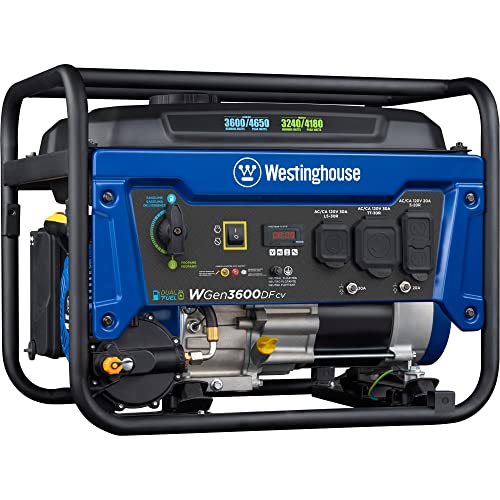
This Westinghouse model provides 4650 peak watts on gasoline and 4650 peak watts on propane, with 3600 gasoline running watts and about 3240 propane running watts. It includes a 4-gallon fuel tank with a fuel gauge and run times up to 14 hours per tank. The setup includes multiple outlets (including an RV-ready TT-30R) and a robust safety package with rubber outlet covers to reduce exposure to the elements. It’s designed for extended use in home or RV contexts and includes essential accessories for immediate operation.
Westinghouse 4000 Peak Watt Inverter Dual Fuel

The Westinghouse inverter generator delivers 4000 peak watts and 3300 running watts at less than 3% total harmonic distortion (THD). It runs on gasoline or propane and is RV-ready, with several outlets including a TT-30R 30A RV outlet and a 5–20R 120V duplex. A remote start with a key fob provides convenient operation, and a digital display shows fuel level, runtime, voltage, and hours, aiding in planning and maintenance. This model emphasizes portability and smart monitoring for travel or emergencies.
Champion Power Equipment 2500-Watt Dual Fuel

The Champion 2500-watt inverter is designed for quiet operation at 53 dBA from 23 feet, using dual-fuel capability for gasoline or propane. It provides 2500 starting watts and 1850 running watts on gasoline, with about 11.5 hours of run time on gasoline and up to 25 hours on propane. An optional, sold-separately parallel kit lets you connect with another Champion inverter for extra power and runtime. It also features CO Shield for automatic shutoff when CO is detected, contributing to safe use in enclosed spaces or camping scenarios.
Buying Guide: Key Considerations For Propane Dual Fuel Generators
Power needs: Determine your essential wattage requirements for lights, appliances, and electronics. If you plan to run air conditioners or multiple high-demand devices, choose a higher surge and running wattage. Dual fuel units offer flexibility when gasoline isn’t readily available, especially during outages.
Run time and fuel capacity: Compare tank size and rated run times at a typical load. Larger tanks and efficient engines translate to longer runtimes, which is critical for home backup or long camping trips. Consider how often you’ll refuel and how quickly you can access propane in your area.
Outlets and safety features: Look for a mix of outlets (5–20R, TT-30R for RVs, USB ports) and protections like CO shutoff, low-oil shutdown, and automatic shutdown features. A digital monitor or display helps you track runtime, voltage, and fuel levels for smoother planning.
Noise and portability: Inverter generators tend to run quieter and deliver cleaner power, which is essential for electronics. If you need mobility, weigh weight, wheel kits, and handle design. For RV users, trailing and storage dimensions matter as well.
Fuel compatibility and availability: Propane is widely available and burns cleaner, but you’ll want to assess your access and preferred fueling method. Gasoline remains common, but it can be less stable over time without additives. A dual-fuel system reduces reliance on a single fuel source.
Warranty, support and maintenance: Review warranty length, coverage for dual-fuel components, and availability of replacement parts. Regular maintenance, such as oil changes and air filter checks, extends life and reliability of the generator.
Usage environment: Consider climate and storage. Outdoor exposure, dust, and humidity can affect performance. Look for units with protective housings and splash-resistant outlets to handle varied conditions.