Low voltage lighting systems rely on reliable relays to switch lights, sensors, and controls without sacrificing safety or efficiency. This guide highlights five top relays and power packs that suit residential and light commercial applications, from legacy Touch-Plate replacements to modern sensor-ready packs. Each pick is evaluated for performance, compatibility, and ease of integration with existing low-voltage circuits. Use this overview to compare options and select a relay that matches your system’s voltage, current, and control needs.
Summary of selected products
| Product | Brand | Key Use | Voltage / Current |
|---|---|---|---|
| TOUCH-PLATE 3000-Relay | TOUCH-PLATE | Replacement relay for Touch-Plate systems | 120/277VAC, 20A |
| Lithonia Lighting PP20 Power Pack | Lithonia Lighting | Central power pack for sensor networks | 120/240/277V to 15VDC, up to 14 sensors |
| ENERLITES MPP-24 Power Pack | ENERLITES | Self-contained power supply for low voltage sensors | 120–277VAC to 24VDC |
| IS Digital Low Voltage Protector | IS | Battery/solar energy systems protection switch | 12–36V, various discharge controls |
| OONO DPST 1NO 1NC 8A Relay Module | OONO | Compact 24V control relay for AC/DC loads | 8A @ 250VAC / 30VDC |
TOUCH-PLATE 3000-Relay, 20-AMP Relay

The TOUCH-PLATE 3000-Relay serves as a direct replacement for legacy Touch-Plate systems manufactured between 1946 and 1985. It is designed to be compatible with multiple Touch-Plate models including 1550-A, 1550-B, 2500-B, and 4000. With a voltage rating of 120/277VAC and a 20A capacity, this relay supports typical residential lighting loads and small commercial fixtures. Its straightforward two-wire configuration streamlines retrofits without requiring extensive rewiring. This unit is suitable for users upgrading older low-voltage controls who need reliable, familiar compatibility.
Key features: 120/277VAC, 20A, 1.0HP at 125VAC, 1.5HP at 250VAC; compatible replacement for multiple Touch-Plate models; simple two-wire installation.
Lithonia Lighting PP20 Power Pack for Low Voltage Sensor System
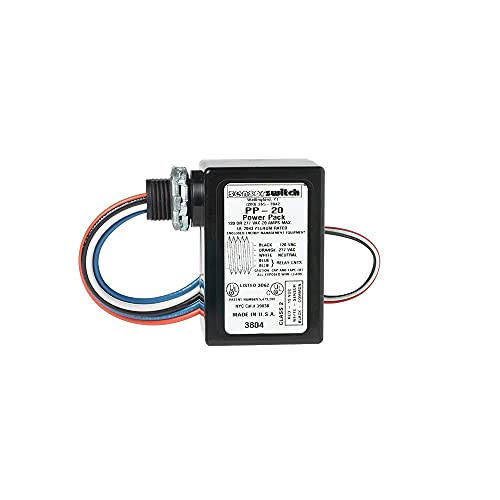
The Lithonia PP20 power pack is a central hub for low voltage occupancy sensor networks. It converts 120, 240, or 277 volts to Class II 15 VDC to power remote sensors and supports up to 14 compatible sensors. The device includes a self-contained relay to control the lighting load and uses a durable plenum-rated housing for long-term installation reliability. It features patented relay circuit protection that is rated for extensive cycling, ensuring dependable operation in sensor-activated lighting schemes.
Key features: dual voltage transformer, 15 VDC output, supports up to 14 sensors, durable, high-cycle relay protection, self-contained relay for efficient control.
ENERLITES MPP-24 Ceiling Sensor Power Pack

ENERLITES MPP-24 is a self-contained power supply and relay system designed for low voltage ceiling sensors and related devices. It converts line voltage (120–277V AC) to 24V DC to power remote ceiling sensors and allows connection of up to six low voltage sensors. The unit emphasizes ease of installation, indicator visibility via an LED, and compatibility with Enerlites’ sensor lineup. It’s suitable for modern sensor-based lighting control in residential hallways, offices, and small commercial spaces.
Key features: 120–277V AC input, 24V DC output, up to 6 sensors, built-in LED indicator, compact and self-contained.
Digital Low Voltage Protector Disconnect Switch

This IS device is a digital protection switch intended for voltage-controlled systems that discharge lead-acid or similar batteries. It acts as a relay-based disconnect that can be configured to automatically stop output when a preset voltage is reached, helping prevent over-discharge. It includes a memory function to preserve settings after power loss, which is valuable for critical lighting or energy storage setups that require consistent configurations after outages.
Key features: adjustable over-discharge protection, configurable parameters, memory protection on power loss, relay-based switching, suitable for solar and battery-backed lighting systems.
Qnbes 2Pcs 3D0951253A Relay for VW Group

These relays are designed for automotive use but exhibit features relevant to low-voltage control of high-current circuits in harsh environments. The design prioritizes fast response to low-voltage triggers, safety for 12V DC environments, and a robust, sealed construction to resist dust and moisture. While primarily marketed for automotive applications, their fast response and durable build can be advantageous for custom low voltage lighting setups requiring quick switching and reliable performance in varying conditions.
Key features: 12V DC operation, high-current capability via low-voltage trigger, rugged construction, fast response, sealed design for harsh environments.
OONO DPST 1NO 1NC 8Amp Power Relay Module

The OONO DPST 1NO 1NC relay module provides a compact 8A relay with DPST configuration, operable from 24V DC control signals. It supports AC loads up to 250VAC or DC loads up to 30VDC. Its small form factor and ready-to-mount design make it a versatile choice for integrating low-voltage controls with AC lighting loads, alarms, or sensor networks. LED indication helps users verify relay action at a glance.
Key features: 8A rating, 24V control, DPST configuration, LED indicator, easy mounting.
AEDIKO 4pcs DC 12V Relay Module, Optocoupler Isolation

This AEDIKO 4-piece DC 12V relay module emphasizes optocoupler isolation for robust isolation between control signals and relay outputs. It features normally open and normally closed contacts, allowing flexible wiring for sensing and lighting control. The modules are designed for straightforward integration with microcontrollers and other low-voltage control systems, providing reliable switching for small to moderate lighting loads while protecting control circuitry from relay-switch currents.
Key features: 12V DC, 1-channel module per piece, optocoupler isolation, normally open/closed contacts, compact and compatible with standard wiring.
OONO DPST 1NO 1NC 8Amp Power Relay Module (AC/DC 12V)
This OONO variant provides a 12V control voltage with DPST 1NO 1NC switching. It is suitable for controlling moderate loads in low-voltage lighting systems or sensor networks. The compact design, similar to other OONO modules, makes it easy to install in small enclosures or tight spaces where space is at a premium. LED indication assists in quick status checks during installation and troubleshooting.
Key features: 8A rating, 12V control, DPST configuration, compact enclosure, LED status indicator.
Buying Guide: Key Considerations For Low Voltage Lighting Relays
When selecting a relay or power pack for low voltage lighting, consider load type (inductive vs. resistive), circuit voltage, and desired control method. Here are important factors to compare:
- Voltage and current ratings: Match the relay’s coil voltage to your control signal (e.g., 12V or 24V) and ensure the contact rating covers your lighting load or sensor network current.
- Integration with existing systems: For legacy Touch-Plate installations, replacement relays should be compatible with the original model families to avoid rewiring.
- Power pack vs. standalone relay: Sensor networks often benefit from a central power pack that provides stable low-voltage supply to multiple sensors, while standalone relays are suitable for switching individual loads.
- Isolation and protection: Optocoupler isolation and protective features reduce risk to control electronics and improve reliability in environments with moisture, dust, or electrical noise.
- Durability and cycling: Look for high-cycle ratings and durable housings (plenum-rated when installed in air spaces) for long-term service in residential or light commercial settings.
- Ease of installation: Labeling, LED indicators, and compact form factors simplify setup and troubleshooting, especially in retrofits or DIY projects.
- Compatibility with sensors: If you plan to run an occupancy or motion-sensor network, ensure the power pack can supply sufficient current to all sensors and provide stable output for reliable sensing.
Selecting the right component depends on whether you need to retrofit an old system, expand a sensor-based installation, or simply replace a failed relay with a like-for-like unit. For retrofits, prioritize compatibility with the existing model family; for new installations, prioritize a centralized power pack with multi-sensor support to minimize wiring complexity and maximize system reliability.