This guide highlights top LiFePO4 server rack batteries ideal for solar storage and home backup. Each pick emphasizes space efficiency, monitoring features, safety certifications, and long lifecycle performance to support reliable off-grid and grid-tied setups. The selections combine strong BMS protection, communication interfaces, and rack-friendly designs suitable for modern server cabinets and closets. Use the buying tips below to compare capacity, expandability, and integration with inverters and solar systems.
Summary of chosen products
| Product | Capacity | Key Features | Improvement Focus |
|---|---|---|---|
| ECO-WORTHY 48V 100Ah | 5.12 kWh | CAN/RS485, Bluetooth/WiFi, UL/CEC listed | Expandability with up to 32 units |
| VATRER POWER 48V 100Ah | 5.12 kWh | Touch display, APP monitoring, 100A BMS | User-friendly monitoring |
| MFUZOP 48V 100Ah | 5.12 kWh | 3U rack, RS485/CAN, 15,000 cycles | Lifespan and compact form |
| HumsiENK 48V 100Ah | 5.12 kWh | BYD cells, 100A BMS, active balancing | High cycle life and safety |
| CYCCLEVOLT 48V 100Ah | 5.12 kWh | WiFi/Bluetooth, real-time app, dual terminals | Integrated monitoring |
ECO-Worthy 48V 100Ah LiFePO4 Battery

The ECO-WORTHY 48V 100Ah LiFePO4 server rack battery is designed for space efficiency and smart integration. It features a closed-loop CAN/RS485 interface and multiple communications protocols, enabling use with leading solar inverters. Built-in Bluetooth and WiFi allow monitoring via the ECO-WORTHY app. The unit supports vertical mounting in server racks and can be paralleled with up to 32 units, expanding capacity to meet higher storage needs. It is UL1973, UL9540A, and CEC listed, reflecting strong safety and performance credentials.
Key considerations: The combination of integration options and mobile monitoring helps optimize system operation. The safety certifications provide confidence for home storage and backup applications. As with other 48V packs, plan for proper cooling and rack spacing to minimize thermal buildup in long runtimes. Potential users should evaluate inverter compatibility and communication protocol support for seamless data exchange.
VATRER POWER 48V 100Ah LiFePO4 Battery

The VATRER POWER 48V 100Ah LiFePO4 battery emphasizes user-friendly monitoring with a touch display and a mobile app. The battery delivers robust power (51.2V nominal) and supports easy integration with solar systems for off-grid or backup applications. It features a built-in 100A BMS for protections against overcharge, over-discharge, and short-circuit events. The compact 5.12 kWh unit aligns with standard 3U rack footprints, making it suitable for home or small-scale commercial installations.
Buying tips: The single-unit form factors simplify initial deployment, while the app and display enable quick checks of SOC and health. When expanding, verify inverter support for RS485/CAN communications and ensure that parallel stacking remains within the designed limit for safe operation. Temperature and ventilation in a rack cabinet remain important to maintain performance and longevity.
MFUZOP 48V 100Ah LiFePO4 Battery
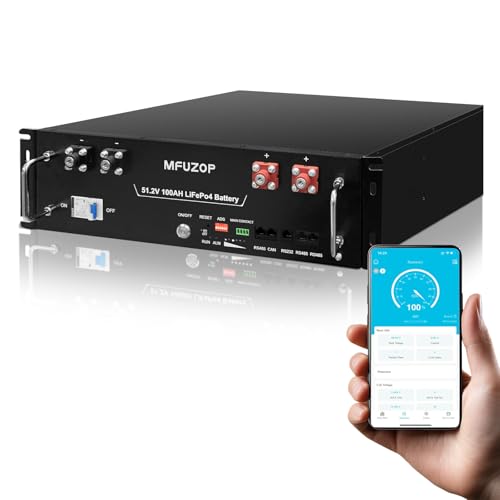
MFUZOP offers a compact 3U rack-ready LiFePO4 battery with 5.12 kWh usable capacity. It ships with a 100A BMS and supports RS485 and CAN communication, enabling integration with common solar inverters and energy systems for real-time data sharing. The pack emphasizes long cycle life and stable performance, making it a strong candidate for long-term home energy storage and backup power. The standard rack footprint helps fit paired installations in closets or telecom enclosures.
Considerations: Evaluate the 3U form factor against your cabinet dimensions and ensure adequate airflow for cooling. The BMS protections and protocol support are critical for maintaining consistent performance with inverters. If remote monitoring is important, confirm app compatibility and update processes for firmware and communication modules.
HumsiENK 48V 100Ah LiFePO4 Battery

The HumsiENK 48V 100Ah LiFePO4 server rack battery highlights BYD cells and a robust 100A BMS, with 5120Wh of energy and 5120W of output. Active balancing improves efficiency and lifetime, while the dual safety features (automatic isolation and an air switch) enhance protection during overload or fault conditions. It supports automatic addressing for multiple parallel connections, enabling scalable storage for larger setups like home backup or off-grid systems.
Best-use scenarios: This battery suits users prioritizing high cycle life and safety in a metal cabinet environment. Verify that the rack cabinet allows for sufficient heat dissipation and that the parallel connection plan aligns with inverter and BMS capabilities. The BYD cell composition offers strong performance characteristics across temperature ranges, critical for reliability during peak solar production or outages.
CYCCLEVOLT 48V 100Ah LiFePO4 Battery
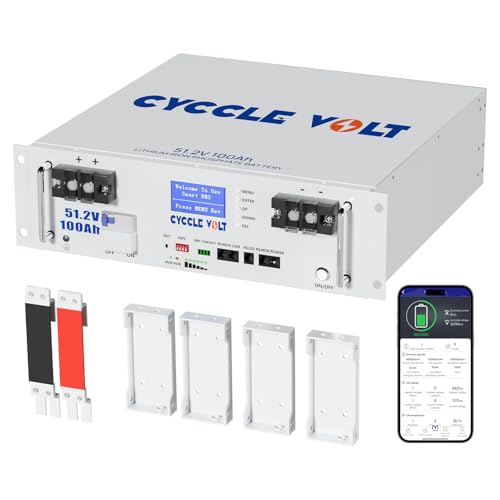
CYCCLEVOLT provides a 3U rack-ready LiFePO4 battery with a built-in touch-screen display and app-based monitoring enabled via WiFi/Bluetooth. The battery uses a 100A BMS with RS485 and CAN interfaces, enabling seamless integration with popular 48V inverters. Its dual-terminal design helps with current sharing and cooling, while the compact dimensions support straightforward cabinet installation. The product emphasizes real-time monitoring and easy on/off control for protection against overloads.
Considerations: Ensure your rack and cooling design can handle continuous operation at 5.12 kWh. The online monitoring features are helpful for proactive maintenance, so confirm compatibility with your chosen inverter model and ensure your network supports the required app ecosystem for remote checks.
Buying Guide: Key purchase considerations
- Capacity and scalability: Start with the required usable energy (kWh) for your backup duration, then plan for parallel expansion. Many 5.12 kWh packs can be paralleled up to 16–32 units depending on the model.
- Voltage and form factor: Most racks use 48V LiFePO4 systems with 3U or 4U heights. Confirm cabinet dimensions and ensure vertical mounting or stacking brackets are included or available.
- Battery management and protections: A strong BMS (100A or higher) with overcharge, over-discharge, short-circuit, and thermal protections is essential. Active balancing and cell quality (e.g., BYD cells) can influence cycle life.
- Communication and monitoring: Look for CAN/RS485 interfaces, RS485/CAN compatibility, and app-based monitoring. Real-time SOC, voltage, and current readouts improve system reliability.
- Safety certifications: UL1973, UL9540A, and local safety listings (such as CEC) indicate adherence to safety and performance standards essential for home use.
- Inverter compatibility: Ensure inverters support 48V lithium configurations and the available communication protocols. Check for firmware updates and recommended wiring for parallel banks.
- Thermal management: Server rack environments can trap heat. Verify ventilation plans or built-in thermal protection to avoid degradation and reduce fire risk.
- Installation and serviceability: Look for user-friendly installation, accessible terminals, and clear labeling. Consider warranties and ease of battery replacement if needed.
- Cost-per-kWh and lifecycle: Compare total cost of ownership by considering cycle life (e.g., 6,000–15,000 cycles) and the expected number of years of operation in typical home environments.
These considerations help ensure a balanced choice among capacity, safety, monitoring features, and physical fit for a home solar storage setup. While the products above share core advantages—rack-ready form factors, LiFePO4 chemistry, and robust BMS—match to your system’s inverter, solar array, and cabinet constraints to maximize reliability and efficiency.