Power outages can disrupt daily life, from crowded kitchens to essential medical devices. This guide examines top backup generators by fuel type, power output, and key features to help American homeowners choose a dependable unit. Whether you need whole-house style resilience or portable peace of mind for weekend outages, the products below highlight strong performance, ease of use, and safety considerations for modern homes.
Summary of Selected Products
| Product | Brand | Output (Gas/Propane) | Key Feature Highlights |
|---|---|---|---|
| Westinghouse 12500 Watt Dual Fuel | Westinghouse Store | Gas: 9500 Running / 12500 Peak; Propane: 8500 Running / 11200 Peak | |
| Westinghouse 14500 Peak Watt Tri-Fuel | Westinghouse Store | Gas: 11,500 Running / 14,500 Peak; Propane/Natural Gas variants | |
| Power Equipment 4400 Watts Inverter | Oxseryn Store | Gas: 3400 Running / 4400 Peak | |
| PowerSmart 4800-Watt Portable Inverter | PowerSmart Store | 4-Stroke, 4800 Starting / 3600 Running | |
| 4400-Watts Inverter Generator, Open Frame | Oxseryn Store | 3400 Running / 4400 Peak, RV/eco modes |
Westinghouse 12500 Watt Dual Fuel Backup Power

The Westinghouse 12500 Watt dual fuel generator offers flexible fuel options with robust power output for home backup. It delivers 9500 running watts on gasoline and 8500 running watts on propane, with peak capacities up to 12500 and 11200 respectively. The unit features remote start via included key fob, electric and recoil starting, and a long-lasting 457cc engine. A 6.6-gallon tank provides extended runtimes with a fuel gauge for real-time monitoring. The list of outlets includes two GFCI 120V 5-20R receptacles, a transfer switch-ready 120V L14-30R, and an RV-ready 120/240V 14-50R, all with rubber outlet covers for safety.
Key considerations include the heat and noise profile typical of large portable units, the need for a compatible transfer switch, and ensuring space for safe ventilation. Its VFT display shows real-time voltage, frequency, and lifetime hours, enabling proactive maintenance. This model is suited for mid-to-large homes seeking versatile fuel options during outages.
Westinghouse 14500 Peak Watt Tri-Fuel Generator

This tri-fuel backup generator supports gas, propane, and natural gas, making it a versatile option for larger homes or frequent outages. It delivers up to 11,500 running watts and 14,500 peak watts on gasoline, with proportional performance on propane and natural gas. A heavy-duty 550cc Westinghouse OHV engine with a cast-iron sleeve underpins reliability for long runtimes, and a built-in fuel gauge helps monitor usage. The design emphasizes endurance, with up to 19 hours of operation on a full nine-and-a-half gallon tank and substantial propane endurance.
Critical factors include the availability of natural gas connections in your area, storage considerations for a larger portable unit, and the noise profile during extended outages. The model is well-suited for homes that require significant power for HVAC, sump pumps, and multiple appliances during emergencies.
Power Equipment 4400 Watts Inverter Generator

This portable inverter generator combines strong output with quiet operation, featuring 4400 peak watts and 3400 running watts. It includes multiple outlets (two 120V ports, a 120V/240V RV option), plus an RV-ready connection. The unit is designed for extended use with an efficient 2-gallon tank and ECO mode to maximize fuel efficiency. It is well-suited for home backup and mobile power needs where noise and fuel economy are priorities, such as outdoor activities or emergency situations.
PowerSmart 4800-Watt Portable Inverter Generator

The PowerSmart 4800-watt portable inverter combines a 223cc OHV engine with inverter technology to deliver clean power with less than 3% total harmonic distortion. It weighs about 72 pounds with a wheel-handle kit for easier transport and storage. Quiet operation is emphasized at 58 dBA at quarter load from 23 feet, making it suitable for residential use, camping, and RVs. It runs on a robust gasoline engine and provides reliable power for essential appliances during outages or outdoor activities.
4400-Watts Inverter Generator, Open Frame
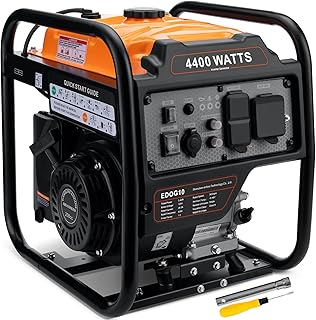
This open-frame inverter generator delivers 3400 running watts with a 4400 peak output, offering essential portability for home backup and RV use. It includes two 120V AC ports, a 30A RV port, and a 12V DC port, providing versatile connections for appliances and devices during outages. With ECO mode and EPA-compliant features, this model focuses on efficient fuel use and compliant operation. It is a practical option for lightweight, portable power solutions where moderate power is sufficient.
Buying Guide: Key Considerations For Selecting A Home Power Backup Generator
- Power needs and fuel type: Assess your essential loads (HVAC, sump pump, refrigeration, lighting) and choose a generator that comfortably covers peak and running watts. Dual-fuel models offer flexibility during fuel shortages, while natural gas compatibility can simplify long-term use if your home has a gas line.
- Transfer switch compatibility: For seamless home protection, ensure your generator can be safely connected to a transfer switch. This enables automatic or manual power transfer without backfeeding, protecting both appliances and utility workers during outages.
- Runtime and fuel storage: Larger tanks extend runtimes but require more space and ventilation. Account for typical outage durations in your region and plan fuel storage accordingly, following safety guidelines.
- Noise and portability: Inverter generators typically run quieter and produce cleaner power, ideal for residential neighborhoods. Open-frame models provide higher peak power but may be louder and heavier, affecting portability and placement.
- Outlets and safety features: Look for a mix of 120V and 240V outlets, including RV connections if needed. Safety features such as automatic low oil shutdown, rubber outlet covers, GFCI protection, and CO detection (for some models) enhance reliability and safety for home use.
- Maintenance and warranty: Favor models with accessible service, durable engine components, and clear maintenance indicators (like hour meters). Longer warranties indicate confidence in reliability and build quality.
- Storage and placement: Plan a dedicated, well-ventilated area outdoors with weather protection and away from living spaces due to exhaust. Follow manufacturer guidelines for distance from structures and openings.
- Budget vs. resilience: Higher-wurst units provide more resilience for larger homes but come with higher upfront and ongoing fuel costs. Balance your monthly energy needs with outage frequency for best value.