High voltage differential probes enable safe, accurate floating measurements for modern oscilloscopes. This guide highlights top options that balance bandwidth, attenuation, safety features, and portability. Each pick is suited for demanding HV circuits, from power electronics to telecommunications, and integrates with standard BNC-equipped oscilloscopes. The following product table provides a quick snapshot before diving into detailed sections.
| Product | Brand | Key Specs | Attenuation | Voltage Range |
|---|---|---|---|---|
| HDP50 High Voltage Differential Active Probe | Goupchn | 100 MHz, DC to 100 MHz, 1400 V | 50X / 500X | 140 V / 1400 V |
| DP10013 High Voltage Differential Probe | Micsig | 100 MHz, 3.5 ns rise time | 50X / 500X | 0–1300 V (typical) |
| DP Series HV Differential Probe | Micsig | Low noise floor, robust amplitude-frequency response | 10X / 100X | Up to 700 V (100X) / higher with variants |
| DP Series HV Differential Probe (DP3000/DP1500 family) | Micsig | Low noise, SigOFIT tech | 10X / 100X | Up to 700–1000 V depending on model |
| HT8100 Oscilloscope Probe | Hantek | 100 MHz, high-voltage isolation, compact | Single-ended diff probe with 50 MHz+ | Up to 700 V (typical) |
Below, each product section covers key features, typical use cases, and practical considerations for safe, accurate HV measurement in American labs and workshops.
Goupchn HDP50 High Voltage Differential Active Probe
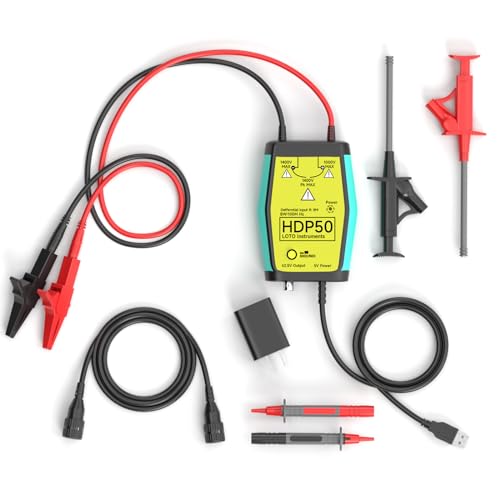
The Goupchn HDP50 is designed for high-frequency and high-voltage measurements, offering 100 MHz bandwidth and two attenuation ranges: 50X (up to 140 V) and 500X (up to 1400 V). It uses a 5 V DC adapter, eliminating battery dependence, and can be powered from common sources such as USB power packs and mobile chargers. The probe supports floating measurements and is compatible with a wide range of oscilloscopes armed with standard BNC connectors. A compact black storage case enhances portability for field and lab use.
Micsig DP10013 High Voltage Differential Probe
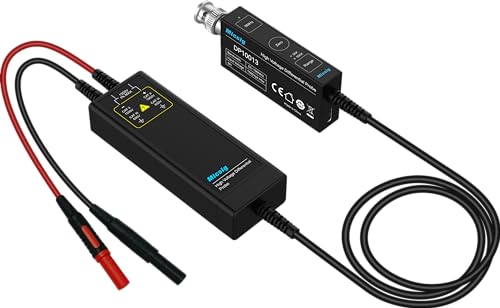
The DP10013 from Micsig is a lightweight, portable differential probe designed for high-voltage floating measurements. It covers 100 MHz bandwidth and supports a 50X/500X attenuation scheme. A USB 5 V power supply keeps the setup slim and battery-free when connected to a powered oscilloscope or a USB charger, making it convenient for quick field checks or bench testing. Its design emphasizes safety and ease of use in high-voltage environments.
Micsig 700V 100MHz Differential Probe Kit (DP10007)
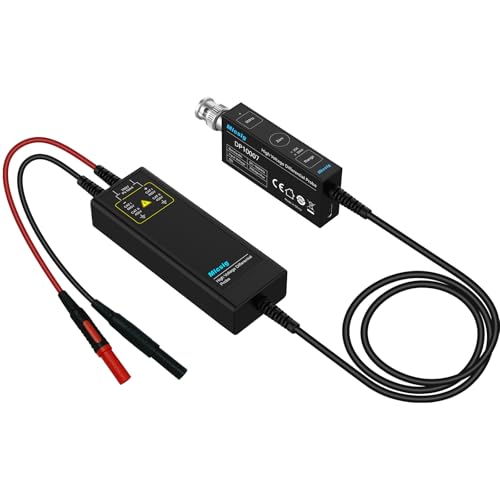
This Micsig kit targets higher voltage applications with 10X/100X attenuation. It supports floating voltage measurement up to 700 V and offers a bandwidth of up to 100 MHz. The design emphasizes safety, featuring high-impedance isolation between input and output to reduce risk to the operator. A USB 5 V power supply option adds portability for mobile setups and field work, alongside compatibility with most oscilloscope USB interfaces.
Hantek HT8100 High Voltage Differential Probe

The Hantek HT8100 offers 100 MHz bandwidth with a focus on stability and reliability for precise HV differential measurements. It includes features such as over-range alarm indicated by a red LED and a compact, durable build suitable for lab benches or field work. The device is designed for long service life with consistent performance in high-voltage environments, delivering safe, floating measurements when paired with compatible oscilloscopes.
Rigol RP1050D Digital Oscilloscope Passive Probe

The Rigol RP1050D represents a digital oscilloscope passive probe option with high-voltage differential capabilities. It supports a wide bandwidth range and multiple attenuation settings, aligning with practice in high-voltage measurement scenarios where low-noise data is essential. While a passive probe, it complements HV differential probes by providing a stable reference path for floating measurements and extended measurement chains when combined with appropriate differential adapters.
Buying Guide: Key Considerations for High Voltage Differential Probes
- Bandwidth and Rise Time: Higher bandwidth (e.g., 100 MHz) and fast rise times (a few nanoseconds) enable accurate capture of fast HV transients in switching power supplies and power electronics.
- Attenuation Ratio: Typical options include 10X, 50X, 100X, and 500X. Choose attenuation based on the maximum expected voltage, the oscilloscope’s input range, and the need to protect the scope from high voltage.
- Voltage Range and Safety: Ensure the probe voltage rating exceeds the highest voltage in your measurement scenario. Look for features like isolation, protective housings, and over-range indicators to improve operator safety.
- Isolation and Grounding: Floating measurements require proper isolation between the probe input and output. Check for galvanic isolation and compatibility with your oscilloscope’s ground reference.
- Powering Options: USB power, USB-C, or dedicated adapters can affect portability. Battery-free operation is a benefit for bench setups and field service.
- Scope Compatibility: Most HV probes use standard BNC connectors; confirm the probe is compatible with your oscilloscope model and input impedance.
- Portability vs. Rigidity: For field work, a compact design with a protective case is advantageous. For lab use, a robust build and clear LED indicators help during long sessions.
- Noise and Stability: Lower noise floors enhance accuracy for low-signal HV measurements. Probes claiming SigOFIT or similar technology can indicate robust performance.
- Safety Certifications: Verify any safety ratings or certifications relevant to your industry (e.g., electrical safety standards) for compliance and risk reduction.
- Documentation and Support: Good technical documentation, clear setup guides, and reliable vendor support minimize downtime during complex measurements.
When selecting a high voltage differential probe, balance the voltage range, bandwidth, and attenuation with the oscilloscope you own. For mixed tasks—bench testing, field diagnostics, and lab validation—opting for versatile models offering both 50X and 500X attenuation provides flexibility across scenarios.