The right group 31 battery with 1000 CCA can ensure quick starts in cold weather, steady power for marine or RV systems, and lasting performance under demanding conditions. This guide highlights five top-rated options, comparing their strengths, compatibility, and typical use cases to help you choose a dependable power source for your vehicle, boat, or equipment.
| Product | Brand | CCA (Approx.) | Type | Use |
|---|---|---|---|---|
| Mighty Max MM-G31 | Mighty Max Battery | 900 CCA | AGM | Car, commercial, deep discharge recovery |
| Litime 12V 140Ah | Litime | 1000 CCA | LiFePO4 (dual purpose) | Boat, outboard cranking, storage |
| WEIZE BCI Group 31M | WEIZE | 825 CCA | AGM | Marine, RV, dual purpose |
| Odyssey ODX-AGM31 | ODYSSEY | 1150 CCA | AGM | Marine, high-demand cranking |
| Redodo 12V 140Ah | Redodo | 1000 CCA | LiFePO4 (dual purpose) | Marine, starting with reserve |
The selections cover traditional AGM models and modern LiFePO4 options. They emphasize strong cold-start power, cycle life, and compatibility with marine, RV, and automotive configurations. Each entry includes key specs and typical scenarios to help you compare at a glance.
Mighty Max MM-G31 Start and Stop Battery
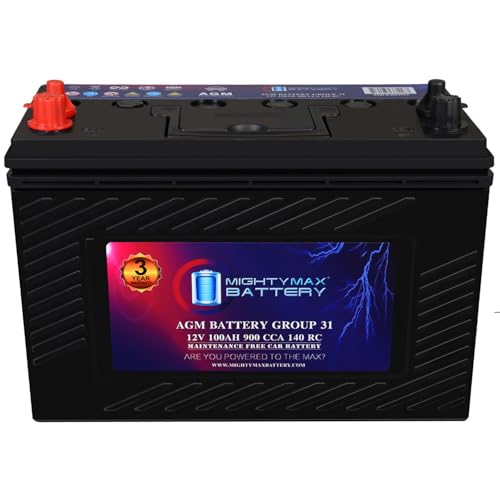
Mighty Max MM-G31 is a 12V AGM battery designed for robust starting performance with 900 CCA. It features a 100Ah capacity and a 140-minute Reserve Capacity, supporting longer run times and extended battery life. The sealed, spill-proof design minimizes maintenance while offering reliable deep-discharge recovery for steady power when it matters most. Suitable for commercial vehicles, heavy equipment, and marine starting applications where consistent cold-weather starts are critical.
Litime 12V 140Ah LiFePO4 Dual Purpose Battery

The Litime LiFePO4 battery is a dual-purpose 12V unit delivering up to 1000 CCA and 140Ah in a compact form. It combines starting power with deep-cycle capability for marine use, enabling reliable outboard cranking and powering ancillary devices like fish finders or trolling motors. Compatible with multiple outboard brands (Yamaha, Mercury, Honda, Suzuki, Evinrude), it adheres to ABYC installation standards for safe cross-brand use. It helps reduce weight and space on boats compared with traditional lead-acid alternatives.
WEIZE BCI Group 31M Dual Purpose AGM Battery

WEIZE’s Group 31M is a dual-purpose AGM battery designed for marine and RV use. It emphasizes strong starting power combined with deep-cycle capability and a long life thanks to AGM technology. The model features a low internal resistance and a design that supports quick charging, with guidance on proper charging voltages and currents. While listed CCA is 825, the battery is marketed for robust performance in demanding environments and cross-brand compatibility with a focus on reliability and cycle stability.
Odyssey ODX-AGM31 Extreme Series

Odyssey ODX-AGM31 is part of the Extreme Series, offering a 12V system with high cranking capacity and robust reserve capacity. With a CCA around 1150 and a strong reserve, this AGM battery is designed for marine and other high-demand environments where consistent power and quick starts are critical. The advanced AGM chemistry emphasizes durability, surge resistance, and long service life in fluctuating temperatures, making it a strong option for boats and heavy equipment that demand reliability at all times.
Redodo 12V 140Ah Dual Purpose LiFePO4 Battery

Redodo’s 140Ah LiFePO4 battery delivers 1000 CCA, pairing strong starting power with deep-cycle versatility for marine applications. This dual-purpose lithium option supports outboard cranking and sustained electrical loads, while its Energy Reserve Mode helps reserve a portion of capacity to ensure engine starts after a long day at sea. It is compatible with a variety of marine brands and provides efficient charging and stable performance in varied climates.
Buying Guide: Key Purchase Considerations
When selecting a group 31 battery with 1000 CCA or similar power, consider these factors to align with your needs:
- Battery chemistry: AGM batteries offer maintenance-free operation and good high-current performance, while LiFePO4 provides higher cycle life, lighter weight, and steady voltage but requires compatible charging equipment.
- CCA and RC: Cold-cranking amps (CCA) indicate starting power, while reserve capacity (RC) or minutes measure endurance. For cold climates or heavy loads, prioritize higher CCA and RC values.
- Application fit: Marine batteries differ from automotive ones in mounting, vibration resistance, and charging profiles. Check manufacturer recommendations for your boat or vehicle’s make and model.
- Size and terminals: Verify dimensions and terminal positions (left/right, positive/negative) to ensure compatibility with your battery tray, cables, and terminals.
- Charging regimen: AGM and LiFePO4 have distinct charging needs. Follow voltage and current limits (e.g., 14.4V–14.7V for many AGM, 14.2V–14.6V for LiFePO4) to maximize life and performance.
- Maintenance and longevity: Look for warranties, cycle-life claims, and density of plates to estimate how many full discharge-recharge cycles you can expect in real-world use.
- Weight and space: LiFePO4 options are typically lighter and more compact, which can improve efficiency on boats and ATVs, but require compatible charging systems and space considerations.
- Brand support and availability: Choose brands with established support networks and easy access to replacement parts and services in your region.
In selecting a group 31 battery, you should balance starting power with endurance, weight, and fit. For cold-weather starts, higher CCA is beneficial, while for long outings, reserve capacity and cycle life can matter more. Lithium options like LiFePO4 variants offer longer-term benefits, whereas AGM models may provide lower upfront cost and familiar charging profiles.