Choosing a grid tie inverter with limiter helps ensure your solar or wind power system delivers just the power your home needs, while guarding against overproduction and protecting equipment. This guide highlights five top options from trusted brands, detailing how each unit manages power, MPPT efficiency, battery compatibility, and limiter features. Read on to compare specs, installation notes, and practical considerations for US homes using 110/240V grids.
| Product | Brand | Key Feature | Input Voltage Range |
|---|---|---|---|
| Y&H 1000W Grid Tie Inverter Power Limiter DC25-60V Solar Input AC110V/240V Auto Switch | Y&H | Limiter sensor with 99% MPPT efficiency | 22-60V |
| Y&H 1200W Grid Tie Inverter Power Limiter LCD Display DC55-90V Solar Input | Y&H | LCD status, PV/battery mode options | 55-90V |
| Y&H 2000W Grid Tie Inverter Power Limiter LCD Display DC50-90V Solar Input AC185-265V | Y&H | Battery discharge optimization, stacked units | 50-90V |
| TINGEN 1000W Grid Tie Inverter with LCD Display LCD Limiter | TINGEN | Limiter function, MPPT >99% | 26-45V |
| Marsrock 1000W Wind Grid Tie Inverter with Limiter | Marsrock | Limiter sensor, MPPT, pure sine wave | 22-60V |
Y&H 1000W Grid Tie Inverter With Limiter
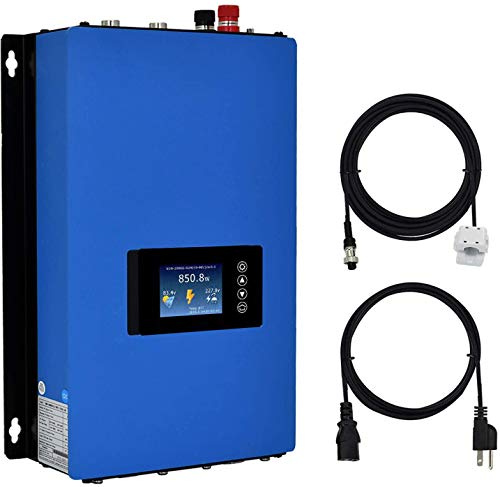
The Y&H 1000W unit accepts a DC input of 22-60V and supports AC outputs at 110V or 240V. It includes a limiter sensor designed to provide only the power required by the load, helping protect appliances and the grid connection. MPPT efficiency can reach up to 99%, with a peak conversion rate around 80%, and it is recommended to pair with solar panels in the 200W range for stable output. Battery usage is supported via a 36V/48V configuration with an automatic discharge depth adjustment for the battery bank. Wiring length to the controller should stay under 66 feet.
Best use cases include small residential solar arrays linked to a standard US 110/240V grid, where the limiter prevents excess feed-in. Typical installation should ensure open-circuit voltage stays within the recommended range for optimal MPPT performance. The product supports auto-switch between grid and battery modes as needed and emphasizes safety through controlled output.
Y&H 1200W Grid Tie Inverter With Limiter LCD Display

This model provides a higher wattage ceiling with an LCD that displays working status and supports switching between photovoltaic and battery modes. The device is designed for solar panels with an open-circuit voltage (Voc) in the 76-90V range to maintain MPPT efficiency and avoid voltage drop. It is suitable for larger residential setups where consistent, limiter-guided feed-in is desired. The LCD helps homeowners monitor performance, detect faults, and adjust operation without complex tools.
Considerations include ensuring consistent panel specs to keep MPPT within the optimal window and planning for wiring runs to prevent voltage drop. The unit integrates well with 48V to 60V battery banks when battery mode is preferred, and its limiter ensures load-driven output aligns to demand.
Y&H 2000W Grid Tie Inverter With Limiter LCD Display

The 2000W model targets higher-demand homes and can operate with a 50-90V DC input, making it compatible with 60V battery banks. It supports an American 240V AC output configuration and recommends solar panel arrays of 1000W or more with corresponding Voc around 76-90V. The unit offers a battery discharge optimization mode, enabling safer operation with battery backups, and it supports stacking multiple inverters to increase total output without a hard limit. MPPT efficiency remains a strong point, rated up to 99%.
For installations in larger homes or small commercial settings, ensure proper derating and fuse sizing, and plan for a robust cooling solution if multiple inverters operate simultaneously. The limiter helps keep the system within safe load bounds, protecting both panels and appliances from overproduction.
TINGEN 1000W Grid Tie Inverter With LCD Display

This Tingen unit features a 26-45V PV input range, with 24V battery compatibility, and a single-phase 90V-140V AC output. It uses an LCD to show real-time operating parameters, and provides four working modes including PV limiter and battery limiter. MPPT efficiency is stated to exceed 99%, making it suitable for precise energy capture from moderate-sized solar arrays. A limiter function helps scale output to demand, preventing unnecessary energy export during low-load periods.
Key considerations include ensuring the solar array voltage stays within the MPPT window and that the recommended Voc aligns with the panel string configuration. The device may be well-suited for homes with modest to mid-size solar installations or as part of a hybrid system pairing PV with limited battery storage.
TINGEN 1000W Solar Grid Tie Inverter With Limiter (22-65V)

This model uses a 22-65V DC input window and a 95-265V AC output, suitable for 48V battery use or solar panels connected in parallel with multiple panels. The MPPT function tracks maximum power points to maximize solar energy harvest, and a limiter ensures the inverter only supplies the energy the load requires. A practical option when solar panels meet or exceed 245W per panel, with Voc around 36.9V, and when you anticipate variable load demand that benefits from controlled feed-in.
When deploying multiple panels, observe the recommended wiring strategy to maintain MPPT efficiency, and consider how the limiter interacts with the grid-tied setup to comply with local regulations and interconnection requirements.
TINGEN 1000W Solar Grid Tie Inverter With Limiter (21-65V)
This variant features a 21-65V DC input and 95-265V AC output, with similar battery-sourced operation guidance as the other Tingens. The limiter and MPPT design aim to deliver up to 30% more energy than PWM-based counterparts under the right conditions. The product highlights simple LCD display use, four operational modes, and a focus on safe grid integration. It is a viable option for homes expanding from small PV arrays toward greater energy independence while maintaining grid compatibility.
Marsrock 1000W Wind Grid Tie Inverter With Limiter

The Marsrock wind-focused model converts 22-60V DC to 110V/240V AC and features a limiter sensor to provide only the power needed by the connected load. MPPT is employed to maximize wind and solar energy harvest, while delivering a pure sine wave output suitable for sensitive electronics. This unit is designed for wind-powered home setups but aligns with grid-tied requirements where a limiter helps match generation to demand, reducing strain on the grid and equipment during gusty conditions.
Buying Guide: Key Purchase Considerations And Comparisons
- Input voltage and battery compatibility: Choose units that match your battery bank voltage (commonly 24V, 48V, or 60V) and ensure the DC input range supports your solar panel array or wind turbine voltage.
- Limiter sensor and load matching: A reliable limiter ensures the inverter only exports what the load requires, protecting inverters, panels, and grid connections while improving overall energy efficiency.
- MPPT efficiency and panel compatibility: Look for MPPT efficiency near or above 99% for best energy harvest. Ensure Voc and Vmp specs align with your solar panel strings (voltage range often 36-90V depending on model).
- AC output voltage and grid compatibility: Most models support 110V/240V single-phase output. Confirm compatibility with your local utility interconnection requirements and available voltages.
- Expandability and stacking: Some models allow stacking multiple inverters to increase total output. Consider future expansion plans and electrical code implications.
- Battery backup and discharge control: If planning to use batteries, confirm supported voltage (e.g., 36V, 48V) and whether the inverter provides automatic depth-of-discharge management for longevity.
- Installation and safety: Check for required breakers, proper wiring distances (controller to inverter) and cooldown needs. Follow local electrical codes and utility interconnection standards.
- Panel and panel-configuration considerations: For optimal MPPT, ensure solar panel strings provide the recommended voltage and current, and avoid exceeding Voc ratings during cold weather or high irradiance.
These products share a core capability: grid-tied inverters with limiter to tailor energy output to actual load while maintaining safety and grid compatibility. When selecting, weigh your expected load profile, panel wind resource, battery use, and future expansion plans to choose the model with the best balance of MPPT efficiency, limiter reliability, and installation flexibility. For urban homes, prioritizing units with LCD displays and clear fault prompts can simplify monitoring and maintenance over time.