As homes increasingly adopt renewable energy, grid-connected solar power systems offer reliable, scalable, and efficient ways to reduce utility costs while staying connected to the public grid. This article highlights five high-performing solar kits that align with common home energy needs, emphasizing capacity, inverter features, battery compatibility, and ease of installation. Explore practical options that support daytime solar generation, weatherproof hardware, and smart monitoring for modern American households.
| Product | System Type | Approximate Capacity | Best For |
|---|---|---|---|
| ECO-WORTHY 48V Off Grid Solar System Complete Kit 1200W | Off-Grid / Grid-Linked Ready | 1200W panel, 4.68 kWh/day | Small homes, cabins, sheds |
| ECO-WORTHY 5KW Off Grid Solar System Complete Kit | Off-Grid with Inverter | 2340W panels, 5kW inverter | Independence from the grid |
| ECO-WORTHY Home Off-Grid Solar Power System: 10KW | Off-Grid with Large Inverter | 4920W panel array, 10kW inverter | Medium homes, backup power |
| [Ultra] ECO-WORTHY 1200W 24V 5.52KWH | Off-Grid with Battery Bank | 5.52 kWh storage | RV, cabin, trailer, remote locations |
| ECO-WORTHY 9.36KWH 2340W Kit | Off-Grid with All-in-One Inverter | 9.36 kWh/day, 2340W panels | Full-home backup, extended outages |
Note: All kits described are designed to work with 110V/120V or 240V AC loads and include solar panels, inverters, and battery capabilities. When pairing with the grid, ensure compatibility with local codes and any required interconnection approval.
ECO-WORTHY 48V Off Grid Solar System Complete Kit 1200W

The 1200W kit combines six 195W N-type bifacial solar panels with a 48V 50Ah LiFePO4 rack battery and a 3500W inverter. It supports parallel connection of up to six units (21kW total) and offers an 80A MPPT controller, 20ms UPS switching, and built-in WiFi for monitoring. The system is designed to power common AC 110V/120V devices, including air conditioning, refrigerators, and household electronics, under four hours of full sun per day.
ECO-WORTHY 5KW Off Grid Solar System Complete Kit

This kit provides 12 upgraded 195W panels (2340W total) with a 5KW all-in-one inverter and a 48V 100Ah LiFePO4 battery pack. All panels are wired in series for simple installation, and the battery bank is designed to be expandable via parallel connections. The system enables independent operation away from the grid while supporting 120V/208V/240V outputs in parallel configurations, making it suitable for larger homes or remote locations.
ECO-WORTHY Home Off-Grid Solar Power System: 10KW

This system features a 10KW inverter with a 4920W solar panel array and a UL1973/UL9540A-certified 51.2V LiFePO4 battery compatibility. It emphasizes seamless plug-and-play integration with ECO-WORTHY’s 48V rack battery and CAN/RS485 communication for easy monitoring. It is designed for robust off-grid operation and can be expanded with additional batteries to reach higher storage capacity while maintaining safe, reliable power for daily loads.
[Ultra] ECO-WORTHY 1200W 24V 5.52KWH Kit
![[Ultra] ECO-WORTHY 1200W 24V 5.52KWH Kit Image](https://m.media-amazon.com/images/I/51lAep6VX2L._SL500_.jpg)
Designed for travel trailers, RVs, cabins, and small homes, this kit uses six 195W panels and a 12.8V 280Ah lithium battery bank to deliver about 5.52 kWh of storage with a 3000W pure sine wave inverter. It employs a 60A MPPT controller and dual-axis tracking to boost efficiency by more than 40%. The system supports a solar/mains hybrid charging approach for continuous power reliability.
ECO-WORTHY 9.36KWH 2340W Kit
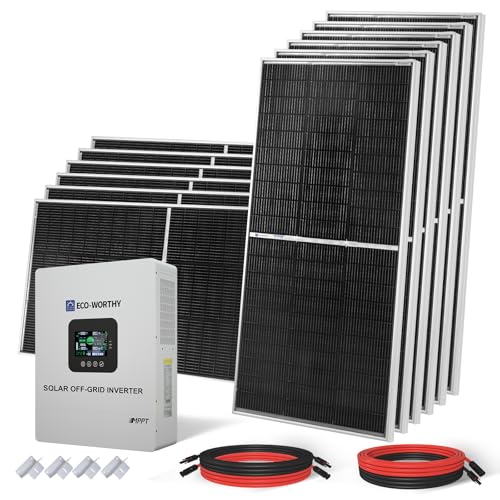
The 9.36 kWh daily output kit pairs 2340W of solar panels with a 5000W 48V all-in-one off-grid inverter and a 12x195W mono panel configuration. It includes a 100A MPPT controller and is designed for plug-and-play use with easy interconnection to a home’s electrical system. This kit targets reliable full-home backup and energy resilience for outages or high-usage periods.
Buying Guide: Key Purchase Considerations
- System size and energy needs: Assess daily energy consumption and select a kit whose panels, inverter, and storage capacity align with typical loads (HVAC, refrigerators, water heaters, electronics). Larger homes may require higher kW inverters and more battery storage, potentially enabling parallel inverter configurations.
- Inverter type and capacity: Choose a pure sine wave inverter with sufficient continuous and surge power. 120V/240V outputs and the ability to parallel multiple inverters provide flexibility for single- or multi-phase setups in homes.
- Battery chemistry and packaging: LiFePO4 batteries offer long cycle life and better safety, especially in wall-mounted or rack configurations. Check BMS features, CAN/RS485 compatibility, and whether batteries fit your installation space (some are rack-mountable).
- Monitoring and connectivity: WiFi or Bluetooth monitoring enables real-time system health checks and performance optimization. Ensure the kit includes or supports compatible inverters and monitoring software.
- Installation and interoperability: Some kits are designed as plug-and-play with simplified wiring; others require more advanced electrical work. Verify safety certifications (UL1973, UL9540A) and local electrical interconnection requirements.
- Expandability: If future energy needs rise, consider kits that allow adding panels, batteries, or additional inverters in parallel to scale capacity up to 20kW or more.
- Durability and warranties: Inspect panel ratings (efficiency, temperature tolerance, and shading resistance) and inverter; pay attention to warranties on panels and battery packs for long-term reliability.
- Local grid interconnection rules: Grid-tied configurations must adhere to interconnection standards and utility requirements. Confirm available net metering, backfeed protections, and required metering equipment.