When preparing for power outages or remote work sites, a generator with a 240-volt outlet provides the versatility to power heavy appliances, transfer switches, and whole-house backup circuits. This guide focuses on reliable dual-fuel and tri-fuel models that support 120V/240V output, strong running watts, and safety features. Below are five top options that balance power, ease of use, and endurance for American homes and small businesses.
| Product | Brand | Fuel Options | Key 240V Features |
|---|---|---|---|
| WEN DF475T | WEN | Gasoline / Propane | 120V/240V selector, electric start, 4750 surge / 3800 running watts |
| WEN DF8000X | WEN | Gasoline / Propane | 120V/240V, 8000 surge / 6500 running, CO watchdog sensor |
| Westinghouse 6500 | Westinghouse | Gasoline / Propane | 120V/240V selector, transfer switch ready, CO sensor |
| WEN DF1100T | WEN | Gasoline / Propane | 120V/240V, 11000 surge / 8300 running watts, electric start |
| WEN TF1450X | WEN | Gasoline / Propane / Natural Gas | Tri-fuel, 120V/240V, CO watchdog, electric start |
Note: Each model includes features designed for safe operation, convenient starting, and easy integration with home transfer switches. When selecting a generator, consider fuel availability, runtime, noise levels, and the number of 240V circuits you need to support common household and workshop loads.
WEN DF475T Dual-Fuel Generator With 240V Output

The WEN DF475T provides a versatile dual-fuel option for running on gasoline or propane. It features a 120V/240V selector to accommodate transfer switches and emergency backup needs. The 224cc OHV engine delivers 4750 surge watts and 3800 running watts on gasoline, while propane delivery offers 4350 surge and 3500 running watts. Electric start simplifies ignition with a single key, and the dual-fuel design expands fuel flexibility during outages. This model is a practical choice for mid-sized loads requiring intermittent 240V power.
WEN DF8000X Dual-Fuel Generator With 240V Output

The WEN DF8000X offers a larger power plant featuring dual-fuel operation for gasoline or propane. It delivers 8000 surge watts and 6500 running watts on gasoline, with propane output of 7200 surge and 5850 running watts. An electric start activates the 340cc engine for quick ignition, and a CO watchdog sensor adds safety by shutting down the unit if carbon monoxide levels become dangerous. This generator suits larger homes, workshops, and construction sites needing 240V capability and robust runtime.
Westinghouse 6500-Watt Dual Fuel Backup Generator
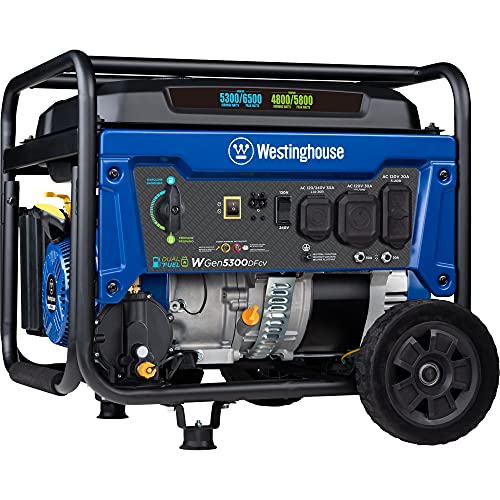
The Westinghouse 6500-watt model combines 120V/240V versatility with dual-fuel flexibility. Gasoline operation provides 6500 peak watts and 5300 running watts, while propane offers 5800 peak and 4800 running watts. A 4.7-gallon fuel tank with a gauge supports long runtimes, and the unit ships with essential accessories like an oil funnel, propane hose, and wheel kit. Protection features include rubber-covered outlets and CO monitoring for safer operation in homes and campsites. This generator is a balanced choice for medium to heavy load scenarios.
WEN DF1100T High-Capacity 240V Dual-Fuel Generator
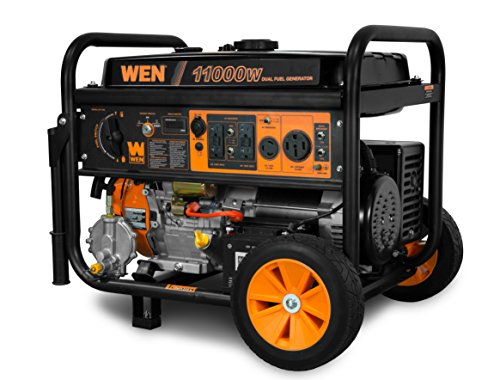
The WEN DF1100T is designed for demanding backup power needs with 11,000 surge watts and 8,300 running watts on gasoline, and 9,500 surge / 7,500 running watts on propane. The unit offers 120V/240V operation and an electric start for quick restoration of power. This model is well-suited for larger homes and job sites where a strong 240V supply is essential, and it includes features oriented toward easy startup and reliable dual-fuel performance for extended outages.
WEN TF1450X Tri-Fuel Generator With 240V Output

The WEN TF1450X adds a tri-fuel capability, allowing operation on gasoline, propane, or natural gas. It provides 14500 surge watts and 11500 running watts on gasoline, 12500 surge / 10300 running on propane, and 10500 surge / 8750 running on natural gas. The generator runs at 120V and 240V and includes an electric start along with a CO watchdog to enhance safety. This is a high-capacity option for advanced backup power, capable of supporting large appliances and multiple circuits via 240V outlets.
Buying Guide: Key Considerations for 240V Ready Generators
- Output and fuel type: Evaluate surge vs running watts at both 120V and 240V. Dual-fuel and tri-fuel options offer flexibility when fuel availability varies.
- Transfer switch readiness: If you plan to connect to a home transfer switch, ensure the generator supports 120V/240V operation and has appropriate receptacles (including TT-30R and L14-30R where applicable).
- Safety features: Look for CO shutdown sensors or watchdog sensors, proper grounding, and protected outlets with rubber covers for weather resistance.
- Starting mechanism: Electric start simplifies startup, especially during outages. Manual recoil is a fallback but may be less convenient in cold weather.
- Runtime and tank size: Consider fuel capacity and efficiency to estimate how long a generator can run between refuels. Larger tanks extend runtime for critical loads.
- Portability and accessories: Wheel kits, oil funnels, and hoses improve setup speed and ease of relocation or storage.
- Noise and emissions: Higher-watt models can be louder; verify noise ratings and ensure compliance with local restrictions or campsite rules.
- Maintenance and parts availability: Choose brands with broad service networks and accessible replacement parts to minimize downtime.
When selecting a 240V-capable generator, align the model’s power profile with your typical load profile, whether you’re keeping essential circuits online during outages or powering heavy tools on a construction site. The options above provide a range of power, fuel flexibility, and safety features to support reliable emergency power in American homes and workplaces.