When selecting a continuous duty solenoid relay, reliability, current handling, and environmental resistance are key. This article highlights five solid options designed for 12V systems in golf carts, winches, and marine applications. Each product section includes a concise spec snapshot, an image, and practical notes drawn from their listed features. A Buying Guide at the end helps compare factors like current rating, wiring, mounting, and durability to support informed decisions.
| Product | Brand | Voltage | Current Rating | Mounting Bracket |
|---|---|---|---|---|
| Max 300A Continuous Duty Solenoid Relay Nickel-Plating | Lucky Seven | 12VDC | Up to 300A transient; recommended under 150A continuous | Straight bracket |
| Newdeli Max 300A Continuous Duty Solenoid Relay | Newdeli | 12VDC | Up to 300A transient; continuous under ~150A | Straight bracket |
| irhapsody Relay 200A, 12V | iRhapsody | 12VDC | 200A rated; notes 10-15% below capacity | 4-pin layout |
| Max 200A 12V 3 Terminal Solenoid Relay | LDMINDA | 12VDC | 200A transient; continuous ~100A | 3 terminal |
| Zhushan Max 300A Continuous Duty Solenoid Relay | Zhushan | 12VDC | 300A transient; continuous under ~150A | Straight bracket |
Lucky Seven Max 300A Continuous Duty Solenoid Relay

The Lucky Seven relay is designed for heavy loads common in winches, golf carts, and marine setups. It uses a 12VDC coil with a 14Ω resistance and a coil insulation suitable for demanding environments. The device features a normally open (NO) contact arrangement and 5/16 x 19/32 mounting holes, with a straight bracket for straightforward installation. The unit references compatibility with a wide range of OEM solenoids, indicating broad interchangeability with classic Delco, Johnson Electric, and EZGO parts. This makes it a versatile choice for re-wiring or upgrades in legacy vehicles.
Key highlights include its 10.2W power rating and robust copper winding, which supports repeated on/off cycles typical of continuous duty operation. When selecting this relay, consider whether your system will routinely approach high current and ensure proper heat dissipation and wiring gauge to sustain performance over time. This model suits aggressive environments where corrosion resistance is beneficial thanks to its nickel-plated exterior.
Newdeli Max 300A Continuous Duty Solenoid Relay
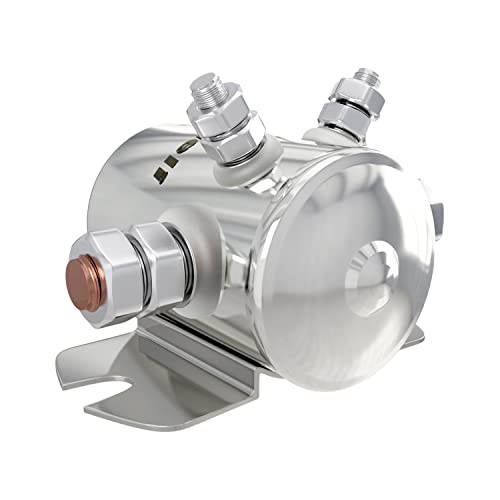
Newdeli emphasizes 12VDC operation with a 14Ω coil and 10.2W capacity, matching many heavy-duty electrical systems in marine and off-road equipment. The nickel-plated exterior and sealed unit design help resist moisture and corrosion, which is important for winch and marine use. The coil uses 180°C copper wire for improved conductivity, and the relay provides two copper contact points in a normally open arrangement. The product notes its broad applicability—from marine to military vehicles and hydraulic control units—indicating strong versatility for various fleets and accessory installations.
Consider this model when you need solid corrosion protection, compact form, and a straightforward straight-bracket installation. Ensure your mounting hardware aligns with the holes/center spacing and that your system’s continuous current remains well below the 150A guidance to maintain longevity.
iRhapsody 200A 12V Continuous Duty Relay

The iRhapsody model advertises a high-current capability with a 12VDC coil and 8V pickup voltage, offering a practical safety margin below its pickup and dropout specs. With a 6mm (M6) terminal stud configuration and a four-pin layout, this relay is tailored for installations needing solid high-current switching in compact spaces. The manufacturer stresses reliability over lower-power alternatives by pointing to lower coil power at 1.8W, implying reduced heat generation during operation. These factors are favorable for installations in constrained spaces where heat and electrical noise can be a concern.
For engineers, this relay provides a balance between compact design, reliable switching capacity, and an explicit emphasis on staying under rated limits. It’s suitable for heavy-duty automotive or marine applications where a strong, stable relay is required but space is at a premium.
LDMINDA Max 200A 12V 3 Terminal Relay

LDMINDA offers a 12VDC, three-terminal continuous duty solenoid with a 200A transient rating and a 100A continuous rate, according to product notes. The design includes a nickel-plated exterior for corrosion resistance and a 5/16 x 19/32 mounting pattern with a straight bracket for easy mounting. The unit uses two copper contact points, with 14Ω coil resistance and a 10.2W capacity, aligning with common mechanical and marine loads. This relay is well-suited for installations requiring a three-terminal configuration and robust environmental sealing to withstand outdoor use.
When evaluating this option, verify your wiring plan accommodates the three-terminal arrangement and confirm mounting compatibility with your vehicle or equipment. This model sits well in fleets that demand reliable power control under continuous duty loads with resistance to elements.
Zhushan Max 300A Continuous Duty Relay

The Zhushan relay presents a nickel-plated exterior and a 12VDC coil with a 14Ω resistance and 10.2W capacity. It lists a straight-mount bracket with the standard 5/16 x 19/32 holes and a 2-13/64 center spacing. The device replaces many common part numbers (70-111224, 1114208, 1114218, etc.), indicating broad compatibility with older systems. A 300A transient rating paired with a recommended continuous current under 150A makes this a strong candidate for marine, winch, or golf cart projects that require durable, easily sourced relays.
Potential buyers should confirm bracket compatibility with their mounting surface and ensure heat management is suitable for the expected duty cycle. Its wide compatibility with legacy part numbers can streamline replacements in older fleets.
Buying Guide: Key Considerations For Continuous Duty Solenoid Relays
When choosing a continuous duty solenoid relay, you should evaluate several practical factors to ensure reliable performance in real-world scenarios:
- Current and voltage ratings: Match the relay’s continuous current capacity to your load. Transient capacity matters for short spikes, but continuous operation should stay well below the rated limit to avoid overheating.
- Coil resistance and power: A higher-resistance coil typically draws less current, producing less heat, but ensure the coil’s pickup voltage aligns with your control circuit.
- Contact configuration: NO (Normally Open) is common for power-on control. While 3-terminal or 4-terminal variants offer flexibility for wiring and isolation, ensure the terminal layout matches your harness.
- Durability and enclosure: Nickel plating and sealed units improve corrosion resistance in marine and outdoor environments. Sealed units reduce the risk of moisture-related failures in wet conditions.
- Mounting and space: Straight brackets and standard mounting hole spacings simplify installation. Verify that your mounting surface and hardware fit the provided pattern.
- Dimensions and weight: In compact installations, size and weight can influence assembly, heat dissipation, and vehicle clearance.
- Compatibility with OEM parts: Some models advertise compatibility with Delco, Johnson Electric, or EZGO parts. This can simplify replacements in older fleets with proven performance history.
- Environmental considerations: For outdoor or water-adjacent use, consider sealed or corrosion-resistant variants and those with additional protective coatings.
- Maintenance and replacement: Check replacement part numbers and warranty terms. Availability of spares can reduce downtime in critical applications.
In practice, select a relay whose continuous current rating comfortably exceeds your normal operating load, and prefer models with corrosion resistance for marine or off-road environments. For installations with space constraints, favor compact, four-terminal or three-terminal designs with straightforward mounting and compatible connectors. Finally, validate that any replacement maintains compatibility with existing control wiring and safety certifications where applicable.