Choosing the right contactor with an overload relay helps protect three-phase motors from overloads, phase failures, and unbalances while keeping control panels compact. This guide highlights five reliable options from trusted brands, detailing key specs and where they fit best in HVAC, pumps, compressors, and manufacturing setups. Learn how to select the right combination for your system’s current, coil voltage, and protection class.
Summary of Selected Products
| Product | Brand | Coil/Rating |
|---|---|---|
| Schneider Electric DPER07 Easy TeSys | Schneider Electric | 1.6-2.5 Amps |
| Schneider Electric DPER21 Easy TeSys | Schneider Electric | 12-18 Amps |
| Schneider Electric DPER22 Easy TeSys | Schneider Electric | 16-24 Amps |
| Schneider Electric LRD10 Overload Relay | Schneider Electric | Class 10 (varies by model) |
| SIEMENS 3RU21161HB0 | SIEMENS | 5.5-8.0 A |
Schneider Electric DPER07 Easy TeSys Thermal Overload Relay

This TeSys thermal overload relay provides manual/automatic reset options and screw clamp terminals. With a 1.6-2.5A rating, it suits small motors in HVAC, heat pumps, and compressors. It supports a network frequency of 0-4000 Hz and offers 600V insulation (UL/cUL and 690V IEC) with Class 10 trip. Its compact, modular design makes it easy to fit in space-limited panels while offering reliable motor protection against overloads and phase issues.
Schneider Electric DPER21 Easy TeSys Thermal Overload Relay
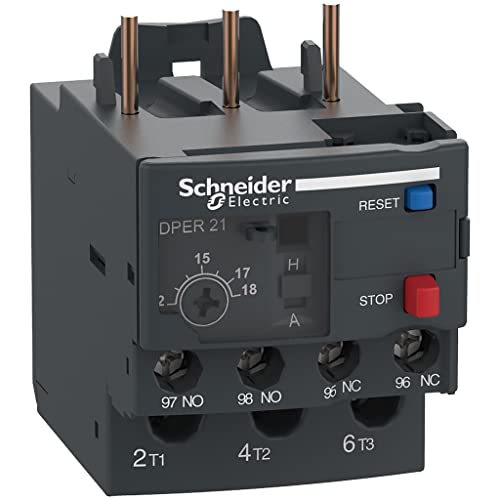
Designed for 12-18 Amp motor protection, this relay mirrors the DPER07’s robust build with a larger current range for medium-sized three-phase motors. It maintains a compact, modular footprint and same protective features: manual/automatic reset, 0-4000 Hz compatibility, and 600V insulation with Class 10 tripping. It’s a solid choice for HVAC drives, pumps, and compressors requiring dependable overload control in tighter spaces.
Schneider Electric DPER22 Easy TeSys Thermal Overload Relay

The DPER22 covers 16-24 Amps, making it suitable for larger three-phase motors in HVAC, pumps, and compressors. It keeps the same 0-4000 Hz network range, 600V insulation, and Class 10 trip. Its modular design supports quick integration into control panels and offers protection against overloads and unbalanced phases without adding bulk to the installation.
Schneider Electric LRD10 Overload Relay

The LRD10 is a bi-metallic thermal overload relay designed for IEC contactors. It provides Class 10 protection and is commonly used in conjunction with Schneider contactors. This option highlights Schneider’s integrated approach to motor protection, balancing reliability with straightforward installation for industrial drives and HVAC systems.
SIEMENS 3RU21161HB0 Thermal Overload Relay
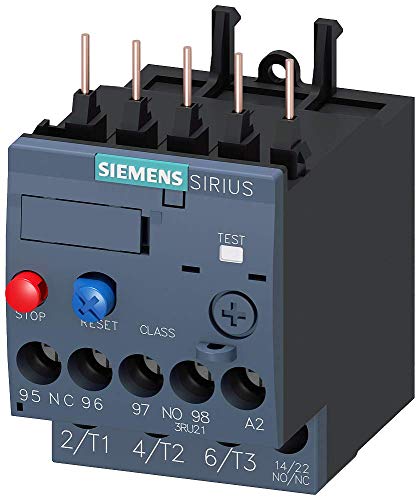
This Siemens model offers a 5.5-8.0A range with a compact size suitable for S00 contactors. It features manual/automatic reset and a screw terminal interface. The trip class is 10, aligning with standard protection for small to mid-size motors in commercial and industrial settings, with straightforward mounting on compatible Siemens contactors.
Buying Guide: Key Considerations For Choosing A Contactor With Overload Relay
Selecting the right combination requires balancing motor specs, control voltage, and protection needs. Consider coil voltage, current ratings, and the motor’s starting and running loads. The overload relay should match the motor’s full-load amps (FLA) and duty cycle (AC-3 for motor loads, AC-1 for resistive tasks). A Class 10 trip provides fast protection for many industrial motors, but some applications may require higher sensitivity or a different trip class.
Important factors include compatibility with your existing contactor family, ease of integration in control panels, and space constraints. Look for modular, plug-in designs that simplify maintenance and spare parts inventory. Confirm environmental tolerance—dust, humidity, and temperature can affect performance in HVAC and outdoor setups. Insulation and voltage ratings should meet or exceed your system’s requirements to prevent insulation breakdown or nuisance trips.
Protection features to evaluate include overload protection (adjustable vs fixed), phase fault protection, and phase unbalance handling. Some models offer manual/automatic reset, which can be important in safety-critical applications or where automated recovery is desired after a fault. Finally, consider supply chain availability and warranty support from the manufacturer to minimize downtime during replacements or upgrades.