This article highlights top CNC servo motor controllers that American makers rely on for precise motion control. Each entry summarizes key specifications, compatibility, and practical considerations to help you compare options for routers, lathes, mills, and engravers. The selections balance compact standalone controllers, multi-axis systems, and servo-ready kits from trusted brands.
Below is a quick overview of the featured products to help you assess suitability at a glance.
| Product | Brand | Axis Support | Voltage | Special Notes |
|---|---|---|---|---|
| SainSmart 1 Axis CNC Servo Stepper Motor Motion Programmable Controller | SainSmart | 1 | Not specified | 8-digit display, autorun via panel |
| RATTMMOTOR YPMC-750W 110V Servo Motor Kit | RATTMMOTOR | 1 | 110V | High torque, IP65 considerations |
| RATTMMOTOR YPMC-1000W 110V Servo Motor with Driver Kit | RATTMMOTOR | 1 | 110V | Brake option, strong performance |
| CNCTOPBAOS 4 Axis 500KHz DDCSV4.1 Offline Controller | CNCTOPBAOS | 4 | Not specified | Standalone, MPG handwheel |
| CNCTOPBAOS HBS860H Digital Nema34 Closed Loop Driver | CNCTOPBAOS | 1 | 30-110VDC / 24-80VAC | 512 micro-steps, RS232 |
SainSmart 1 Axis CNC Servo Stepper Motor Motion Programmable Controller

The SainSmart controller is designed for single-axis positioning and non-positioning tasks. It provides a compact solution for basic CNC setups that require programmable control and easy panel management. The unit features an 8-digit display to monitor steps, counts, and program status, along with run/stop indicators and input/output status. This controller also supports autorun capabilities, enabling automated sequences initiated from the panel. It suits hobbyist machines, small engravers, and DIY routers where a straightforward control interface is valued.
Key considerations include its single-axis focus, which makes it ideal for dedicated axes such as a Z-axis or a gantry approach on a compact machine. Operators should confirm compatibility with their servo driver, encoder type, and wiring conventions. While it excels in simple, reliable tasks, users seeking multi-axis coordination or advanced interpolation may need to pair it with additional controllers or upgrade to a multi-axis system.
RATTMMOTOR YPMC-750W 110V Servo Motor Kit

This kit pairs a 750W servo motor with a dedicated driver intended for CNC engravers, milling machines, and robotic applications. It offers a robust torque profile with a rated speed around 2500 r/min and a peak near 3000 r/min, delivering reliable performance for mid-range machines. The system highlights IP65-rated protection, a 17-bit encoder, and compatibility with RS-232/RS-485 interfaces for external control. It emphasizes strong disturbance resistance, low noise operation, and quick response—benefits for mills and routers subject to dynamic loads.
Practical considerations include ensuring adequate cooling and electrical supply compatibility with your control software. The absence of a brake on this variant means you’ll want to manage mechanical braking approaches if your application requires rapid hold or braking during power-downs. Overall, this kit is suitable for users upgrading from stepper to servo or building a compact CNC setup that prioritizes torque and steady control.
RATTMMOTOR YPMC-1000W 110V Servo Motor With Driver Kit

This 1000W servo motor kit extends the same high-torque, low-noise philosophy to a higher power level. Featuring brake options and a 110V supply, it delivers improved performance for heavier milling and engraving tasks. The motor’s 5-pole configuration and a 10000 PPR encoder support accurate positioning, while the IP65 rating underlines durability in varied shop conditions. The accompanying driver (S2SVD20) is designed for 110V operation with air cooling and a 17-bit encoder integration.
Users should verify the electrical compatibility with existing CNC controls and ensure that the system’s maximum current settings align with motor torque requirements. This kit is well-suited for mid-to-high torque needs, enabling more aggressive feeds and depths without sacrificing precision on suitable machines.
CNCTOPBAOS 4 Axis 500KHz CNC Offline Controller DDCSV4.1
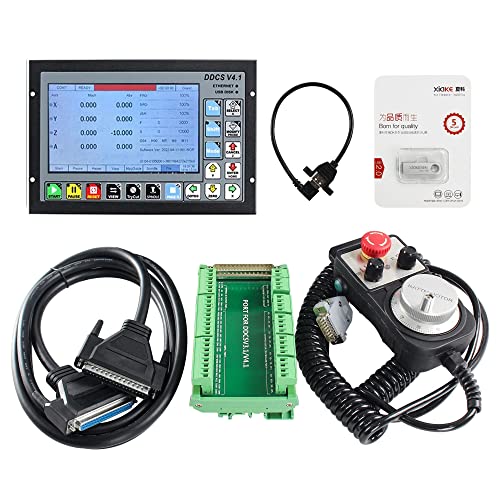
The CNCTOPBAOS DDCSV4.1 offline controller offers multi-axis motion control with 4 axes and a 7-inch TFT display. It supports 500KHz per axis for high-speed interpolation and provides both differential and double pulse output modes. The system includes a robust FPGA-based core, ARM9 processing, and multiple isolated I/O channels, making it suitable for gantry-style machines and multi-axis routers. The MPG handwheel facilitates intuitive manual control during setup or fine-tuning.
Considerations include confirming spindle configuration flexibility (analog or servo spindle), the suitability of the slave function for coordinating independent motors, and ensuring compatibility with your milling or routing software. The DDCSV4.1 is a strong pick for builders seeking a stand-alone controller with rich I/O options and capable interpolation features without requiring a separate PC-based control loop.
CNCTOPBAOS HBS860H Digital Nema34 Closed Loop Driver

The HBS860H stands out as a closed-loop servo motor driver optimized for Nema34 motors. It supports 30-110VDC or 24-80VAC input and delivers up to 8A peak output, with 32-bit DSP and digital filtering enabling up to 512 micro-steps for smooth motion and precise positioning. The device emphasizes optical isolation of inputs to minimize noise interference and offers single/double pulse modes with configurable DIP switches, which helps tailor performance to varied CNC tasks.
This driver is particularly relevant for users who require high precision and reliability in demanding applications, such as high-speed engravers, CNC lathes, or complex milling setups. It pairs well with compatible Nema34 motors and broader CNC control schemes that demand robust closed-loop feedback and resistance to electrical noise.
CNCTOPBAOS 1.8KW AC Servo Motor Driver Kit

This high-power AC servo driver kit is designed for demanding CNC tasks requiring substantial torque and robust acceleration. With a 1.8 kW motor specification, 5-pole configuration, and 3000 rpm nominal speed, it targets larger gantries and heavy-duty milling or cutting work. The drive features 17-bit encoder feedback, SVPWM control, and IP54 protection, along with a flexible input range suitable for diverse shop electrical setups.
Common considerations include ensuring adequate cooling, drive sizing for motor current and torque, and compatibility with your control software and encoder interface. This option suits users expanding to larger frame sizes or more aggressive machining, where precise closed-loop control is essential for maintaining dimensional accuracy under dynamic loads.
Buying Guide: Key Purchase Considerations
- Axis coverage: Determine how many axes you need to control now and in future upgrades. Multi-axis controllers simplify synchronization for gantry and multi-spindle setups.
- Power and voltage compatibility: Verify motor power ratings, supply voltages (AC vs DC, common 110V or 220V), and driver current limits. Align with your machine’s torque and speed requirements.
- Closed-loop versus open-loop: Closed-loop (servo with feedback) provides higher precision and error correction, but can be more complex and costly. Open-loop options may suffice for lighter tasks.
- Encoder resolution and interpolation: Higher micro-stepping and PPR enable smoother motion and finer positioning. Check whether the encoder type and supported micro-step range meet your precision goals.
- Control interface and integration: Consider whether you need standalone offline controllers, PC-based control, or networked Modbus/RS485 connectivity for industrial PLC integration.
- Cooling and environmental tolerance: Heat dissipation is critical for sustained performance. Look for IP ratings appropriate to your workshop conditions and service life.
- Software compatibility: Ensure the controller supports your preferred CAM/CNC software, toolpath formats, and any required scripting or macro functionality.
- Safety features: Brake options, hold torque, and robust fault protection help ensure safe operation during power loss or faults.
- Future-proofing: Some kits offer upgrade paths to higher power motors or additional axes, which can reduce total cost of ownership over time.
In sum, the best choice depends on your machine size, workload, and control philosophy. Standalone offline controllers are convenient for compact machines, while multi-axis systems excel in synchronized, complex operations. Closed-loop drivers serve high-precision needs, particularly in production environments where consistent repeatability matters.