Choosing a reliable AC/DC clamp meter is essential for safely diagnosing electrical issues in homes, workshops, and industrial settings. This guide highlights five top-rated models with true RMS sensing, non-contact voltage detection, and user-friendly features. Each option supports essential measurements like current, voltage, resistance, and continuity, with extras such as temperature, capacitance, and live-wire testing to match varied applications.
| Product | Brand | Key Features |
|---|---|---|
| KAIWEETS Digital Clamp Meter | KAIWEETS | True-RMS, D-shaped jaw, NCV, temperature, 4000 counts |
| AstroAI Digital Clamp Meter 4000 Counts | AstroAI | Auto-ranging, backlit display, NCV, data hold |
| Klein Tools CL490 AC/DC Clamp Meter | KLEIN TOOLS | Dual display, NCVT, wide range of measurements |
| Fluke 325 True-RMS Clamp Meter | Fluke | 400 A clamp, 600 V voltage, true RMS |
| Fluke-301D/ESP Clamp Meter | Fluke | 600 A capability, slim jaw, safety rating |
In this article, each product is presented with a concise overview, a clickable purchase link, a visual image, and the most relevant features that impact performance, accuracy, and ease of use. A Buying Guide follows to help you compare top factors like safety, accuracy, display readability, and battery life.
KAIWEETS Digital Clamp Meter With D-Shaped Jaw

The KAIWEETS meter offers true-RMS measurements for AC/DC current and voltage, plus temperature with a thermocouple, NCV detection, and a variety of tests including capacitance, frequency, resistance, and continuity. Its distinctive D-shaped jaw opens up to 1.1 inches, enabling clamping around diverse cables. NCV detection provides a quick non-contact voltage check with audible and visual alarms, making it suitable for electricians and DIY enthusiasts working on solar systems, automotive wiring, and industrial circuits.
AstroAI Digital Clamp Meter 4000 Counts
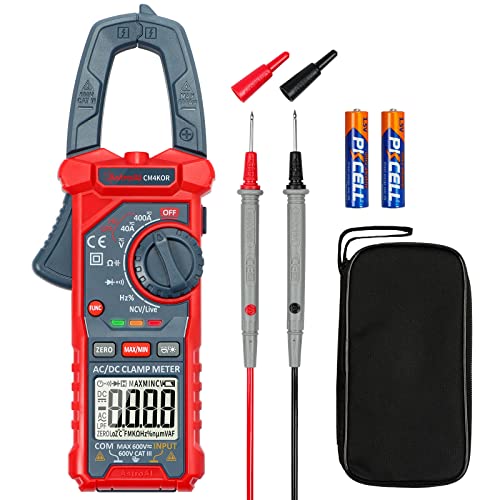
This versatile clamp meter measures AC/DC current and voltage, along with capacitance, frequency, resistance, continuity, and live wire tests. The non-contact voltage testing feature uses audible and visual alarms to indicate voltage presence. A backlit LCD screen and flashlight enhance usability in dim environments. Additional functions include data hold, max/min, auto power-off, low battery indicator, and a zero function to minimize measurement errors caused by the earth’s magnetic field.
Klein Tools CL490 AC/DC Digital Clamp Meter

The CL490 clamp meter features dual displays for improved visibility and a broad measurement set, including AC/DC current and voltage, resistance, continuity, frequency, DC microamps, diode test, capacitance, and temperature via a thermocouple. It includes non-contact voltage testing in a compact design, making it a practical tool for professional electricians who need quick situational awareness and reliable readings in tight spaces.
Fluke 325 True-RMS Clamp Meter

The Fluke 325 delivers True RMS sensing for accurate readings with AC current up to 400 A, AC/DC voltage up to 600 V, and resistance up to 4 kΩ. The jaw opening accommodates conductors up to 30 mm without unplugging, and the true RMS capability ensures dependable results on non-linear loads. This model is widely regarded for durability, ease of use, and consistent accuracy in professional settings.
Fluke-301D/ESP Clamp Meter

The Fluke 301D/ESP offers a slim body with a 600 A AC/DC clamp capability and a compact 10 mm jaw, ideal for tight spaces. It carries safety-rated CAT III 300 V and provides essential readings for current, voltage, and resistance. The slim form factor can improve accessibility in crowded electrical panels and limited-service installations, while maintaining reliable measurement integrity.
Buying Guide
When selecting an AC/DC clamp meter, consider these key factors to ensure the tool matches your needs:
- True RMS vs. average responding: True RMS provides accurate readings with non-linear loads (such as dimmers or switching power supplies). This is critical for professional work.
- Jaw design and size: A larger jaw opens more for easier clamping around conductors; a slim jaw aids in tight spaces. D-shaped or slim bodies improve grip and accessibility.
- Measurement range and features: Look for voltage (AC/DC), current (AC/DC), resistance, capacitance, frequency, and continuity. Extras like temperature, diode tests, and NCV detection add versatility.
- Non-contact voltage (NCV) detection: Helpful for quick status checks before touching wires. Audible and visual alarms improve safety.
- Display readability: Backlit and reverse-contrast displays enhance visibility in dim environments. Dual displays can show more data without switching modes.
- Data hold and min/max: Useful for capturing transient readings and documenting results without continuous monitoring.
- Safety rating: CAT levels and voltage ratings indicate the meters’ suitability for different environments. Higher ratings are safer for industrial use.
- Durability and warranty: Durable housings, splash resistance, and manufacturer warranties reflect long-term reliability for daily use.
How to use an AC/DC clamp meter effectively
- Clamp only around a single conductor to measure current; clamping around a pair can give erroneous results.
- Zero the meter if it offers a zero or REL function before measuring resistance or small signals.
- Use NCV mode before touching wires to verify that a circuit is de-energized.
- Keep probes and leads in good condition; replace damaged leads to maintain accurate measurements.
Across the five options, these meters offer solid performance for standard electrical troubleshooting, solar setups, automotive work, and general electrical maintenance. They provide a balance of measurement capabilities, user-friendly design, and reliability suitable for American electrical environments and common test scenarios.