Power reliability is essential for industrial, commercial, and residential setups that rely on stable three‑phase electricity. A 3 phase transfer switch automatically routes power from a primary source to a backup source during outages or fluctuations, helping minimize downtime and protect critical equipment. This article reviews five top 3 phase transfer switches, highlighting key features, protection levels, and installation notes to help you choose the right model for your system.
Summary of selected products:
| Product | Brand | Key Benefit | Voltage/Current |
|---|---|---|---|
| Automatic Transfer Switch Three Phase ATS 100A 220V | GAEYAELE | Fast automatic backup switching with back‑to‑normal transfer | 3P, 100A, AC220V |
| 125A 110/120V Triple Power Automatic Transfer Switch | MARSTEK | Triple-source automatic switching with flexible priority | 3P, 125A, AC110/120V |
| Three Phase ATS 63A 220V | GAEYAELE | Compact DIN rail mounted, reliable phase switching | 3P, 63A, AC220V |
| SZW26-40/D303.3D Rotary Changeover Switch | Baomain | Three‑position, 3‑pole rotary with robust terminals | 3P, 40A, 660V |
| SZW26-63/D303.3 Rotary Switch | Baomain | High‑current, 3‑pole rotary changeover with 3 positions | 3P, 63A, 660V |
GAEYAELE Automatic Transfer Switch Three Phase ATS 100A
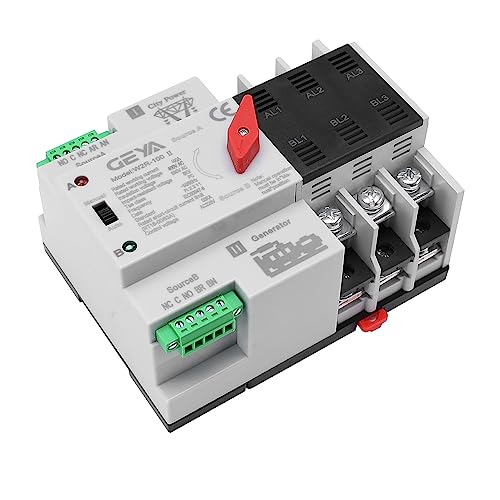
Brand: GAEYAELE. This three‑phase ATS is designed for DIN rail mounting and 220V AC circuits. Features include automatic switching when the normal power is abnormal and automatic return to the normal source when it stabilizes. It emphasizes minimizing interruptions rather than guaranteeing uninterrupted power, suitable for systems where quick failover is critical but complete continuity is not required.
MARSTEK 125A 110/120V Triple Power Automatic Transfer Switch

Brand: MARSTEK. This unit supports triple‑source automatic switching, transferring loads among Primary, Backup 1, and Backup 2 during outages or irregularities. It includes built‑in overvoltage, undervoltage, and overcurrent protections, and offers a flexible priority phase setting with programmable energy features, such as a savings timer for automatic shutdown to reduce phantom loads.
GAEYAELE 63A Automatic Transfer Switch Three Phase ATS

Brand: GAEYAELE. A compact three‑phase ATS suitable for 63A, AC220V applications. It mirrors the core operation of larger switches: if normal power falters, backup power takes over immediately, then reverts when normal power returns. It emphasizes reliability while acknowledging possible transient interruptions.
Baomain SZW26-40/D303.3D Rotary Changeover Switch

Brand: Baomain. This rotary changeover switch provides 3 poles and 3 positions (ON-OFF-ON) with a locking action, suitable for 660V systems up to 40A. It uses a 12-terminal configuration and includes an exterior master switch box for easy mounting and wiring in three‑phase setups.
Baomain SZW26-63/D303.3 Rotary Switch

Brand: Baomain. A 3‑pole rotary changeover switch rated for 660V and 63A, designed for three‑phase applications with three selectable positions (ON-OFF-ON). It provides robust mechanical operation and straightforward wiring for seamless phase switching in medium‑duty environments.
KEYMOO 63A Rotary Changeover Switch with Master Box

Brand: Keymoo. This 63A, 660V, 3 position, 2‑pole rotary switch includes a master box and eight terminals, designed for sturdy three‑phase switching, with IP65 protection for rugged environments. It supports ON-OFF-ON operation and is suitable for installations requiring durable, easy manual control of phase selection.
Baomain SZW26-20/D202.2D-W Rotary Switch

Brand: Baomain. A 2‑pole, 3‑position rotary changeover designed for 660V and 20A. It provides straightforward wiring with a compact exterior box, suitable for lighter three‑phase switching tasks that require reliable manual control and simple installation.
Buying Guide: Key Purchase Considerations for 3 Phase Transfer Switches
Choosing the right 3 phase transfer switch involves balancing electrical requirements, protection features, and installation constraints. Consider these factors:
- Voltage and Current Ratings: Ensure the switch supports your system’s phase count, voltage (AC), and current, with a comfortable safety margin for startup surges.
- Source Configuration: Decide if you need primary/backup sources, or multiple backups with priority settings. Flexible source designation helps adapt to grid conditions and cost.
- Protection Features: Up/over‑voltage, overcurrent, short‑circuit protection, and automatic reversion logic reduce damage risk to connected equipment.
- Control Type: Automatic transfer versus manual or mixed control; DIN rail mounting can simplify panel integration in control cabinets.
- Response Time and Interruption Levels: Some applications require faster switchover; others tolerate brief interruptions. Review transfer time specs and documented interruption risk.
- Wiring and Terminals: Evaluate the number of poles, terminal count, and ease of wiring; ensure compatibility with existing panels and conduit layouts.
- Physical Footprint and Mounting: DIN rail versus enclosure-based mounting; confirm space in the electrical cabinet and accessibility for maintenance.
- Maintenance and Diagnostics: Look for clear wiring diagrams, status indicators, and fault reporting to streamline service and minimize downtime.
Product Comparisons and Use‑Case Scenarios
For data centers or critical facilities, higher current ratings (like 100A or 125A) with comprehensive protections offer more headroom and reliability. In residential or small commercial environments, compact 40–63A units with DIN rail mounting provide sufficient capacity while staying economical. Rotary switch models offer robust, manual control, useful in environments where automatic control is less critical or for letter‑box style retrofits. When shopping, align the switch’s phase configuration (3P vs 2P) and voltage rating with your electrical panel and generator or utility sources to ensure seamless compatibility.
In all cases, verify certification standards, installation instructions, and the availability of spare parts or replacement modules. A well‑chosen 3 phase transfer switch reduces downtime, protects equipment, and supports stable power delivery across varied operating conditions.