If you’re designing or maintaining a water system, a reliable 3/4 inch flow switch is essential for automatic control, safety, and efficiency. This article highlights five top 3/4″ flow switches, their key features, and how to choose the right one for your application. Each option balances sensitivity, temperature tolerance, and ease of installation, so you can match performance to your system’s demands.
Summary table of chosen products:
| Product | Brand | Thread | Key Feature |
|---|---|---|---|
| GREDIA 3/4″ Water Flow Sensor | GREDIA | G3/4″ male | Hall effect, 1–60 L/min, DC 5–24 V |
| Solimeta HFS-20 Flow Sensor | Solimeta | R3/4 | SPDT output, wide fluid compatibility |
| Tyenaza Water Flow Switch | Tyenaza | G3/4″ to 3/4″ | High sensitivity, wide temperature range |
| PDT R3/4 HFS-20 Flow Controller | Niiyen | R3/4 | Adjustable setpoint, IP54 |
| Flow Switch 3/4″ Dimension One | Dimension One | 3/4″ | Simple 3/4″ Flow Switch Only |
GREDIA 3/4″ Water Flow Sensor

The GREDIA flow sensor uses a hall-effect sensor to monitor water flow with a 3/4 inch male thread for straightforward installation. It supports a flow range of 1–60 L/min and operates on DC power from 5 to 24 volts. The device is suitable for water systems with pressures up to about 1.2 MPa and provides a predictable output proportional to flow, making it easy to integrate with microcontrollers or automation controllers in household or industrial applications.
Key considerations include ensuring a clean, straight pipe run to minimize turbulence and selecting a compatible power source within the specified 5–24 V range. The F=(5.5*Q)±2% specification helps estimate signal output relative to flow, which is helpful when calibrating monitoring dashboards or alarms.
Solimeta HFS-20 Flow Sensor
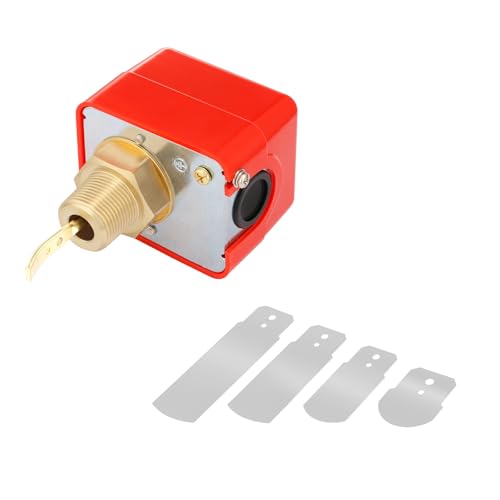
Solimeta’s HFS-20 is a paddle-type flow switch with an SPDT output rated for 250V and 15A, designed for broad fluid compatibility. Its 3/4 inch sizing supports common residential and commercial water lines while offering a simple switching action when a target flow is reached. The IP54 rating adds a layer of protection against dust and water splash, making it suitable for environments where condensate or moisture exposure is possible.
In practice, ensure the paddle clearness and straight piping to avoid false triggering. This model is well-suited for basic control tasks such as turning a pump on or off or triggering a valve in response to a specific flow rate. The wide fluid compatibility makes it adaptable to water-based systems, light oils, or other non-hazardous liquids depending on the user’s operational parameters.
Tyenaza Flow Switch, 3/4″

This 3/4 inch flow switch from Tyenaza is designed for AC 220V operation with a high-sensitivity mechanism. The device uses a robust return spring and is engineered to activate when the water flow exceeds a low threshold, around 0.03 KG, enabling reliable pump start at low water pressure. It emphasizes temperature resilience, with materials chosen to withstand temperatures up to about 70C, making it suitable for hot water lines and mixed climate installations.
The design separates the sensing room, magnetic control room, and electronics, reducing interference from ferrous materials in the pipe and improving switching reliability. Installation should consider ensuring nice straight runs and aligning electrical connections with the SPDT output for simple integration into control schemes or alarm systems.
PDT R3/4 HFS-20 Flow Controller

The PDT R3/4 HFS-20 is a paddle-type flow switch intended for automatic flow control in water treatment, HVAC, chillers, and related industries. It offers a micro switch with SPDT output rated for up to 15A at 250V, with adjustable setpoints to fine-tune triggering. The device’s IP54 rating helps it withstand typical industrial environments, while the adjustable feature supports stable, repeatable responses to changes in flow.
When selecting this model, consider the fluid type, potential agitation, and whether the service requires precise, repeatable action at a specific flow rate. Calibration may involve empirical testing under your operating conditions to determine the optimal activation point for your system’s safety interlocks or pump control.
Flow Switch 3/4″ Dimension One

Dimension One’s 3/4 inch flow switch focuses on compact, straightforward installation with a dedicated 3/4″ flow switch assembly. It’s designed to monitor and switch at specific flow conditions suitable for standard piping configurations. This option is often favored for simpler automation setups where a dedicated 3/4″ switch is all that’s needed, without additional complexity or integrated electronics.
Practical considerations include verifying compatibility with the system’s control logic, ensuring the chosen switch’s electrical rating matches the control circuit, and confirming that the installation environment remains free of magnetic interference that could affect the switch’s operation.
GREDIA 3/4″ Flow Sensor (Pack of 2)

This listing offers two GREDIA 3/4″ flow sensors with the same hall-effect measurement principle and electrical range as the single-unit version. The pair can support redundant monitoring, parallel sensor data collection, or phased deployment in larger systems where multiple sensing points are beneficial. The 1–60 L/min range remains appropriate for moderate flow scenarios, and the components retain compatibility with a 5–24 V DC supply.
When using multiple units, ensure proper power distribution and signal management to avoid electrical noise or cross-talk. Calibration across sensors can help establish consistent readings and reliable interlocks for automated control schemes.
Water Flow Sensor HT-30 (XUNKUANER)

The HT-30 from XUNKUANER offers a robust 3/4″ to 3/4″ threaded water flow sensor with a 0–110V operating range and a low-current design (0.2A). It’s designed for CO2 laser tube protection and similar high-reliability needs, balancing a 3/4″ thread with features that emphasize stable sensing and protection against magnetic interference. The device’s maximum flow capacity is stated as 3000 L/H, making it suitable for higher-flow applications within a compact footprint.
Practical deployment should include verifying electrical safety for the high-voltage domain and ensuring the sensor’s sensing room remains isolated from magnetic contaminants that could affect accuracy. The included accessories help with installation alignment and seal integrity in piping runs.
Buying Guide: Key Purchase Considerations
- Thread size and connection type: Ensure the 3/4″ thread matches your piping or valve fittings. Some variants offer 3/4″ to 3/4″ or G3/4″ male threads, so verify the exact fitting before ordering.
- Electrical rating and output: Decide if you need a simple SPST/SPDT switch, a micro-switch, or an integrated output for a control system. Check voltage (AC/DC) and current ratings to avoid overloads.
- Flow range and sensitivity: Consider the typical flow in your system. Sensors with wider ranges may be forgiving, but you’ll want accurate actuation at your target threshold.
- Material compatibility and temp tolerance: For hot water or aggressive fluids, confirm temperature limits (some units tolerate up to 70°C) and material compatibility to avoid premature wear or corrosion.
- Protection and enclosure: IP ratings (like IP54) indicate splash and dust resistance. In industrial environments, a rugged enclosure may be warranted.
- Installation considerations: Straight pipe runs, minimal turbulence, and clean connections improve accuracy. Some sensors separate sensing and electronics to reduce magnetic interference.
- Reliability and serviceability: Look for models with straightforward calibration, accessible components, and options for replacement parts or packs (e.g., packs of 2).
- Intended application: If the switch supports specific fluids (water, light oils, non-hazardous liquids), confirm the fluid compatibility noted by the manufacturer to prevent damage or false readings.