This article highlights top 200W solar panels ideal for RVs, vans, motorhomes, and other off-grid setups. Each option emphasizes high-efficiency N-type or mono-crystalline cells, durable frames, and reliable charge controllers. Use this guide to compare performance, installation, and reliability to help choose a panel that fits roof space and power needs for daily use, boosts battery life, and supports camping independence.
Summary Of Selected Products:
| Product | Brand | Key Feature | Link |
|---|---|---|---|
| ECO-WORTHY 200W Panel Kit | ECO-WORTHY | High-efficiency mono cells, 30A PWM controller | Amazon |
| Renogy Adventurer Kit 200W | Renogy | 30A PWM controller, compact for small spaces | Amazon |
| Renogy 200W ShadowFlux 12V | Renogy | ShadowFlux anti-shading technology, 25% cells | Amazon |
| Renogy 200W 24V N-Type Panel | Renogy | 24V operation, 25% cell efficiency | Amazon |
| Callsun N-Type 200W Bifacial | Callsun | N-type 16BB, bifacial improves rear-side capture | Amazon |
ECO-WORTHY 200W Panel Kit

The ECO-WORTHY 200W kit combines a high-efficiency monocrystalline panel with a 30A PWM charge controller, making it suitable for RVs, campers, and other off-grid applications. It is designed to deliver daily output around 800Wh under optimal sun, with a durable aluminum frame rated against wind and snow loads. The IP65 junction box provides protective sealing, helping the system endure varied outdoor conditions. Installation flexibility makes it compatible with many RV roof setups and auxiliary power needs.
Renogy Adventurer 200W Kit
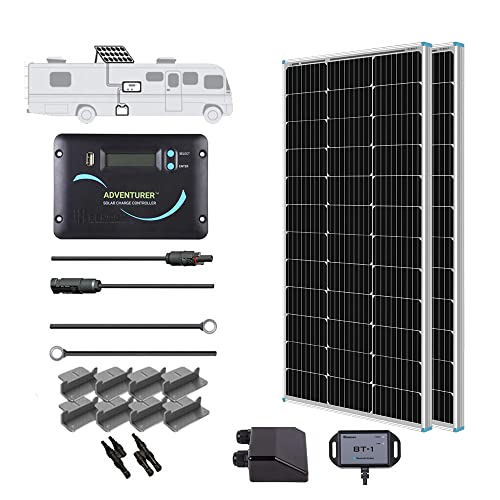
This Renogy Adventurer 200W kit is tailored for compact spaces. It uses a 30A PWM charge controller and a corrosion-resistant aluminum frame, ensuring resilience against outdoor exposure. Claimed to deliver strong performance with 22% efficiency, the kit is especially suitable for RVs, boats, trailers, and other mobile or off-grid installations where space matters and a clean, flush-mounted look is preferred.
Renogy ShadowFlux 200W Panel

Renogy’s ShadowFlux 200W panel emphasizes shading tolerance and longevity. With 25% cell efficiency and anti-shading technology, it reduces hot spots and micro-cracks while maintaining performance under partial shade. The compact and lighter design fits tight RV rooftops and marine applications, with compatibility for both 12V and 24V battery systems to support diverse power needs.
Renogy 200W 24V N-Type Panel

This 24V Renogy panel uses advanced N-Type 16BB cells for high efficiency and reduced microcrack risk. It is designed for RVs and off-grid roofs with a smaller, lighter footprint, making it easier to fit on Class B vans or compact RVs. The 24V rating optimizes system efficiency and offers flexible installation alongside 12V or higher voltage configurations, depending on battery setup and charge controller choice.
Callsun N-Type 200W Bifacial Panel

The Callsun 200W bifacial panel leverages N-Type 16BB cells and a bifacial design, capturing light from both sides to increase total energy output. It incorporates twin-cell anti-shade technology, enabling the panel to maintain power when portions are shaded. This design is advantageous for RV roofs with partial shading from vent stacks or nearby obstacles, offering improved reliability and overall system efficiency.
Buying Guide: Key Purchase Considerations
When selecting a 200W solar panel for an RV, consider installation space, roof weight, and mounting compatibility. N-Type cells often provide higher efficiency and better performance in high temperatures, while mono-crystalline panels offer durability and strong power output. Evaluate the following factors to choose optimally:
- System Voltage: Decide between 12V and 24V configurations. Higher voltages can reduce current and improve efficiency over longer cable runs.
- Efficiency and Cell Type: N-Type cells (16BB or similar) tend to deliver better performance and longevity, with reduced microcracking risks, especially in hot climates.
- Shading Tolerance: Anti-shading or bifacial designs help sustain output when panels experience partial shading from vents, antennas, or tree cover.
- Durability and Weather Rating: Look for corrosion-resistant frames, IP-rated junction boxes, and robust mounting hardware suitable for wind, rain, and snow loads.
- Controller Compatibility: Ensure the panel kit includes a compatible PWM or MPPT controller, and verify that it matches your battery bank (12V or 24V) and RV electrical system.
- Physical Footprint: Measure roof space and compare with panel dimensions and mounting brackets. Compact designs benefit Class B vans and smaller RVs.
- Ease Of Installation: Pre-drilled holes, quick-connect cables, and included brackets can simplify roof mounting and reduce installation time.
- Reliability And Support: Consider brand reputation, warranty length, and availability of replacement parts or technical support for long-term use.
In summary, the 200W class offers a practical balance of roof footprint, weight, and daily energy generation for many RVers. Panels with advanced cell technology and shading resilience can deliver steadier performance across seasonal changes, ensuring more consistent power for appliances, lighting, and charging needs while off-grid.