For reliable off-grid power, a sturdy 12V deep cycle solar battery is essential. The following options cover AGM and LiFePO4 chemistries, balancing safety, longevity, and performance. Whether you’re powering an RV, cabin, marine setup, or home backup, these batteries are designed to store energy efficiently and withstand demanding cycles. This guide compares capacity, discharge power, self-discharge rates, and maintenance needs to help you choose the right fit for your system.
| Product | Brand | Chemistry | Capacity | Typical Use |
|---|---|---|---|---|
| Renogy Deep Cycle AGM 12V 100Ah | Renogy | AGM | 100Ah | RV, Cabin, Off-Grid |
| WEIZE Deep Cycle AGM 12V 100Ah | WEIZE | AGM | 100Ah | Solar, Marine, Off-Grid |
| Renogy Deep Cycle AGM 12V 200Ah | Renogy | AGM | 200Ah | Larger systems, Backup |
| GRNOE 2-Pack 12V 100Ah LiFePO4 | GRNOE | LiFePO4 | 100Ah per battery | RV, Off-Grid, Solar |
| GREENOE 12V 100Ah LiFePO4 (Group 31) | GREENOE | LiFePO4 | 100Ah | Solar, RV, Marine |
Renogy Deep Cycle AGM 12V 100Ah Battery

The Renogy AGM 12V 100Ah battery uses sealed, maintenance-free AGM technology with a conservative 3% self-discharge rate. It supports series connections (no practical limit) and up to four parallel units, enabling scalable capacity for growing systems. The chemistry emphasizes safety and stability, reducing the need for extensive troubleshooting compared with liquid electrolyte options. Its design targets RVs, cabins, marinas, and off-grid installations where safe, reliable power storage is essential. The 100Ah rating balances usable energy with a compact footprint for compact setups.
WEIZE Deep Cycle AGM 12V 100Ah Battery
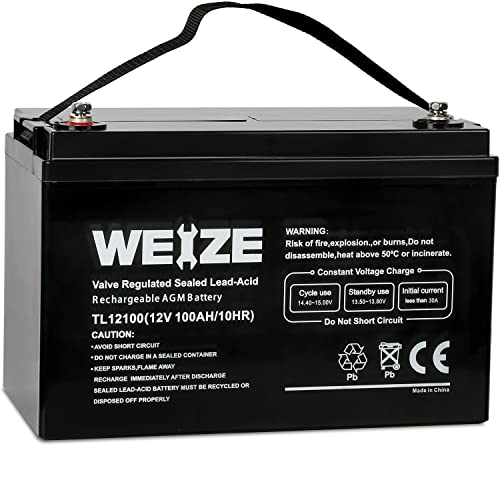
The WEIZE 12V 100Ah AGM battery is maintenance-free and designed for extended storage with a low self-discharge rate. Its compact dimensions and rugged construction suit RVs, solar systems, trolling motors, and off-grid cabins. The internal AGM separator reduces the risk of acid leakage, while the sealed case minimizes maintenance tasks. Its broad operating temperature range supports year-round use, though best results come from charging at moderate temperatures. This option offers a solid balance of price, performance, and reliability for practical 12V systems.
Renogy Deep Cycle AGM 12V 200Ah Battery

The Renogy 200Ah AGM battery provides a substantial energy reserve for larger off-grid systems, campers with higher power needs, or backup power infrastructure. Its 3% self-discharge rate helps with storage and seasonal use, while the AGM design minimizes maintenance and risk of electrolyte leaks. High discharge capability supports higher current draws during peak usage. This option is ideal for users looking to reduce the number of individual batteries in a system without sacrificing reliability or safety.
GRNOE 2-Pack 12V 100Ah LiFePO4 Battery

These GRNOE LiFePO4 batteries deliver long life and robust safety, with built-in BMS protection against overcharge, over-discharge, and short circuits. Offering a typical lifespan well beyond lead-acid options, LiFePO4 cells support 15000+ cycles under proper use. The batteries are significantly lighter than lead-acid equivalents, enhancing portability and ease of installation in RVs, cabins, and solar backup configurations. The included BMS also guards against temperature extremes, helping preserve performance in varying environments.
GREENOE 12V 100Ah LiFePO4 Battery Group 31

GREENOE’s Group 31 LiFePO4 battery emphasizes longevity with up to 15000 deep cycles and a smart low-temperature cut-off to protect the battery at freezing temperatures. The 100A built-in BMS provides comprehensive protection against overcharging, over-discharging, overcurrent, and short circuits. Like other LiFePO4 options, it is maintenance-free and lighter than traditional lead-acid batteries, making it suitable for RVs, cabins, and off-grid builds that require reliable, long-term energy storage. Ensure proper charging voltage and parallel/series configurations to meet your system’s demands.
Buying Guide
- Chemistry choice: AGM batteries are robust, maintenance-free, and safer around household environments. LiFePO4 offers longer cycle life, lighter weight, and deeper safety protections, but typically at a higher upfront cost. Choose based on budget, system size, and preferred lifecycle.
- Capacity and scalability: Consider both the usable capacity and how easily you can scale with parallel or series connections. For larger systems, a higher Ah rating or modular LiFePO4 packs can simplify expansion.
- Discharge current and peak loads: Higher maximum discharge current benefits short, high-power demands (inverters, motors). Ensure the battery’s peak current meets or exceeds your expected draw.
- Self-discharge and storage: AGM options typically exhibit low but finite self-discharge; LiFePO4 cells maintain very low self-discharge over long periods, ideal for seasonal storage.
- Temperature effects: Temperature protection matters. Batteries with low-temperature cut-off or BMS controls help prevent damage during cold charging or discharging.
- Maintenance and safety: AGM is maintenance-free, but LiFePO4 requires attention to charging voltages and proper BMS operation. Sealed styles reduce leaks and odor concerns in enclosed spaces.
- Weight and footprint: LiFePO4 batteries are notably lighter, which eases installation in smaller vehicles and boats. AGM cells are heavier but often more affordable upfront.
- Warranty and support: Check warranty terms and customer support. Longer coverage can offset higher initial costs and protect against early failures.
- System compatibility: Verify that your solar charger, inverter, and wiring are compatible with the chosen chemistry and voltage, especially when mixing large packs or using series connections.