Choosing the right alternating relay for pumps ensures dependable operation and longer equipment life. This guide highlights five well-regarded options, covering different voltage ranges, pin configurations, and durability features. Each product section analyzes key specifications to help you compare performance, installation ease, and suitability for residential, commercial, or agricultural pump systems.
| Product | Brand | Voltage | Type | Notes |
|---|---|---|---|---|
| ARP120A3R Alternating Relay | Macromatic | 120 VAC | DPDT, 8 pins | High-quality US-made relay |
| Time Mark 261-S-120 | Time Mark | 120 VAC / DC | SPDT | UL/CSA listed, solid-state reliability |
| 8‑Pin 120VAC Relay | Macromatic | 120 VAC | 8-pin, 10 A | Reliable, standard control voltage |
| Rva2alkl Well Pump Relay Control Box | Jiacheng | 230 V | Control box for well pumps | Durable ABS/plastic with brass components |
| Briidea Pump Start Relay | briidea | 120/240 V | Relay for sprinkler/pump start | Weather-resistant, quick wiring |
Macromatic ARP120A3R Alternating Relay — 120 VAC
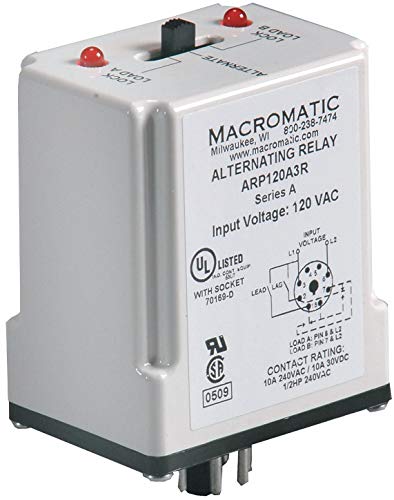
The ARP120A3R from Macromatic is a DPDT (double pole double throw) alternating relay designed for 120 VAC systems. Its eight-pin termination supports straightforward wiring for pump control circuits. The unit is built to meet standard industry expectations for durability and reliability, with materials and construction suitable for frequent switching in pump applications. This model is particularly suited for residential and light commercial pump control where alternating activation is needed to balance wear between circuits.
YOOZENA Relay, Alternating

This alternator-style relay from YOOZENA is positioned for industrial electrical supplies. It is described as a unit suitable for United States manufacturing contexts, with an emphasis on durable construction for alternating duty in pump or motor circuits. When evaluating, consider compatibility with your control voltage and the necessary contact configuration for your specific pump setup.
Time Mark 261-S-120 Alternating Relay

The Time Mark 261-S-120 offers alternating switching with 120V AC/DC compatibility and SPDT configuration. It is UL/CSA listed, emphasizing safety and reliability for pump control tasks. The model supports optional load 1-load 2 toggle and is reputed for solid-state reliability, which can be beneficial in circuits requiring stable switching without frequent mechanical wear.
Macromatic 8‑Pin 120VAC, 10 A Alternating Relay

This Macromatic device provides 10 A operation at 120 VAC with an 8-pin termination layout. It is appropriate for simple relay-based pump start/stop control schemes, offering compatibility with common control voltages and straightforward installation for technicians and DIY enthusiasts alike.
Jiacheng RVA2alkl Well Pump Control Box

The RVA2alkl control box from Jiacheng is designed for Franklin well pump applications, accommodating 5 to 15 HP with 230 V operation. It replaces part numbers 155031102 and 155031110, and 305213902. The housing is made from ABS plastic with brass components for durability, stability, and wear resistance. Prospective buyers should verify compatibility with their pump model and electrical system before purchasing.
Briidea Pump Start Relay for 1-2 HP Pumps
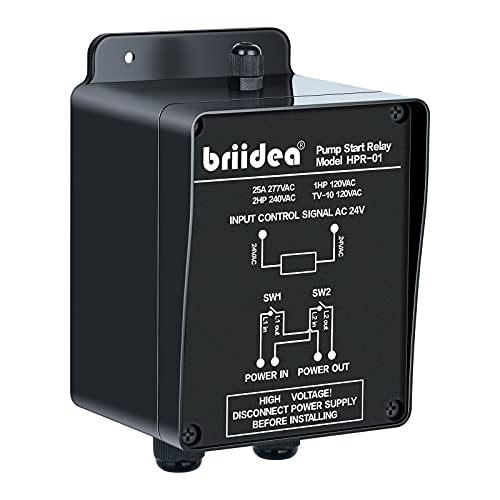
The Briidea relay is tailored for sprinkler systems and small pump setups between 1-2 HP at 120/240 V. It emphasizes automatic activation for watering or pump start operations. The unit features a weather-resistant plastic case and quick lever-nut wire connectors for rapid and straightforward wiring, contributing to reliable operation in outdoor or exposed environments.
Buying Guide: Key Considerations For Choosing An Alternating Relay
- Voltage and current rating: Ensure the relay supports your pump’s supply voltage and current draw (commonly 120 VAC, 230 VAC, with ranges around 5–15 A for many residential-to-light-commercial pumps).
- Contact configuration: DPDT versus SPDT determines how many circuits you can switch and whether you need cross-wiring or alternate activation to balance wear.
- Durability and enclosure: Weather resistance and sturdy housings are important for outdoor installations or rugged environments where pumps operate.
- Control logic: Consider whether the relay uses solid-state or mechanical contacts. Solid-state relays generally offer longer life under frequent switching, while mechanical relays are simpler and widely compatible.
- Size and mounting: Pin configuration (8-pin, etc.), footprint, and mounting style should fit your control panel or enclosure and existing wiring.
- Compatibility and certifications: UL/CSA listings provide assurances about safety and reliability in North American installations.
- Part compatibility: If replacing an existing unit, verify part numbers, horsepower ratings, and warranty terms to prevent mismatches.
- Environmental considerations: For outdoor or damp locations, select models with weatherproof enclosures and corrosion-resistant components.